Reassessing the collaborative genesis of Indian Constitution

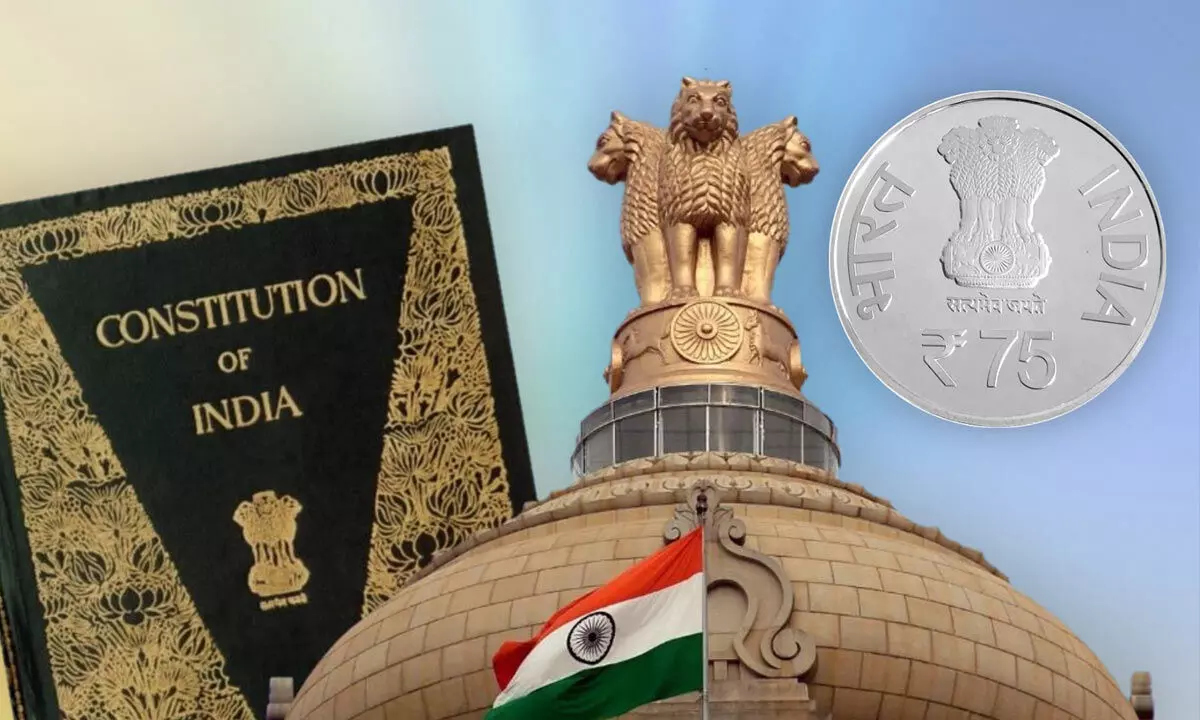
The narrative that B.R. Ambedkar single-handedly crafted India’s Constitution, reinforced by his statues holding the Constitution and his title as “chief architect,” dominates public and judicial discourse.
However, historical evidence reveals a collaborative process involving B.N. Rau’s foundational draft, Jawaharlal Nehru’s political leadership and contributions from the Constituent Assembly’s 299 members. Drawing on primary sources, including Ambedkar’s 1953 Rajya Sabha speech disclaiming sole authorship and Constituent Assembly debates, this article challenges the oversimplified narrative.
It examines the roles of Rau, Nehru, and others, while addressing the narrative’s socio-political origins, including its potential amplification by Christian missionaries among marginalised communities, and its reinforcement through events like the 2025 Gwalior bench of Madhya Pradesh High Court statue controversy. By advocating for educational and judicial reforms, it seeks a balanced recognition of all contributors without diminishing Ambedkar’s pivotal role in championing social justice.
Historical context-Constitutions and the colonial legacy:
Constitutions codify governance systems, often embodying a society’s cultural and philosophical values.
In ancient India, Dharmashastras like Manu Smriti and Yagnavalkya Smriti guided Hindu civilization. In China, Confucian texts such as the Five Classics and Four Books shaped governance until the rise of Communism. In the West, the Bible influenced legal systems until secularism prevailed, while Islamic societies rely on Sharia. These examples highlight constitutions as human creations reflecting their societies’ core beliefs.
After the religion-based partition, which created Islamic Pakistan (including present-day Bangladesh), many expected India to adopt a Hindu-centric framework. Instead, the English-educated elite in the Constituent Assembly chose a secular model, rejecting Dharmashastras. They drew heavily on the Government of India Act 1935, a comprehensive British law, embedding colonial continuities in India’s Constitution and shaping its governance structure.
Colonial continuity;
cultural disconnect:
The Indian Constitution, often celebrated as a post-colonial milestone, largely reworks the British-enacted Government of India Act of 1935, perpetuating colonial governance with limited engagement with India’s ancient civilizational values or modern India’s aspirations. The Constituent Assembly, led by English-educated elites unfamiliar with indigenous political traditions, crafted a voluminous document by blending western constitutional models into the 1935 Act’s colonial framework.
Symbolic gestures, such as illustrations of Hindu gods, goddesses, and historical figures in the Constitution’s original manuscript, aimed to reflect Indian identity. However, these gestures, and adopting Satyameva Jayate from the Mundaka Upanishad as the national motto and the Dharmachakra on the national flag, could not bridge the Constitution’s disconnect from India’s socio-cultural needs. This reliance on colonial and foreign frameworks has perpetuated persistent challenges in governance and social cohesion. These challenges stem from the Constitution’s continued misalignment with India’s socio-cultural and governance needs.
The Constituent Assembly:
A contested foundation:
The Constituent Assembly, formed in December 1946 by the British, was tasked with drafting India’s Constitution. Its legitimacy remains contentious due to its unrepresentative composition. The Indian National Congress (INC) demanded an assembly elected through universal adult franchise but the British opted for indirect elections via provincial assemblies, representing only 15 per cent of Indians and 70 nominated members from the Princely States.
Socialist member Damodar Swarup Seth on November 5, 1948 challenged the Assembly’s legitimacy, arguing that its unrepresentative nature and reliance on the 1935 Act and foreign models fails to reflect India’s civilizational ethos. His motion for a new assembly elected by universal franchise was defeated, but it exposed the Assembly’s democratic deficits and lack of legitimacy.
The Constitution’s Preamble, claiming to represent “We, the people of India,” is often criticised as misleading due to its limited representation. Justifications for the Constitution’s legitimacy, such as its 75-year operation, are dismissed as flawed, like legitimising British colonial rule for its duration. Seth’s critique, combined with Nehru’s admission of British influence, suggests a possible quid pro quo to secure personal power, with the Constitution serving as a tool to align with British interests perpetuating colonial legacy as post-colonial triumph.
Rau’s foundational
contribution:
Benegal Narsing Rau, a Cambridge-educated civil servant and jurist, was appointed Constitutional Adviser in July 1946. His distinguished career included service in the Indian Civil Service, as a jurist, and as Chief Minister of Jammu and Kashmir. In 1945, he joined the Viceroy’s Secretariat to work on constitutional reforms, leveraging his expertise in law and governance. A year later, Rau produced an outline of a New Constitution in January, followed by a comprehensive draft in October 1947, comprising 243 articles and 13 schedules.
This draft, completed eleven months before the Constituent Assembly’s formation, drew heavily on the Government of India Act 1935, and incorporated elements from global constitutions, including those of the United States, Canada, Australia, and Ireland.
His work formed the backbone of the final Constitution, yet his contributions remain largely unrecognised in public discourse, overshadowed by political figures like Ambedkar and Nehru. Even his role as a drafter remains underacknowledged.
Critics may argue that Rau, as a civil servant, should not be credited with the Constitution’s creation, despite his pivotal role. This argument falters against the principle of recognizing contributions over titles. If Rau’s bureaucratic status diminishes his legacy, how do we justify celebrating Mokshagundam Visvesvaraya, a government engineer lauded for nation-building contributions to infrastructure, such as dams and irrigation systems? A legacy lies in the impact of one’s work, not the position held.
Rau’s meticulously crafted draft formed the Constitution’s bedrock. To overlook his role due to his civil service designation is to prioritise form over substance, undermining the Constitution’s collaborative genesis. Honouring Rau’s contributions, alongside those of Nehru, Ambedkar, and others, celebrates deeds over titles.
Sardar Patel’s role in shaping Part III and Schedules 5 and 6:
As Chairman of the Advisory Committee on Fundamental Rights, Minorities, and Tribal and Excluded Areas, Sardar Vallabhbhai Patel played a key role in shaping Part III (Articles 12–35) and Schedules 5 and 6 of the Indian Constitution. This committee, central to the Constituent Assembly, was responsible for framing fundamental rights for all, and governance structures for tribal communities. However, Patel’s committee did not grant Hindus rights equal to those provided to minorities under Articles 25–30. It also failed to integrate tribal communities in forest areas into mainstream society, perpetuating colonial policies that isolated these groups.
These decisions downgraded Hindus to second-class status and left tribal communities in Scheduled Areas vulnerable to missionary-led Christian conversions. The Ambedkar-centric narrative has eclipsed Patel’s controversial role and related concerns in public discourse.
Ambedkar’s editorial role:
On August 29, 1947, the Constituent Assembly established a “Committee to Scrutinize Draft Constitution” chaired by B.R. Ambedkar, who was then Minister for Law and Justice. Erroneously referred to as the “Drafting Committee” in common parlance, this body was tasked with refining Rau’s draft, not drafting a new constitution.
The committee included distinguished members such as Alladi Krishnaswamy Ayyar, N. Gopalaswami Ayyangar, and K.M. Munshi, whose legal and administrative expertise shaped the final document. Ambedkar’s role was primarily editorial, ensuring that the draft aligned with the Assembly’s decisions and reflected India’s democratic aspirations.
Ambedkar’s prominence in Assembly debates as Law Minister, coupled with his identity as a Dalit leader and champion of social justice, drew public attention. However, in a 1953 Rajya Sabha speech, he explicitly disclaimed sole authorship, stating, “People keep saying I am the maker of the Constitution. My answer is I was a hack. What I was asked to do, I did much against my will … I am quite prepared to burn it out. It does not suit anybody.”
This candid admission, preserved in Rajya Sabha archives, reflects his frustration with the attribution and the compromises embedded in the Constitution, particularly its failure to fully address the governance problems.
(The writer is a retired IPS officer and former Director of CBI. Views are personal)