From language to ecology, history to identity…

Mangaluru Lit Fest opens with searching conversations
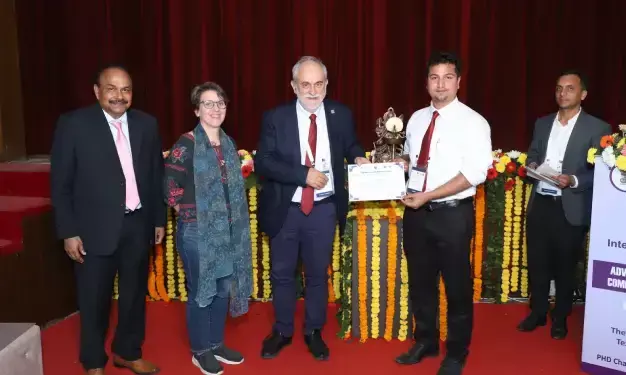
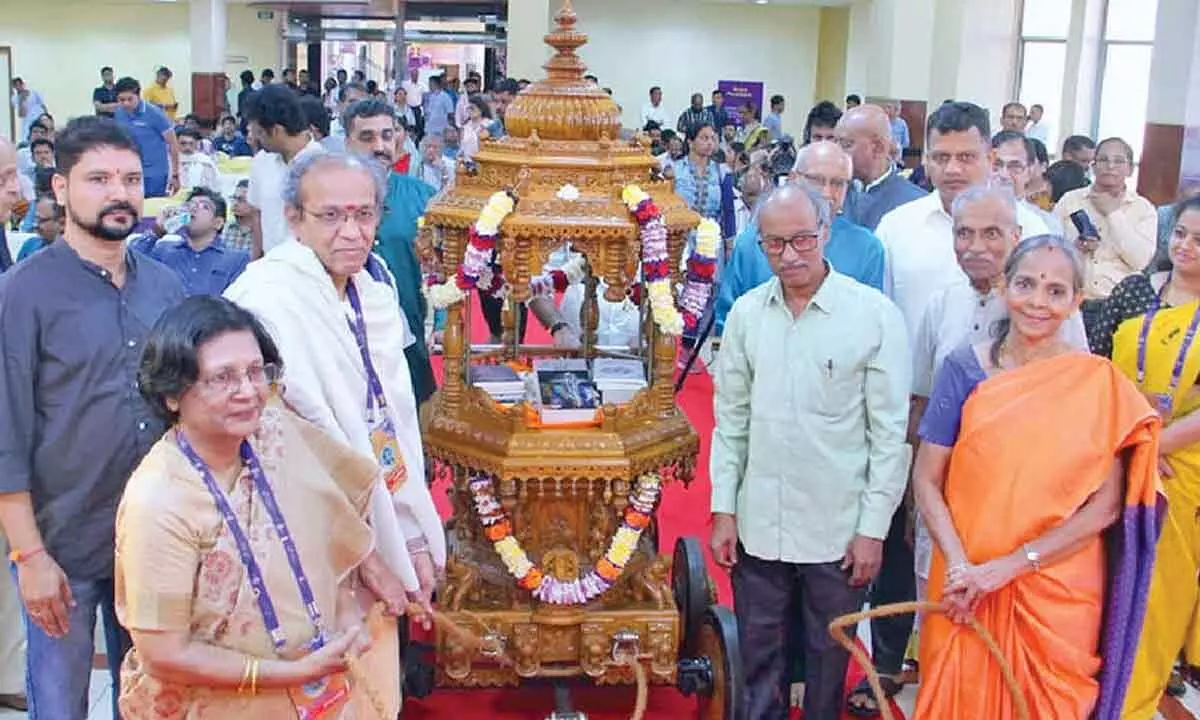
Mangaluru: The eighth edition of the Mangaluru Lit Fest opened on a reflective and wide-ranging note on Saturday, bringing together scholars, writers and public intellectuals to examine questions of language, environmental responsibility and civilisational memory. The festival was formally inaugurated in a symbolic ceremony by pulling the ‘Saraswathi Ratha’, a book-laden chariot, onto the stage.
Delivering the inaugural address, noted Shatavadhani R. Ganesh criticised universities and faculty for what he described as the “systematic neglect of language.” He argued that higher education had reduced literature to summaries, depriving students of deep engagement with texts. “Languages can be understood only through close analysis. Summaries may convey information, but they strip literature of its values and emotional depth,” he said, referring to the superficial teaching of works by classical poets such as Pampa, D.V. Gundappa and Kuvempu.
Ganesh later expanded on these ideas in a dialogue titled ‘Exploring Values Through Literature’, moderated by Ajakkala Girish Bhat. He said values in Indian civilisation were embedded not only in literature but across art forms, transmitted through dhwani (suggestion) and rasa (emotional essence).
“Sensitivity cannot be cultivated by intellect alone; it requires emotion (bhava),” he said, adding that literature driven solely by problems, without insight into the human psyche, rarely endures.
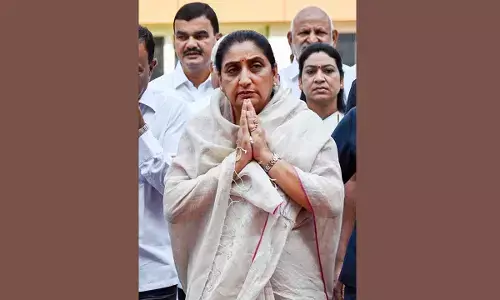
The keynote address was delivered by Ravi S., Honorary Secretary of the Mythic Society, who underlined the role of literature in shaping societies and nurturing critical thinking among young people. Padma Shri awardee Dr. Meenakshi Jain and Bharat Foundation trustee Brijesh Chowta were present, while tributes were paid to the late Dr. S.L. Bhyrappa and Dr. Vinaya Hegde.
The event also featured an invocation song by Lakshmi Mathadamule and was anchored by Shaina D’Souza and RJ Abhishek Shetty.
Environmental concerns came into sharp focus in a later session titled ‘Netravathi–Nile: Local Rivers, Global Stakes’, where climate expert Dr. Raghu Murthugudde warned of the rapid rise of marine pollution due to microplastics. He said waste dumped by ships and unchecked plastic use were gravely affecting marine ecosystems and entering the human food chain through fish. While global efforts were underway to curb plastic pollution, he stressed that microplastics demanded urgent and specific regulation.
Adding a historical dimension, Commodore Udayaraj drew parallels between the Netravathi and the Nile, noting that waterways had connected civilisations long before modern transport, with Indian muslin once exported to Egypt. The session was moderated by Prashanth Vaidyaraj, with C.J. Giridhar Kamath also participating.
In another key interaction, historian Dr. Meenakshi Jain addressed controversies surrounding temple sites in Kashi and Mathura, asserting that Kashi’s history dates back to the Upanishadic period and cannot be confined to medieval records.
She cited archaeological evidence, colonial-era inquiries and inscriptions to argue that India’s civilisation endured not because of rulers, but due to the faith and contributions of ordinary people.
The session was moderated by Prithvi Karinje.Together, the discussions reflected the Lit Fest’s broader ambition—to reconnect literature with lived realities, historical understanding and contemporary challenges.