Script for the South? Revisiting Saraswati Lipi’s promise of linguistic convergence

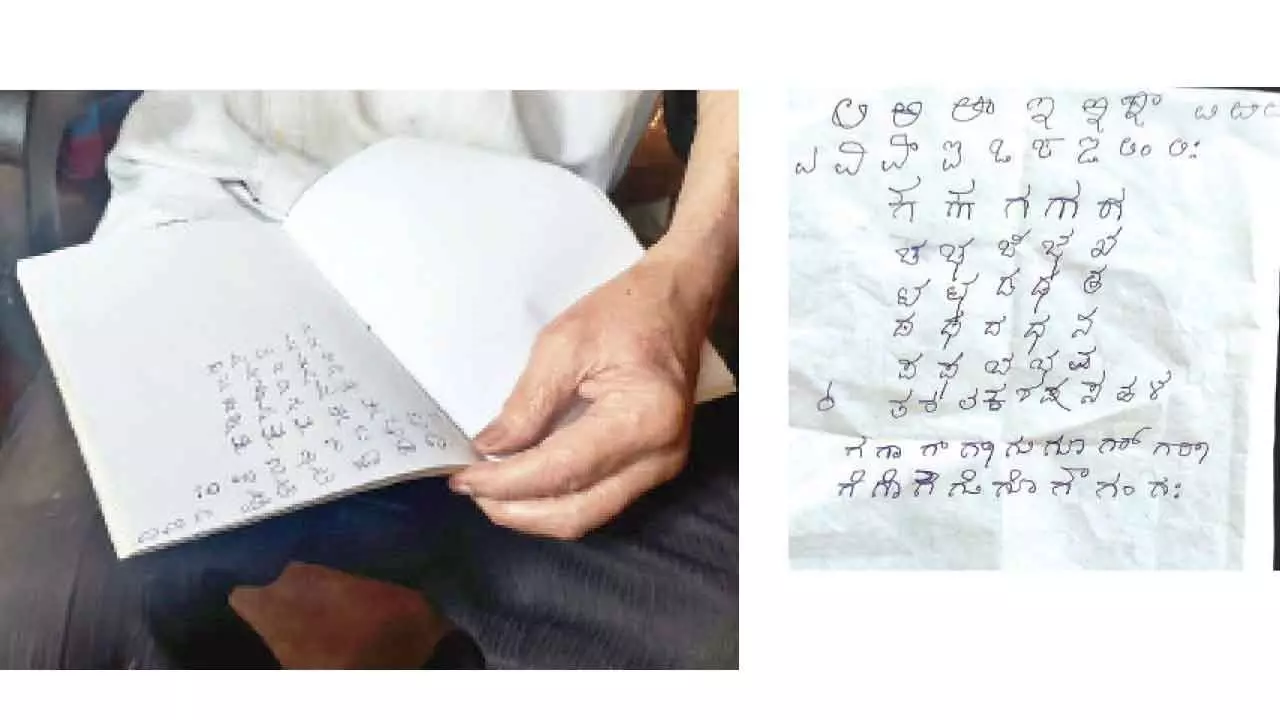
A forgotten proposal from a Mysuru seminar reopens debate on whether Telugu, Kannada, Tamil and Malayalam can share a streamlined writing system
In southern India, language is both an identity and an inheritance. The graceful curves of Telugu, the rounded strength of Kannada, the classical austerity of Tamil and the fluid loops of Malayalam are more than alphabets — they are markers of history. Yet these scripts, closely related in origin, have over centuries evolved into distinct systems that often complicate learning and communication across states.
Decades ago, scholar Badekila Venkataramana Bhatta proposed a bold yet measured response. His concept, named “Saraswati Lipi,” outlined a reformed writing system that could reduce disparities among the scripts of Telugu, Kannada, Tamil and Malayalam, while preserving their phonetic richness. Though the proposal received scholarly discussion at the time, it gradually receded into the background of academic archives.
The idea first surfaced prominently during a specialised seminar hosted by the Central Institute of Indian Languages (CIIL) at its Southern Regional Language Centre in Mysuru. Founded in 1969, CIIL was tasked with advancing India’s language policy, encouraging research, and strengthening the pedagogical and technological foundations of Indian languages. Among its objectives was support for the three-language formula and the development of practical tools for multilingual education.
The Mysuru seminar turned attention to an often under-examined dimension of language learning: script. Scholars analysed how writing systems influence second-language acquisition, classroom instruction, and assessment. Discussions ranged from the formation of individual characters to the broader challenges of printing, typing and emerging electronic text processing. Within this context, Bhatta’s Saraswati Lipi stood out as a forward-looking contribution.
Rather than advocating a radical overhaul, Bhatta proposed calibrated reforms. He suggested simplifying complex character forms, removing redundant elements, and aligning structurally similar letters across scripts. The objective was functional harmony — a writing framework that would allow speakers of one Dravidian language to more easily access another without starting from scratch.
Such a reform carries implications beyond classrooms. In multilingual southern states, students often encounter more than one regional language during their schooling. A harmonised script could reduce cognitive load, make textbooks easier to design, and lower printing costs. For publishers and digital developers, fewer typographic variations would streamline font creation and software compatibility.
When the seminar papers were compiled under the editorship of Dr. K.P. Acharya, Saraswati Lipi was singled out as deserving deeper scholarly engagement. The editor observed that the suggested reforms for Kannada and Malayalam, in particular, warranted more sustained examination. Yet beyond that note of encouragement, the conversation slowed, overshadowed by other language policy debates.
Today, however, the landscape has changed. The rapid digitisation of Indian languages has placed new emphasis on standardisation and interoperability. From keyboard layouts to Unicode encoding, the practicalities of script design now intersect directly with technological access. In such a setting, Bhatta’s proposals gain fresh relevance. What once seemed like an academic exercise now resonates with the everyday realities of digital communication.
At the same time, any discussion of script reform must tread carefully. Writing systems are entwined with literature, devotion and collective memory. Movements to alter scripts have historically encountered resistance, particularly when communities perceive threats to cultural identity. Saraswati Lipi’s strength lies in its incrementalism — it seeks evolution rather than erasure.
The question is not whether Telugu should become Kannada or Tamil merge with Malayalam. Instead, it is whether subtle structural convergence can make multilingualism more accessible. In a region where linguistic pride is strong, a practical approach rooted in scholarship may offer common ground.
As India navigates the twin imperatives of diversity and cohesion, language remains central to the conversation. Revisiting Saraswati Lipi is less about reviving a dormant proposal and more about reopening a thoughtful dialogue. If scholars, educators and technologists engage with it seriously, Bhatta’s vision could move from the margins of seminar volumes to the mainstream of policy debate.
What was once an overlooked footnote may yet prove to be a blueprint for bridging scripts — and, perhaps, strengthening bonds across southern India’s linguistic landscape.