India’s AI Journey : Bridging the Gap with the US and China

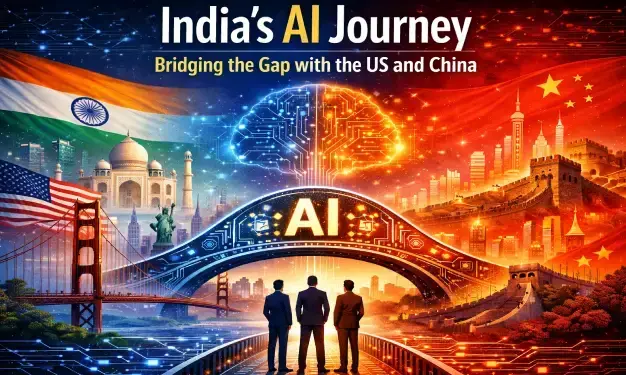
Learn India’s AI journey, from startups and government policies to global competition and future potential against AI superpowers like the US and China.
Abstract
Artificial Intelligence (AI) is transforming global power structures, fueling innovation across sectors from healthcare to defense. While the United States and China are leading the global AI race, India is steadily advancing its position through government initiatives, a growing startup ecosystem, and a vibrant tech talent pool.
In this article we will be exploring the current state of AI innovation in India, government support, key startups, and the challenges India faces in becoming a global AI leader.
Artificial Intelligence Innovation in India
India’s AI journey has attained strong traction over the last decade, transitioning from academic interest to real-world applications. Today, AI has become a strategic necessity. Agriculture (precision farming), education (personalized learning platforms), healthcare (diagnostics and drug discovery), and fintech (fraud detection and credit risk modeling) are few sectors where Indian companies are implementing AI.
AI research hubs have been established in India by various multinational firms like Google, Microsoft, and IBM tapping into the country’s deep talent reservoir. Besides this, Indian tech majors such as TCS, Infosys, and Wipro are integrating AI into their service offerings and internal processes.
Indian AI Ecosystem
According to NASSCOM, India’s AI ecosystem has been ranked third globally due to its AI research output as of 2023, and the AI talent pool is expected to grow significantly by 2025.India's AI ecosystem is fueled by its strong IT services base, academic institutions like IITs/IISc, and the world’s largest youth population.
India is also a hub for AI development in sectors like rural healthcare, language processing for vernacular languages, and agriculture automation. However, the ecosystem is still evolving. While there’s an abundance of raw talent, industry-academia collaboration remains limited, and cutting-edge research is still dominated by a handful of institutions.
Indian AI Startups 2026
As of 2026, India has evolved into a thriving hub for artificial intelligence innovation, now home to over 5,000 AI startups. Cities like Bengaluru, Hyderabad, and Pune continue to lead as major AI and deep-tech ecosystems, supported by strong startup infrastructure and policy backing.
Moreover, there are many startups like Niramai (AI-based breast cancer screening) and CropIn (AI for smart farming) that show how Indian entrepreneurs are solving real world problems using AI. Venture capital funding in Indian AI startups has also increased, although it still trails the levels seen in the US and China.
Government Support for AI in India
As our nation is taking progressive steps towards AI innovation , the Indian government is also taking notable steps to promote AI development. The National Strategy for Artificial Intelligence (NSAI), released by NITI Aayog in 2018, laid the foundation for “AI for All” — focusing on inclusive growth across five sectors: healthcare, agriculture, education, smart cities, and mobility.
In 2021, a centralized platform AI Portal, and INDIAai was launched by the Ministry of Electronics and Information Technology to promote research and foster collaboration.
However, India still lacks a dedicated AI policy with enforceable regulatory frameworks, which limits the pace of adoption and innovation.
Artificial Intelligence - Challenges in India
India is taking progressive steps to become an AI superpower but there are some critical challenges which can’t be overlooked.
- Lack of Infrastructure: Many start up companies in India have limited access to high-performance computing and cloud infrastructure which becomes a bottleneck in front of large-scale AI training.
- Data Privacy and Regulation: India deals with regulatory uncertainty due to lack of comprehensive data protection laws, and the absence of clear ethical AI guidelines
- Skill Gaps: Every year India produces a high volume of engineering graduates but there is still a shortage of industry-ready AI professionals.
- Limited Research Funding: Limited public and private investment in AI R&D continues to place India behind the US and China.
Indian AI vs China AI vs US AI
When it comes to AI leadership:
- The US leads in core AI research, chip manufacturing (NVIDIA, Intel), cloud infrastructure (AWS, Google Cloud), and has the most AI ventures and innovation.
- China rules in AI implementation, especially in surveillance, fintech, and government-backed AI projects. Its central planning model and huge datasets give it a strategic edge.
- India is still in the growth phase, with strengths in service-based AI, low-cost development, and grassroots innovation. However, India lacks the massive public-private funding ecosystem that drives AI in the US and China.
Can India Compete in Global AI?
India can compete but may not match the US or China in raw AI power or infrastructure. India can carve out a niche in ethical AI, low-resource AI solutions, and AI for social good. Its large and diverse population offers an unmatched testbed for scalable, inclusive AI applications.India can become a global AI contributor by focusing on responsible innovation, indigenous AI chips, skilling programs, and stronger research-industry collaboration
Future of Artificial Intelligence in India
As we see, India’s AI future is promising but demands urgent and sustained action. Following actions would help and clear the path of AI for India:
- Building a national AI computing infrastructure
- Encouraging public-private partnerships
- Boosting R&D through dedicated AI funds
- Strengthening AI curriculum in education
- Ensuring ethical and inclusive AI development
Conclusion
With the right mix of policy, talent, and innovation, India has the potential not only to participate in the AI race—but to lead where it matters most: using AI to solve real-world problems for billions.