Precision CNC Machining in India: Boost Global Competitiveness with Advanced Manufacturing

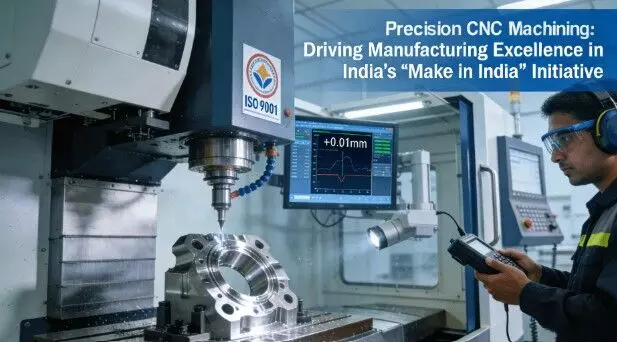
Precision CNC machining enhances India's manufacturing quality and efficiency. Learn how advanced CNC processes improve global competitiveness and meet international standards.
Achieving Global Competitiveness: How Precision CNC Machining Elevates Advanced Manufacturing in India
Introduction
The 'Make in India' movement has put the country's manufacturing industry on the cusp of a growth spurt like never before. The problem Indian manufacturers face today is that as they try to compete at a global level, there is a huge need for them to adhere strictly to quality and delivery terms, as well as provide higher-end parts. A major problem here is associated with non-precision manufacturing or suppliers who normally lack the capability to provide the required tight geometrical tolerance and traceability characteristics necessary for a high-performance product.
Precision CNC machining is viewed through this article as a fundamental enabling tool that enables Indian manufacturers to overcome these challenges because of the manufacturing technology's utmost accuracy, excellent repeatability, and natural scalability. We will explore the major processes involved in precision machining in detail and outline a manner in which a supplier selection can be done based on costs and a need to adhere strictly to globally set standards.
What Does True Precision in CNC Machining Services Entail?
Precision manufacturing and quality mean much more than meeting a target dimension with a product. It encompasses a whole paradigm and a broader vision to ensure every element within a product meets a precision standard.
1. The Multidimensional Nature of Precision
Precision is made possible through interlinked variables. Geometric accuracy is ensured through standards such as those offered in ASME Y14.5 and is critical in ensuring features are accurately located and oriented. Surface finish quality is measured in microns of Ra and is driven by fatigue strength, resistance to corrosion, and cosmetic factors. Integrity of materials is a critical part of machining and means that no machining-related stresses, micro-fractures, or changes must be introduced into materials. Finished quality in mass production then becomes a major determinant of precision.
2. The Critical Divide: Standard vs. Precision Machining
The difference between standard and precision CNC machining is profound. Standard machining may encompass the aim of tolerancing as ±0.05mm, which is more than enough for most industry requirements. For example, the precision CNC machining services will often provide the capability to maintain tolerances of ±0.01mm or even smaller. These requirements highlight the need for excellent machine tools, quality control procedures, as well as the quest for continuous improvement that is reflective of the latest trends in precision engineering.
3. Role of Authoritative Standards and Metrology
Adherence to a set of standards is not negotiable. For instance, with the use of ASME Y14.5 Toolroom Mathematical Interpretations of Geometric Dimensioning and Tolerancing (GD&T), a universal language can be used to prevent any form of misunderstandings between design and manufacturing. Adherence to these standards can only be ascertained through the use of high metrology tools that include Coordinate Measuring Machines and optical comparators.
How a Systematic CNC Machining Process Ensures Part Quality & Consistency
A strong and well-articulated process for machining via Computer Numeric Control is the very backbone of quality and consistency. It translates a designed digital object into a high-quality physical object.
Digital Design and DFM Analysis: It starts well before a machine touches steel. A full Design for Manufacturability (DFM) analysis is performed on the CAD design. This collaborative analysis helps to identify potential manufacturing problems with the design, such as difficult to machine areas or tight tolerances, and makes suggestions on how to optimize these areas of weakness. A full resource guide on precision CNC machining services goes into more detail on these principles of Design for Manufacturability.
Machine Tool Selection and Setup: Machine tools are a strategic choice. Multi-axis CNC centers enable flexible performance for complex shapes. The installation step, such as fixture design and presetting of tools, cannot be overstated. It is essential to fix the workpiece reliably to withstand cutting forces, which might cause it to shift and accumulate errors. Such painstaking planning provides a foundation for a successful production series.
In-Process Monitoring and Final Verification: It has quality always built into the process rather than at the end. The techniques utilized for monitoring processes during the manufacturing stage of the components, including the utilization of probes for critical measurement checks between stages of machining, enable corrections to be implemented in real time. Additionally, a final check of the components involves precision testers such as CMMs for a complete dimensional report with respect to the CAD file only after completion and cleaning for packaging.
What Key Factors Should Indian Manufacturers Consider While Choosing a CNC Machining Vendor?
The choice of contract manufacturers is an important consideration in relation to quality, cost, and time to market. A proper evaluation based on set criteria needs to be made.
1. Technical Capabilities & Quality Certifications
A technical review of the portfolio offered by the partner is required. A varied spectrum of modern, multi-axis CNC machines will assure technical ability. More importantly, an effective CNC machined parts supplier will offer evidence of its culture for quality on its part. Holding certifications such as ISO 9001, AS9100D for aerospace, and IATF 16949 for the automobile industry help prove such a culture on the part of the business. Holding such certifications is an entry-level quality for any good CNC machined parts supplier.
2. Engineering Support and Communication
The most desirable partners are engineering co-developers. Assess their receptiveness to offering helpful DFM reviews. Communication channels that introduce responsiveness and candor into a relationship are critical to managing project complexities and staying on schedule. The option to engage technical talk today with engineers can heavily de-risk a project.
3. Measuring Capabilities and Project Management
However, precision without verification and qualification is pointless. A skilled partner should have a metrology lab well-equipped to tackle any verification need they may have. Moreover, it is important to ask them for information about their project management system in place. There should be a system to effectively and predictably manage the entire flow of work from a quote to a delivery to ensure reliability. For a complete analysis of a supplier’s competencies, analysis of their CNC machining services is necessary.
How is the Cost of Customized CNC Machining Calculated?
One can clearly see that an understanding of what drives a given quote in the field of CNC machining is an essential element in making manufacturing decisions that consider cost as well as functionality.
Primary Cost Drivers: Material & Complexity: The two most influential variables are material choice and part complexity. The exotic alloys that contain titanium are more costly compared to aluminum. For instance, when there are deep pockets with thin walls as well as complicated contours in the part design, the part will require additional machining operations. There are some resources that provide important data related to materials.
The Impact of Quantity and Secondary Operations: Volume is an important factor here. Although cost per piece goes down with increasing volume because of the amortization of setup time, small prototyping volumes versus large production volumes have non-linear cost structures with different pricing paradigms.Secondary processing procedures involving anodizing, heat treatment, or certain coats also increase costs but are sometimes necessary based on performance considerations.
The Value of Quality Assurance: It is incorrect to generalize that quality control has purely cost-prohibitive elements. Thorough review procedures will avoid the significantly greater loss of cost that comes with scrap, rework, and assembly failures. It is an investment in a quality-oriented business partner that will serve to safeguard the cost and time of the project because of the cost-effectiveness of the custom CNC machining service.
What Are the Applications of Precision CNC Machining Across Key Industries?
The versatility offered by precision CNC machining makes it an integral part of industries that are very essential in the development of India’s industry setup.
1. Automotive & Aerospace Innovation
In the automobile industry, CNC Machining is used in the production of light yet robust engine and transmission components. In the aerospace industry, it is used in the manufacture of reliable structural components and complex blades designed to perform in challenging environments. The precision provided by the technology is critical in these industries.
2. Advancing Medical Technology and Telecommunications
The healthcare sector uses CNC machining for surgical instruments and biocompatible implants that demand error-free surfaces and precise dimensions. In telecommunications, the process is employed for making precise waveguides and filters used in 5G communication setups where signal integrity is a function of precise dimension.
3. Enabling Electronics and Industrial Automation
The industry is able to use CNC machined heat sinks, cases, and connector parts to provide reliability and heat dissipation for devices. From robotic arms to custom-made jigs and fixtures, CNC machining supplies the durable and precise components that are the workhorses of automated assembly lines.
Conclusion
Precision CNC Machining is an important foundation for the manufacturing sector in India with regard to increasing its capabilities in the supply chain, innovation, and establishing its strength on the global platform. It all depends on having complete knowledge about efficient processes and technology, and most importantly, associating with the right supplier who can convert the design into high-performance parts, meeting the highest standards in the world.
FAQs
Q: What is the average lead time for precision CNC machined parts?
A: The lead time will depend on the part complexity, the number of pieces that need to be manufactured, and the availability of materials. Even for prototyping, this can range from 3-5 days. But for large productions, the timeline will be discussed in detail as per the project requirement. It is essential to discuss the timeline with the manufacturing company.
Q: What are the required file formats for a CNC machining quote?
A: Preferably, standard formats of 3D CAD files are used in quoting. Such standard formats include STEP, IGES, and Parasolid. Though 2D PDF files may give additional specifications, a 3D model is needed in creating a quote and in CNC programming.
Q: Where might design for manufacturability (DFM) analysis be useful?
A: DFM analysis helps in optimizing the design of a part based on the selected manufacturing process with the result that considerable cost reductions are attained. DFM analysis helps in indicating difficult to machine surfaces, providing alternative shapes and designs, indicating optimal tolerancing values, and also indicating material selections.
Q: What are the primary materials that are employed in precision CNC machining processes?
A: Various materials are available. Alloys of aluminum are used for their strength to weight ratio; steel is used for resistance to corrosion; while titanium is used for strength coupled with biocompatibility. Engineering plastics also include PEEK and ABS.
Q: Do you provide surface finishing processes for CNC machined components?
A: Well, yes. Most industrial suppliers provide a range of surface finishes that can be applied to enhance their appearance, durability, or usability. These finishes may include anodizing (for aluminum grades), bead blasting (for a dull finish), powder coating (for a colored and durable finish), or passivation treatments for stainless grades.