Marginalised communities left in the lurch: Faculty shortage & delayed support stymie TG residential law colleges

Hyderabad: “We decide, and you follow,” is how academicians describe the current state of higher education policy in Telangana, where bureaucratic diktats often leave universities grappling with practical challenges.
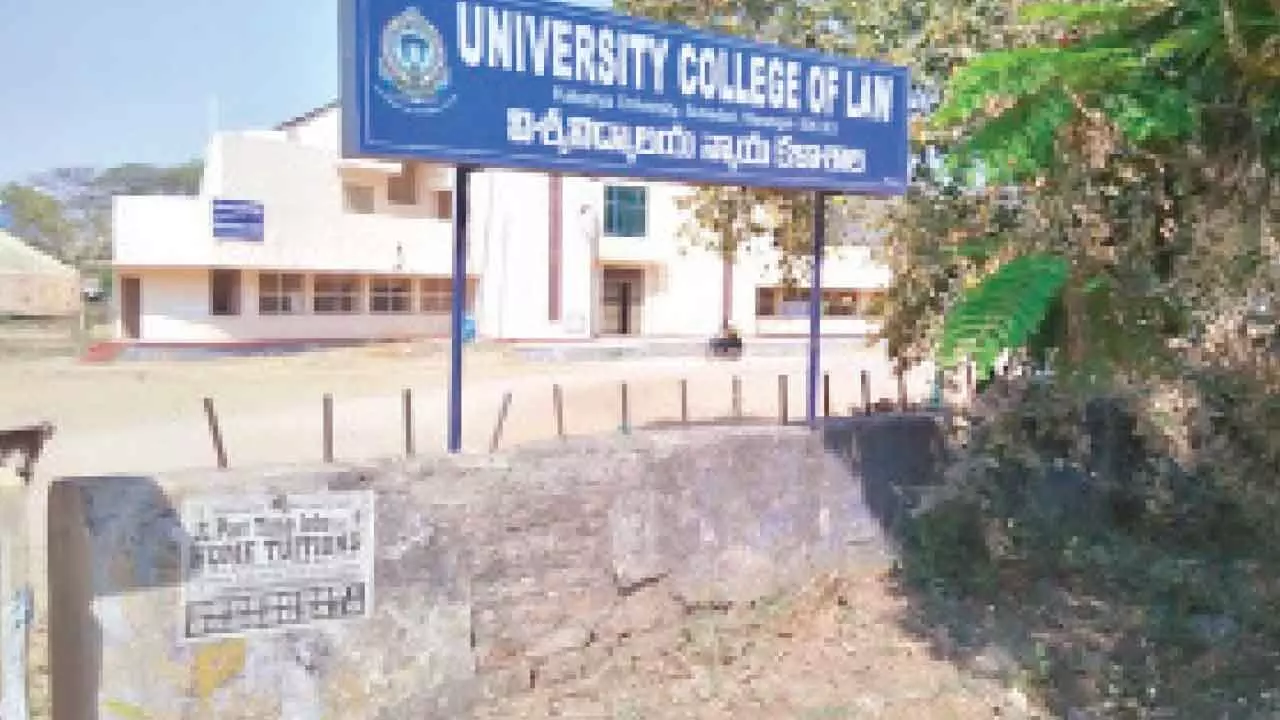
While the government’s initiative to establish residential law colleges for marginalised communities is hailed as “progressive”, concerns are mounting over faculty shortages, delayed financial support, and compromised academic standards in these institutions. A senior official from the SC and ST Welfare Department told ‘The Hans India’ that the previous government had taken a policy decision to encourage legal education among disadvantaged groups. As part of this vision, specialised residential law colleges were set up under the Golden Telangana Initiative and the Scheduled Castes/Tribes Special Development Fund (SCSDF). These include the Telangana Social Welfare Residential Law College for Women (a government-run institution under TSWREIS), the Telangana Tribal Welfare Residential Law College for Men (TSWREIS), and the Mahatma Jyotiba Phule Telangana Backward Classes Welfare Residential Law Colleges for men and women (TSWREIS). Together, they offer 3-year and 5-year LLB courses.
Admissions are conducted through the Telangana Law Common Entrance Test (TG LAWCET), with relaxed eligibility criteria for SC/ST candidates. For instance, the minimum qualifying marks requirement is set at 40 per cent, enabling more students from disadvantaged backgrounds to pursue law. Financial support is also a cornerstone of the initiative, with fee reimbursements covering 75% or more of tuition costs for SC/ST students.
However, academicians point out that the colleges are struggling to meet the Bar Council of India (BCI) norms of approval. A faculty member from Osmania University observed that each law college should have at least six faculty members, including one professor, two associate professors, and three to four assistant professors. “It is surprising how permissions were granted without adhering to these norms. Perhaps officials promised to fulfill conditions after starting operations,” he remarked.
The shortage of qualified faculty has become a pressing issue. An official from the Telangana University admitted that the institutions lack the required number of teachers, making it difficult to maintain standards. Remuneration offered range between Rs 350 and Rs 600 per hour or a lump sum of Rs 20,000 to Rs 40,000, depending on departmental norms. A social sciences faculty member from OU explained that regular teachers carry a load of 16 periods per week. Earlier, part-time faculty exceeding this load were converted into contract lecturers, but this norm was abolished after Telangana’s formation.
Adding to the challenges, fee reimbursements to students are often delayed by two to three years, sometimes even after a student completes the course. This has left colleges struggling to make on-time salary payments to the part-time faculty. As a result, practicing lawyers who once contributed to teaching have withdrawn, citing inadequate and delayed remuneration compared to their professional practice. “When a practicing lawyer gets better remuneration in practice, they would not show interest to come for teaching,” he observed.
The new rules have further discouraged experienced professionals from joining, leaving the colleges dependent on limited resources. While the government’s intent to democratise legal education is commendable, officials’ failure to address policy outcomes is undermining the very academic standards the initiative seeks to uphold. “We cannot openly voice these concerns as doing so is increasingly treated as speaking against the government … we are often accused of making allegations against the university for which we are working,” said an associate professor from the Kakatiya University.