Navigating Pressure and Listening to My Inner Voice, Defines my Journey: Shraddha Srinath

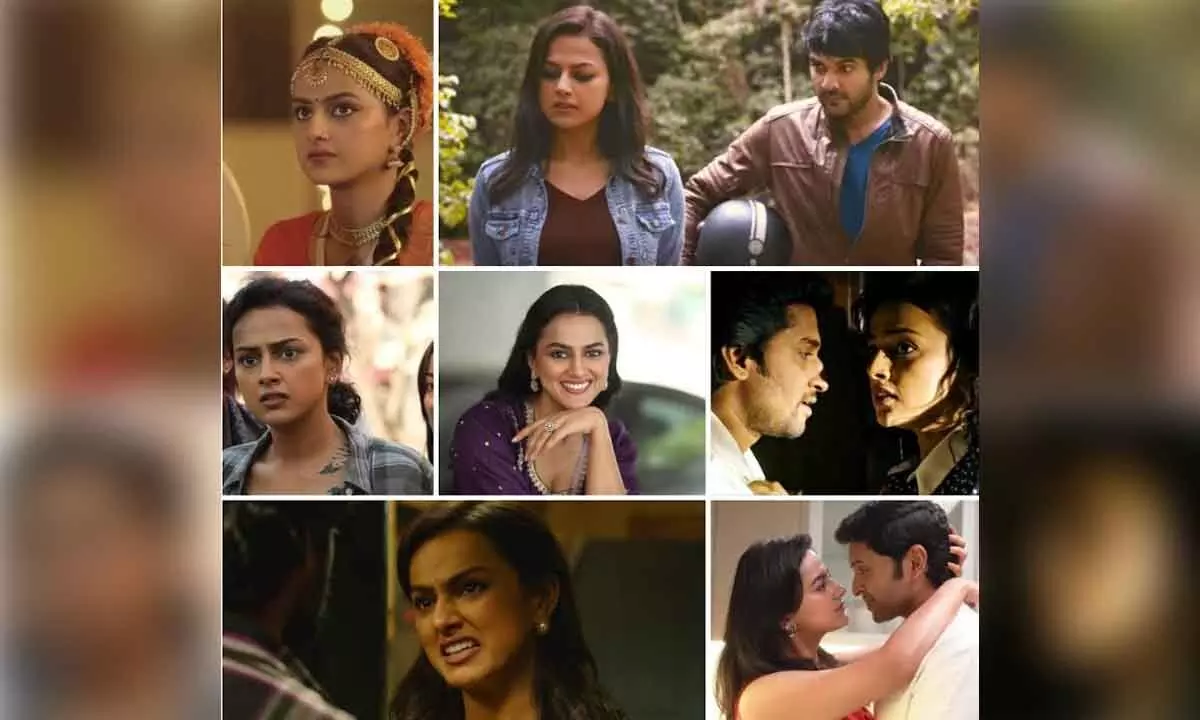
Shraddha Srinath's first signed Telugu film, ‘Krishna and His Leela’, is releasing in theatres as ‘It’s Complicated’ tomorrow. She shares her views on love, breakups, relationships, and her career with The Hans India.
Shraddha Srinath's first signed Telugu film, ‘Krishna and His Leela’, is releasing in theatres as ‘It’s Complicated’ tomorrow. She shares her views on love, breakups, relationships, and her career with The Hans India.
About her first film signed in Telugu, ‘It's Complicated':
Q: How do you feel about the re-release of Krishna and His Leela as It's Complicated, considering it was initially released on OTT and is now coming to theatres?
A: It’s honestly a very unexpected move, but I love it. Krishna and His Leela is one of those rare films where, even as an actor, I enjoyed watching it as a viewer. That doesn’t happen very often. The film was relatable, youthful, and fresh, so I always wondered how it would have performed if it had been released in theatres first. That’s why I’m really excited about this re-release. Also, this was the very first film I signed in Telugu.
Q: You took a month to say yes to the script. Why?
A: I heard the script in March 2017 and officially said yes in April. Technically, it should have been my first Telugu release.
To be honest, I was under tremendous pressure from people in my life—especially from my management team—when deciding whether to take up the project. I was new to Telugu cinema, and there were a lot of voices telling me, "You should do it" or "You shouldn’t do it." I weighed the pros and cons carefully.
Deep down, I knew I wanted to do the film, but since it was my Telugu debut, I felt it had to be a smart decision. Eventually, I decided to go with my gut and said yes. Though I loved the script from the moment I heard it, it took me a month to commit officially.
Q: Were you hesitant about doing a Telugu film?
A: It wasn’t about hesitating to do a Telugu film—it was more about whether this should be my first Telugu film. Since I was new to the industry, I had so many people giving me advice. I took everything seriously because I knew how big the Telugu film industry was and wanted to make the right choices. It was overwhelming at times.
But over the years, I’ve learned that following my instincts has worked best for me. My ten-year career has taught me to trust my gut, and I’m glad I did.
Q: Previously you said you wouldn’t choose Krishna as your love in this story. You prefer him as a friend. May I know why?
A: Because Krishna is a little unreliable if you look at him at face value. I wouldn’t want to be caught in a crossfire or in a three-person relationship with Krishna in the middle—because you never know when he might leave. I wouldn’t want to be the one forced to choose between two people because of him. So, I’d rather have him as a friend. I’d rather give him love advice and be like, "Krishna, please stop these ways, improve, sudhar jao!" (laughs). I think that would be a better dynamic.
Q: Did you know that ‘Krishna and His Leela’ has developed a cult following, which played a role in its theatrical re-release?
A: I wasn’t fully aware of that, but I’ve heard from Sidhu (the lead actor), Ravikant (the director), and Sri Charan (the music director) that they keep getting messages from people who love the film. Someone even told Ravikant that watching this movie felt like therapy!
While these messages haven’t reached me directly, I have noticed fans posting about the film regularly—at least once a month. People still talk about specific scenes and moments from the movie, which is heartwarming.
Q: Ravi Perepu is often described as a writer for the current generation. What are your thoughts on his filmmaking style?
A: I completely agree. Ravi is young, and his stories reflect the experiences of our generation—love, heartbreak, personal growth, and the lessons life teaches us. But beyond that, there’s a certain wisdom in his writing. His stories don’t just cater to the masses; they speak to people who have lived through these emotions and can relate deeply.
He comes from Vizag, and I’ve met his friends, so I’ve seen firsthand the kind of cultural background and upbringing that shaped him. His writing is incredibly honest—he isn’t afraid to put his heart out there, even if it’s not what mainstream audiences typically expect. But that’s what makes his work stand out. There’s always a niche audience that connects with his films in a profound way. He can write mass stories too.
Q: Since the film was originally released on OTT, were you able to gauge its success back then?
A: It was tricky. Unlike theatrical releases, where you have box office collections and sold-out shows to measure success, OTT in 2020 wasn’t as evolved in terms of gauging a film’s impact. You could sense that it was doing well, but it was hard to quantify. That’s why this theatrical release is exciting—it gives the film a second life and a chance to connect with a wider audience.
Q: What made you sign ‘It's Complicated’ in the first place?
A: The film had a refreshing and modern approach, and I connected with it instantly. I knew that it was something I would enjoy watching as well as performing in.
Q: When you read the script, were you always considered for the role of Satya, or was Radha an option too?
A: No, it was always Satya. That was the only choice from the beginning. I liked the character from the start. I can't even imagine myself playing Radha because my personality suits Satya better. It just felt like the right fit for me.
About her co-star:
Q: Siddhu Jonnalagadda is also a writer. On sets, were you and he involved in rewriting the story, or was it purely a directorial discussion?
A: On sets, we primarily discussed our scenes at hand. If I had any thoughts about my character or wanted changes in my lines, I would discuss them with the director, Ravi. Siddhu and I didn’t collaborate on the writing; he was fully in his actor mode, bringing pure performance energy. In fact, in the beginning, I wasn’t even aware that he writes.
Q: Did you and Siddhu improvise or discuss your performances together?
A: Not in terms of script changes, but in terms of performance, yes. He had a fabulous energy on set—young, educated, and still figuring things out. There was a certain vulnerability in him, which resonated with me because I was doing my first Telugu project. At that time, he wasn’t the star he is today; he was just like any regular person. Even now, despite his success, he has retained a lot of his old self, which is really admirable.
About her soulmate:
Q: You previously spoke about the concept of soulmates. What do you think about it now?
A: Do I believe in soulmates? Honestly, no. I think we’re all too practical for that. Some people bring out the best in you, and it’s good to have them in your life. Then, there are others who carry negative energy and don’t let you shine—it's best to stay away from them.
Q: Have you ever experienced a breakup? What did you learn from it?
A: Oh, I’ve had many breakups. What did I learn? Well, most of my relationships ended because I chose to walk away. That made me question whether I was even built for relationships. It led to a lot of introspection.
Q: What kind of introspection?
A: I realized I needed to stop chasing excitement and instead understand what is truly important to me in a relationship. I had to figure out the kind of partner I needed—not based on external factors like family approval or financial stability, but what I genuinely wanted. That self-awareness helped me grow.
Q: Do you believe in "happily ever after"?
A: To be honest, I also learned that relationships are not forever. Marriages can end, relationships can fall apart—there are no guarantees. We often believe in the idea of "happily ever after," but reality doesn’t always work that way. Understanding that has been a crucial lesson for me.
About her friends in the industry:
Q: Do you have any best friends in the industry?
A: My honest answer, and the only person I can actually name without it being a lie, is Ravikanth. Ravikant and I have known each other for years. Even though it’s been about six to eight years since we finished the film, he remains one of my closest friends. He’s the kind of person who will drop everything if I need help. Even if we don’t get much time together, he’ll say, “Come, I’ll drop you at the airport,” and we’ll catch up during the 45-minute drive. That’s the kind of friendship we have.
Q: What about actresses? Are you close to any heroines?
A: I have had good working relationships. For example, Meenakshi Chaudhary—we spent very little time together during Mechanic Rocky, I really respected and admired her, and I felt that admiration was mutual. However, I wouldn’t call it a best friendship because we haven’t met much after that. We only keep in touch through Instagram, which isn’t the same as a real friendship.
Most of my best friends are from school—my friends from 11th and 12th grade. They know the real me from those years. Also, as an actress, I mostly spend time with my male co-stars. I haven’t worked with many actresses because two-heroine films are rare. Plus, I don’t socialize much, I don’t attend parties, and I stay in Bangalore, so the chance to make close friends in the industry is very limited.
Q: Do you have any pets?
A: No, I don’t. I do like them! I like small dogs—ones that can’t jump up and bite my face. (Laughs) It’s been a fear of mine since childhood. I prefer calm, small dogs. And I really like cats too. I take care of my friends’ pups and kids though (laughs).
In the future, even if I move into my own house, I don’t think I will have a pet. I’m just not a pet person.
About her fellow women stories:
Q: Many women-centric films in Telugu cinema tend to fall into two categories—either action-driven, where the heroine performs stunts, or deeply emotional, designed to move the audience. Why do you think this happens? Do you believe we should simply tell women's stories and let the audience take what they want from them?
A: I see why these kinds of stories are written if they continue to work as a formula for success. But I have no problem with women doing action roles. Samantha, for example, has been incredible in action films recently. Personally, I would love to do a well-made spy thriller with an international feel, where I can perform some great stunts.
At the same time, I agree that we should be able to tell a woman’s story for what it is—without exaggeration, without forcing emotions, and without needing to justify its existence with action or melodrama. But commercially, I don't know if such films always work, especially in Telugu cinema.
Q: Do you think Telugu cinema is more commercially driven compared to others? i
A: Definitely. Telugu cinema, for the most part, leans towards commercial storytelling. If you place Malayalam cinema on one end of the spectrum, Telugu cinema is at the other, focusing on larger-than-life storytelling.
Filmmaking is an industry, and films are made because they need to make money. Audiences choose what they want to see, and the market responds to that. It's a cycle—these kinds of films are made because they generate revenue.
Q: Would you like to see more stories that focus on women’s everyday lives rather than making them about extreme circumstances?
A: Absolutely! I would love to see stories that explore a woman's life in a more natural, lighthearted way. Modern-day problems, the life of an unmarried woman, or just something simple and relatable—those kinds of stories would be refreshing.
Q: Do you think having more women writers in the industry could help change this approach?
A: Yes, for sure! The unfortunate reality is that we don't have enough women writers in Telugu cinema. And because of that, we don’t have enough examples to show how a woman’s perspective in writing can make a difference.
In Bollywood, Kanika Dhillon is one of the few celebrated female writers. But in Telugu, we don’t have enough names to point to and say, "Look at the change when a woman writes a film." Once it becomes more common to have women writers on board, we’ll start seeing a real difference in how female characters and their stories are shaped.
Q: If you had to choose a film that got women’s storytelling right, what would it be?
A: There aren’t enough examples, and that’s exactly the issue. We need more women writing for women. Only then will we see a shift in the way female-led stories are told.
About her career goals:
Q: We’ve heard that you’re willing to go to great lengths for a role—if the director explains why a certain scene is important and convinces you. Is that true?
A: Yes, that’s true! If a director gives me a solid explanation of why a scene is necessary, and I understand its purpose in the story, I’m open to doing it. I need to be convinced that it adds value to the film.
I need to see the artistic and narrative reasoning behind it. If it makes sense, I have no problem pushing my limits for a role.
Q: It sounds like you have high standards when it comes to choosing roles. Would you say you’re very selective?
A: Yeah, I’d agree with that. I don’t say yes to projects easily. Even if a film excites me, I don’t let my emotions take over. I have a small circle of people I trust—my manager, my family, and my close friends—who I discuss every major decision with.
My manager helps me understand the market and career trajectory. My parents, coming from an older generation, have a different perspective, and I value their life experience. My friends, some of whom aren’t even hardcore movie watchers, give me a more neutral opinion. At the end of the day, the final decision is mine, but I make sure I’ve considered every angle before saying yes to anything
Q: Out of all your films, which one do you like the most?
A: I feel like a kid being asked to pick a favorite! (Laughs) If I had to choose, I would say U-Turn from the Kannada industry. It’s really special to me, and honestly, it might be my favorite across all industries because it was my first film.
Q: What about Telugu cinema?
A: I would pick Satya. There was something really fun about playing that character. She was quite contradictory—unpredictable yet strong. It was a refreshing experience.
Q: And from Tamil cinema?
A: Nerkonda Paarvai for sure. As a performer, I think I really pushed myself in that film. Even though shooting it was a harrowing experience, it was incredibly fulfilling.
Q: It sounds like each role you’ve played holds a special place for you.
A: Absolutely! Every character teaches me something new, and I cherish each of them in their own way.
About her family:
Q: You are a lawyer, right?
A: Yes.
Q: Are you still practicing law while doing movies?
A: No, no, no. I’m not practicing anymore. I'm only working in movies. Law is only for a strong plan-B. I have always wanted to be an actor. When I saw Kaho Na Pyar Hai on TV, I went inside my room enacted Amish Patel's iconic dialogue "Mere Rohit ko bachao" in front of mirror and decided to pursue acting since then. I was 10-years-old then. It was not an easy road though, there were times when no one saw me as a "heroine". Now I'm here and I'm extremely happy about my journey and achievements.
Q: And you come from an army background, correct?
A: Yes, that’s right.
Q: How has your community, your group of people, supported your decision to act?
A: My friends and family think I’m the biggest star in the world! (Laughs) Any negative comments they come across, they get cutely defensive, even if I’m not affected by them. I often have to tell them, "It’s okay, don’t take it so seriously!"
Q: So the support was there from the beginning?
A: Yes, absolutely. My father, especially, loves sharing anything related to my career—whether it's my movie releases, award functions, or OTT premieres. He always asks me first, "Can I share this?" At first, I would tell him to be careful about over-sharing, but now I just say, "Yes, Papa, go ahead!" My friends and family have always been incredibly supportive and make me feel like I’m much bigger than I am. Their encouragement has meant everything to me.