Rahul’s antics over Naravane’s book will not help Cong

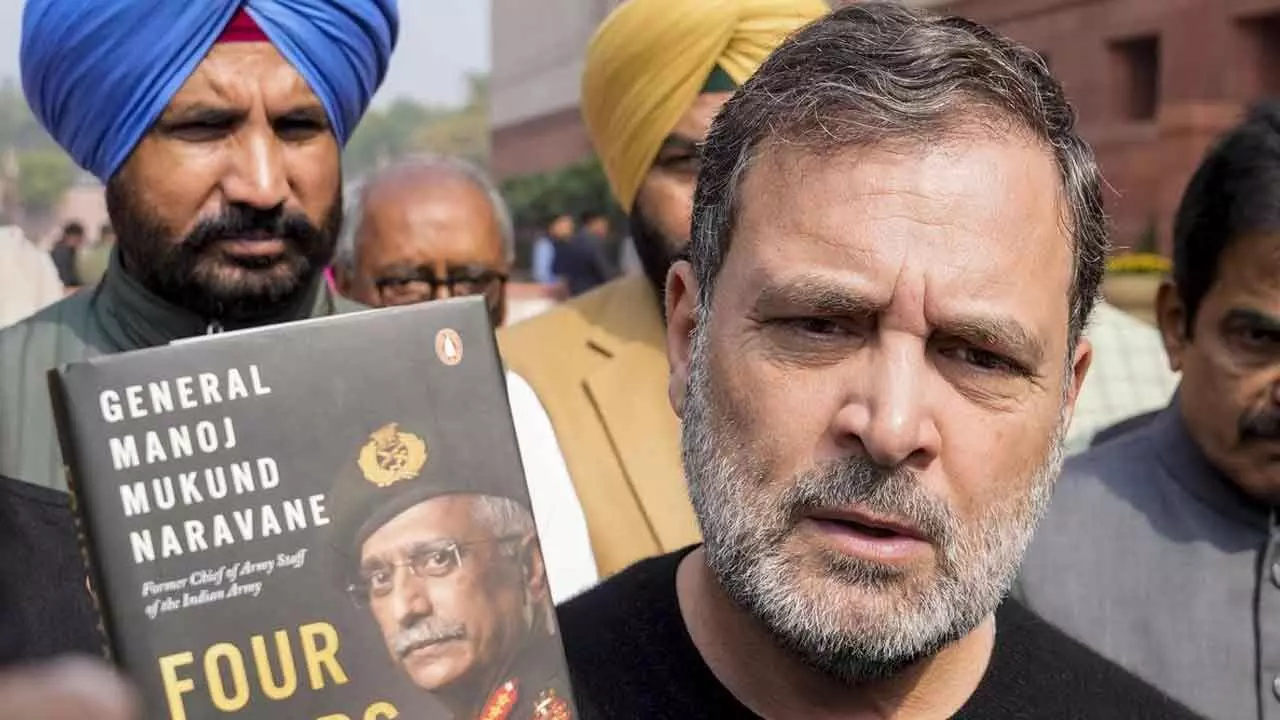
Leader of the Opposition Rahul Gandhi, and his advisers may be happy that his antics over a book by the retired army chief General M M Naravane disrupted Parliament on Monday. Such behaviour, however, does no good for his party. When Gandhi tried to read out an article based on the book, the Treasury benches vociferously protested. There was pandemonium, resulting in adjournments of the House.
Later speaking to reporters in the Parliament premises, he said, “This is what the army chief has written in a book. The book is not allowed to be published. It is languishing. This is his perspective and why is the government scared of it?” It is true that the record of the Narendra Modi government in upholding free speech is not exactly exemplary, but India is not the only country that imposes restrictions on books written by former military officers. Gandhi told reporters that he just wanted to quote from a report in a magazine on the memoirs.
The book ‘Four Stars of Destiny’ was supposed to be published by Penguin but is awaiting clearance by the government. Even if the government is excessive in restricting the retired army chief’s freedom of expression, Gandhi could have elaborated on the subject while talking to reporters. He could also have written an article or a social media post expressing the same thoughts. Why did he have to indulge in theatrics in the Lok Sabha? The next day, some Congress MPs mounted the table and hurled papers at the Chair. Consequently, eight Lok Sabha members were suspended for unruly behaviour.
Meanwhile, Naravane has distanced himself from the controversy. He told a newspaper, “My job was to write the book and give it to the publishers. It was the publishers who were to get permission from the MoD. They gave it [the book] to them. It is under review. It has been under review for over a year now.” The entire episode has exposed the ugly underbelly of Indian democracy. On one side is a government that has normalised opacity and delay as instruments of control.
A book by a former army chief being under review for more than a year raises legitimate concerns, not necessarily about outright censorship, but about a creeping culture of excessive caution, secrecy and bureaucratic inertia. When decisions are endlessly deferred without explanation, the chilling effect on free expression can be as powerful as an explicit ban. Democracies are weakened not only by visible repression but also by silent, procedural suffocation. On the other side is an Opposition that too often appears more interested in spectacle than persuasion. Instead of patiently building a case around civil liberties, institutional accountability, and democratic norms, it frequently resorts to disruption as an end, by itself.
This approach may energise a core support base, but it alienates the wider public, which increasingly sees Parliament not as a place of serious debate but as a stage for performative outrage. What makes this particularly troubling is that both sides feed off each other’s worst instincts. The government benefits when Parliament is paralysed because legislation can be pushed through with minimal scrutiny. The Opposition benefits when it can portray itself as being silenced. In this perverse equilibrium, democratic institutions become collateral damage.