Mapping Colonial India in Paul Scott’s Raj Novels

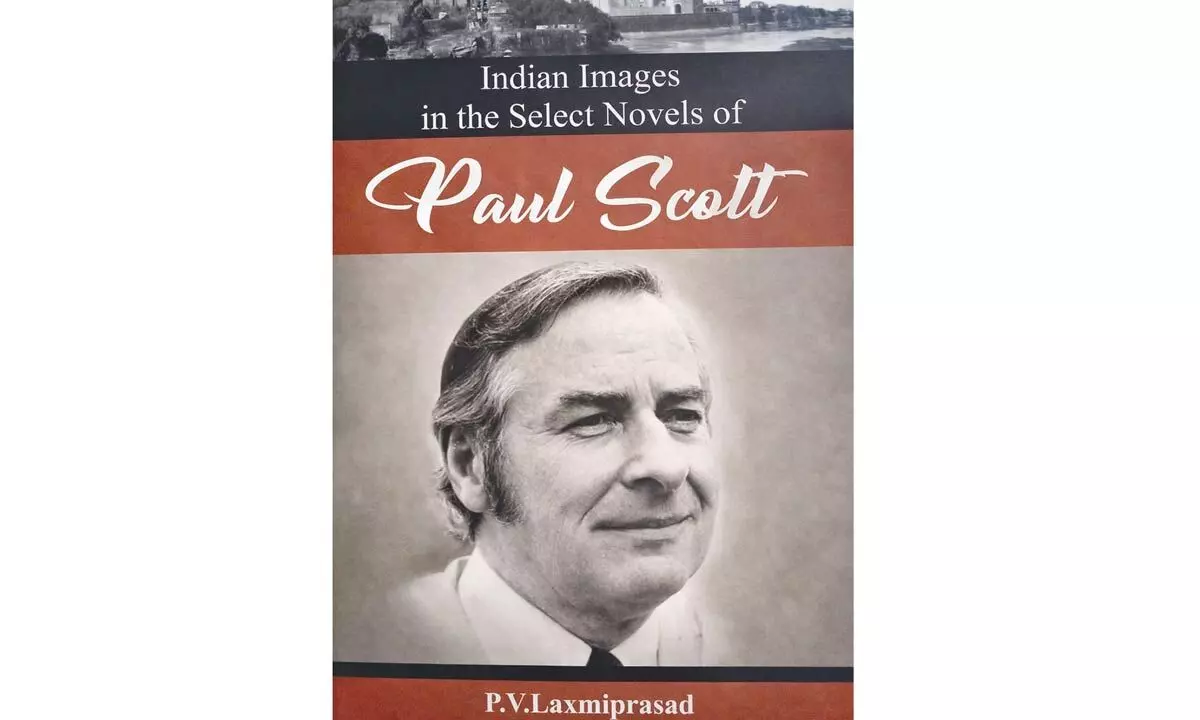
P.V. Laxmiprasad’s ‘Indian Images in the Novels of Paul Scott’ is a focused and insightful critical study of the representation of India in the fiction of Paul Scott, one of the most significant British writers to explore the complexities of the final years of the British Raj. The book examines how Scott constructs the social, political, and psychological landscapes of colonial India, particularly through his celebrated sequence of novels, the Raj Quartet.
Laxmiprasad approaches Scott’s fiction not merely as historical narrative but as a rich site of cultural encounter. The study investigates how India is portrayed in terms of geography, race, class, religion, and emotional experience. It argues that Scott’s India is not a simple colonial backdrop but a living, contradictory, and morally complex world. The author highlights the tension between imperial authority and native resistance, as well as the subtle emotional ties that bind colonizer and colonized.
A major strength of the book lies in its detailed analysis of the Raj Quartet, especially ‘The Jewel in the Crown’, ‘The Day of the Scorpion’, ‘The Towers of Silence’, and ‘A Division of the Spoils’. Laxmiprasad carefully traces how Scott presents India as a fractured yet vibrant society on the brink of independence. The novels’ settings—clubs, cantonments, bazaars, and civil lines—are examined as symbolic spaces where power, prejudice, and misunderstanding operate.
The book pays particular attention to Scott’s portrayal of Indian characters. Instead of reducing them to stereotypes, Scott often presents them as morally complex individuals. Laxmiprasad discusses characters such as educated Indians, civil servants, nationalists, and ordinary townspeople to show how Scott reflects the diversity of Indian society.
The analysis also points out the author’s sensitivity to Indian customs, traditions, and emotional worlds, while at the same time noting the limitations of his colonial perspective.
Another significant aspect of the study is its exploration of the theme of cultural misunderstanding. Laxmiprasad shows how Scott’s novels dramatize the inability of the British rulers to fully comprehend the society they govern.The emotional and political distance between the rulers and the ruled becomes one of the central tragedies of the colonial experience. The author effectively demonstrates how Scott uses personal relationships, particularly interracial friendships and romances, to reflect broader political tensions.
Stylistically, Laxmiprasad’s writing is clear, direct, and accessible. He avoids unnecessary jargon and presents his arguments in a logical, well-structured manner. Each chapter focuses on a specific aspect of Scott’s Indian imagery, such as landscape, social structure, or psychological conflict, making the book easy to follow for both students and general readers.
However, the study remains primarily descriptive in parts and could have engaged more deeply with contemporary postcolonial theory. A stronger theoretical framework might have enriched the critical discussion and connected Scott’s fiction more explicitly to broader debates in colonial and postcolonial studies. Even so, the book succeeds in offering a balanced and readable interpretation of Scott’s representation of India.
Overall, ‘Indian Images in the Novels of Paul Scott’ is a valuable contribution to the study of Indo-British literature. It provides a thoughtful examination of how a major British novelist imagined India during a period of historical transition. The book will be particularly useful for students of English literature, postcolonial studies, and anyone interested in literary representations of colonial India. It stands as a clear, informative, and engaging critical work.
(The writer is an internationally acclaimed literary critic and the founder of Authors Paradise Literary Group.)