Rendezvous with Kahlil Gibran

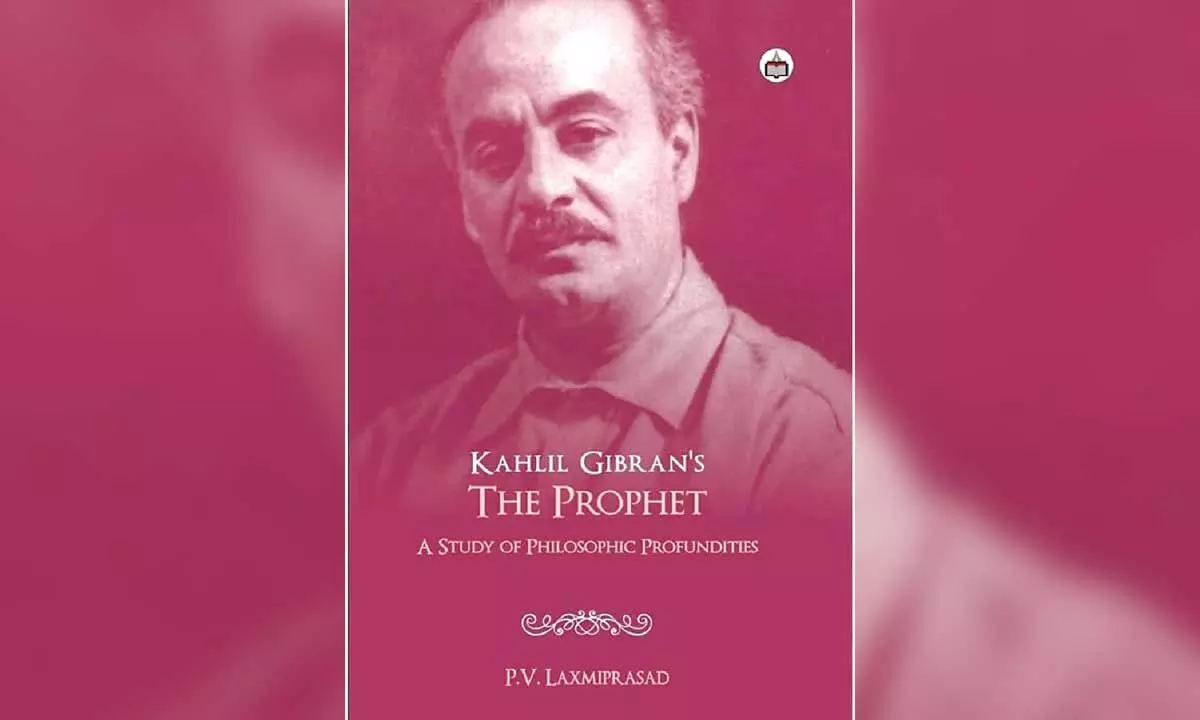
P V Laxmiprasad’s ‘Kahlil Gibran’s The Prophet: A Study of Philosophic Profundities’ is a finely crafted critical work that revisits one of the most beloved spiritual classics of the twentieth century—Kahlil Gibran’s ‘The Prophet’. Marked by scholarly depth, interpretive clarity, and a deep admiration for Gibran’s literary and philosophical stature, the study seeks not only to decode the mystic essence of the Lebanese-American poet but also to situate his writing within a broader moral, aesthetic, and universal human framework.
From the outset, the author confesses his enduring fascination with Gibran, whose lyrical “prose poems” have left an indelible mark on world literature. The preface reads like a personal manifesto, underlining how Gibran’s universal themes, moral vision, and mystical sensibility inspired this critical exploration. Laxmiprasad places Gibran next only to Shakespeare in terms of global influence—an assertion that underscores the poet’s profound connection with readers across cultures and generations.
The book opens with a detailed biographical sketch of Gibran, tracing his journey from Bsharri in Lebanon to Boston’s immigrant neighbourhoods and eventually to New York’s vibrant artistic circles. Rich in historical, cultural, and literary references, this section provides an essential foundation for understanding ‘The Prophet’ in the context of Gibran’s personal struggles, artistic evolution, and philosophical maturation. Laxmiprasad vividly brings to light the many influences—from Leonardo da Vinci to Nietzsche—that shaped Gibran’s creative consciousness, foregrounding his unique role as a bridge between Eastern mysticism and Western Romanticism.
The heart of the study lies in the chapter titled “Timeless Beauties in ‘The Prophet’,” where Laxmiprasad offers a thematic reading of the twenty-eight prose poems that form the work’s core. Each theme—love, marriage, children, work, joy and sorrow, crime and punishment, self-knowledge, freedom, prayer, pleasure, beauty, and death—is examined for its philosophical depth and spiritual resonance. The critic emphasises that Almustafa’s teachings are articulated in a voice that is universal, moral, and gently didactic, reflecting Gibran’s deep concern with human relationships, social harmony, and the pursuit of inner truth.
Central to this exegesis is the conviction that love and self-realisation constitute the nucleus of Gibran’s worldview. Love, as Laxmiprasad explains, is both the anchor and the compass of Gibran’s moral universe. Its power to “purify,” “crown,” and even “crucify” lends it a sacred duality, revealing love as both a source of fulfilment and a path of spiritual trial.
Equally compelling is the critic’s exploration of Gibran’s idea of the “god-self”—the innate divinity within every human being. Laxmiprasad skilfully demonstrates how Gibran elevates humanity by affirming its spiritual potential, its capacity for goodness, and its essential unity with nature and the cosmos. Through such readings, ‘The Prophet’ emerges as a guide to self-preservation, self-transcendence, and universal brotherhood.
One of the notable strengths of this critical study is its readability. Though firmly grounded in scholarship, the prose remains lucid and engaging, making the book accessible not only to academics but also to general readers drawn to Gibran’s thought. The author’s admiration for his subject is unmistakable, yet it never overwhelms his critical discernment. In sum, ‘Kahlil Gibran’s The Prophet: A Study of Philosophic Profundities’ stands as a thoughtful, illuminating, and heartfelt tribute to a timeless literary masterpiece. It deepens the reader’s understanding of Gibran’s enduring wisdom and convincingly reaffirms why ‘The Prophet’ continuesto speak across cultures and centuries.