When watching became scrolling

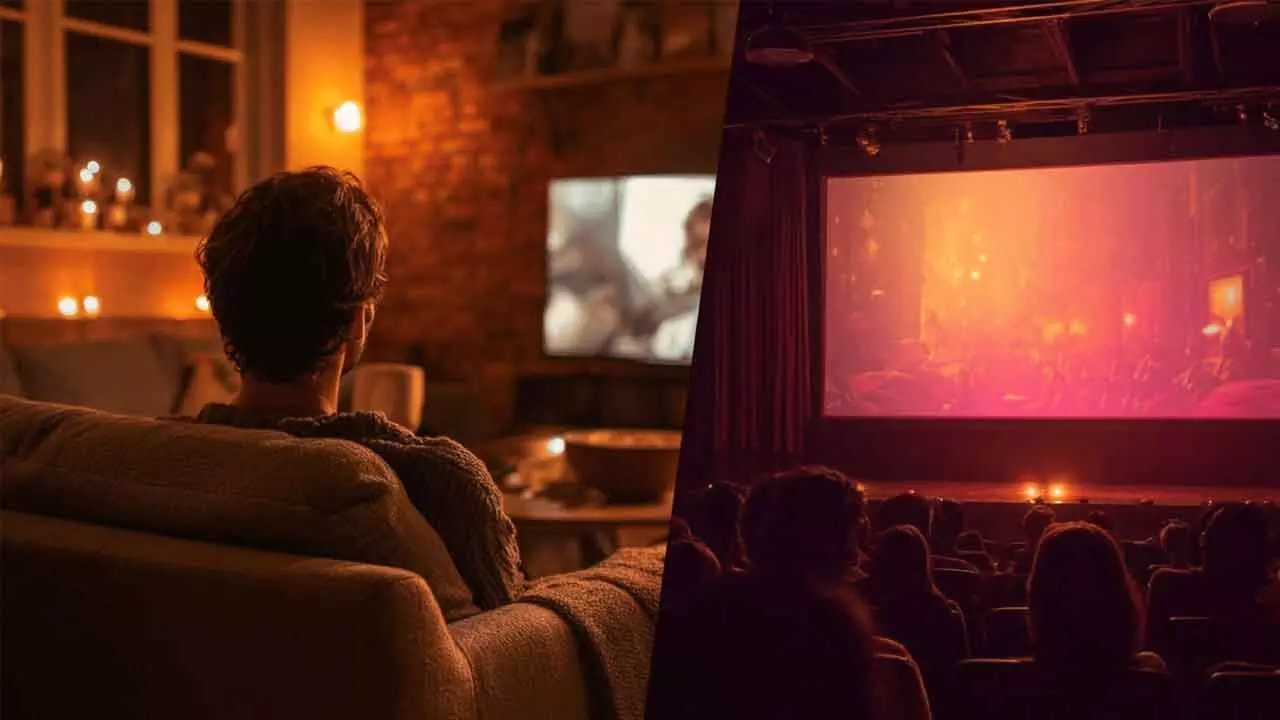
The journey from theatres to glowing homepages reveals how technology has transformed not just films, but our relationship with them.
There was a time when watching a movie required a decision. Not a casual click, not a half-hearted scroll, not the passive surrender of letting an algorithm choose for you. A decision. You checked showtimes. You argued with friends. You arrived early enough to sit through trailers. You silenced your phone not because a notification might pop up, but because the theatre demanded reverence. The lights dimmed. The curtains parted. And for two hours, the world narrowed to a single glowing rectangle.
Today, films arrive flattened into tiles on a homepage.
Streaming platforms do not ask us to commit. They ask us to browse. The opening scene competes with WhatsApp notifications. The climax unfolds while someone reheats leftovers. The credits roll automatically into the next thing before we have time to sit with what we’ve just seen. We do not exit the theatre into humid night air. We close a tab.
In a cinema hall, attention is architectural. The darkness isolates the screen. The sound surrounds you. The size of the image demands submission. You cannot scroll away from a slow scene. You cannot speed up a conversation. You are held hostage, gently but firmly, by the filmmaker’s pace. Directors like Christopher Nolan insist on theatrical releases not out of nostalgia, but because scale is narrative. The overwhelming silence before a bomb detonates in Oppenheimer feels different when it vibrates through your ribcage. A long shot in Interstellar feels infinite when the screen dwarfs you. The medium shapes the emotion.
Streaming, on the other hand, trains us to expect efficiency. If a film does not grip us in ten minutes, we abandon it. If it feels “slow,” we label it boring. Entire genres suffer under this impatience. Mid-budget dramas — the quiet, human stories that once filled theatres — are vanishing. What survives are franchises, sequels, cinematic universes engineered for mass retention.
We talk about “binge-watching” as if it were an accomplishment. But binge-watching is not watching. It is consumption. It is throughput. It is measured in hours logged, not ideas absorbed. The algorithm does not care what lingers in your mind. It cares what keeps you on the platform.
And so stories bend toward engagement metrics. Cliffhangers become mandatory. Open endings feel risky. Subtlety competes with scrollability. Even film posters are designed for thumbnail visibility rather than aesthetic coherence.
This is not an argument against streaming. Accessibility has democratized cinema. A teenager in a small town can now watch international films that would never have reached a local theatre. Independent filmmakers can find audiences beyond geography. The gatekeepers have, in some ways, loosened their grip.
Perhaps we are not losing cinema. Perhaps it is simply evolving. Every technological shift — from silent films to talkies, from black-and-white to color — has been met with resistance. Maybe streaming is just another transition.
But the difference now is not only technological, it is also psychological. To watch is to surrender — to time, to discomfort, to ambiguity. To sit with a scene that does not immediately reward you. To let the credits play without rushing toward the next thing. To engage rather than consume.