
2025 promises to be a landmark year for Isro

India’s space sector is clearly making giant strides, driven by technological advancements, and enabled by government support.
India’s space sector is clearly making giant strides, driven by technological advancements, and enabled by government support. The sector is of late attracting global attention with immense potential for growth and collaboration with other nations. India’s national space agency, Indian Space Research Organisation (Isro), is pushing the limits in space exploration, research, and development.
Since the Indian National Committee for Space Research (INCOSPAR), set up in 1962, was scaled up and rechristened as ISRO in 1969, the organisation has been rendering yeoman service to the nation in the fields of broadcasting, weather forecasting, disaster management, geographic information systems, navigation, cartography (maps), telemedicine, distance education satellites, etc. So far, it has conducted 62 PSLV, 17 GSLV, 7 LVM-3 launches along with 3 SSLV lifts off.
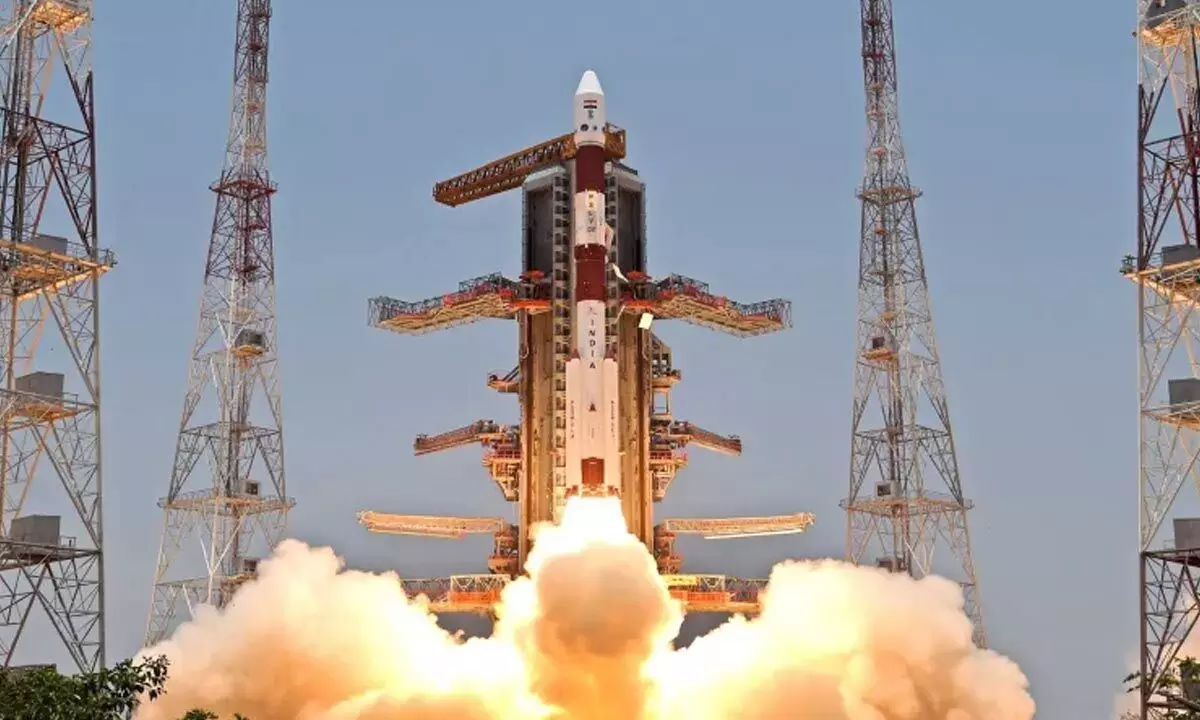
Close on the heels of the historic success of space docking, which elevated India to the ranks of US, Russia and China, Isro has achieved another significant success. On Wednesday, it created history with 100th launch. Indians’ hearts leapt in joy as GSLV-F15 lifted off from the Satish Dhawan Space Centre in Sriharikota. Carrying the NVS-02 satellite, the second generation satellite of India’s NavIC (acronym for Navigation with Indian Constellation; ‘navik’ means sailor or navigator in Indian languages) system, it raised India’s position in regional satellite navigation. Additionally, GSLV-F15 lift-off also marked the 17th flight of the Geosynchronous Satellite Launch Vehicle series and the 11th in the indigenous cryogenic stage. This demonstrates India’s growing self-reliance in increasing payload capacity and enhance its efficiency in satellite launches.
In view of new dynamics of geopolitics, for the sake of national security as well as strategic independence, NavIC importance cannot be overemphasised. NVS-02 seeks to augment accuracy in location services, which will benefit transportation, disaster management, and agriculture etc. Dependency, and problems thereof, on foreign satellite systems like GPS during the Kargil War, made the government sit up and brace for critical situations with its own navigation satellite system, with indigenously developed atomic clocks. Space is seen emerging as the “fourth frontier of warfare.” As such, India has to tap the space technology potential for military applications as well. NavIC will particularly boost our maritime navigation.
The Narendra Modi government deserves kudos for its move to set up a Rs 1,000 crore Venture Capital (VC) Fund to propel the growth of space startups during the period 2025-30. The capital infusion will facilitate direct employment and help in talent retention, preventing brain drain and even paving for reverse brain drain to foster the growth of private participation in the space sector. The fund reflects a long-term strategic vision of the government in building a vibrant, innovative, and sustainable space economy that aligns with the goals of Atmanirbhar Bharat. Domestic private sector role is crucial in the mission to scale up our space economy from the current $8.4 billion, a 2% of global space market, to $44 billion by 2033, including $11 billion in exports.
Last year, the SpaDeX mission laid the foundations for Chandrayaan-4 and the Bharatiya Antariksh Station. While Aditya-L1 set up India’s first space-based observatory to study the sun, demonstration of Vikas engine restarting in space will improve payload capacities of launch vehicles like GSLV and PSLV. It is heartening to learn that 2025 is going to be a momentous year for Isro as it expands capabilities in remote sensing and communication. The space missions would include “uncrewed” mission under ‘Gaganyaan’ besides two GSLV missions, a commercial launch of LVM3, and the much-anticipated ISRO-NASA collaboration on the NISAR satellite.
Nation joins Prime Minister and other dignitaries in wishing Isro all success and more strides in fostering innovation and advancing India’s position as a space-faring nation.


