Beyond The Limits Of Words
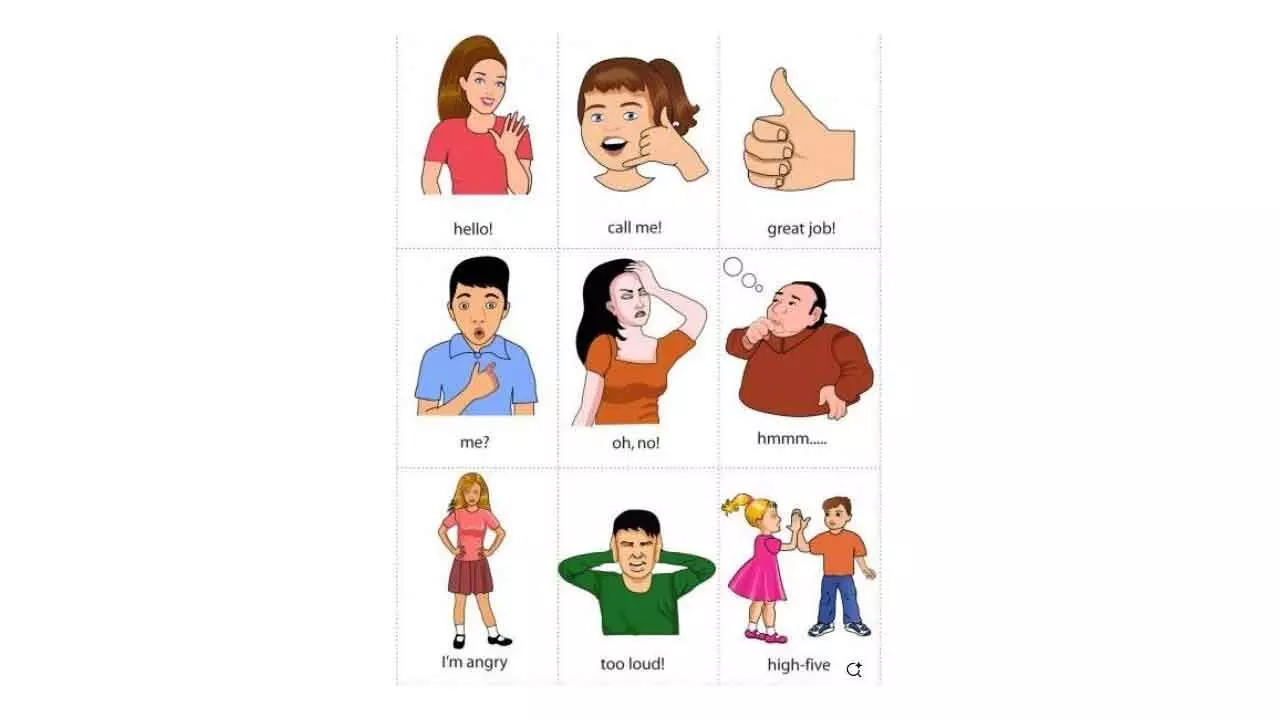
Gestures and signals have the strength, in fact, completely to replace words. Deaf people, for example, manage very effective interpersonal communication, entirely on the basis of hand gestures, facial expressions and body movements alone. In fact, there are TV news readers who can communicate with deaf viewers through this process. Just as in the case of words, gestures and signals also come in various categories, good, bad or indifferent
Languages, no doubt, are an effective medium for communicating thoughts, emotions, intentions, and feelings. Still, gestures and signals play a crucial role in enriching those processes.
Gestures are movements of the body or other limbs, used to express or emphasise an idea, sentiment or attitude; also done by way of formality or courtesy, a symbol or token. Among the most common gestures is the putting of the fore finger to the lips, by way of requesting for silence or asking people to be quiet. A wink of the eye is also a sign, indicating either amusement, approval or sexually suggestive gesture.
Gestures and signals have the strength, in fact, completely to replace words. Deaf people, for example, manage very effective interpersonal communication, entirely on the basis of hand gestures, facial expressions and body movements alone. In fact, there are TV news readers who can communicate with deaf viewers through this process.
Just as in the case of words, gestures and signals also come in various categories, good, bad or indifferent. For example, a smile, eye contact, thumbs up, fist bump, clapping or holding hands up, can convey positive reinforcement, approval and encouragement, enhancing the effect of communication and building rapport. On the other hand, there are also gestures, of hands and arms, which are extremely offensive or vulgar, and sexually suggestive, especially in some cultures.
Gestures also form an important part of the courtesies performed when people meet or great each other.
The custom in the western countries is for people to shake hands with each other by way of a greeting. In the Islamic culture, a wave of the hand, up and down, with a slightly bent posture is used to indicate a respectful greeting. In many cultures, particularly in Japan, people bow stiffly from the waist downwards by way of a respectful greeting, signifying humility and respect. The traditional greeting of a similar nature in Hindu culture is the folding of the two palms, a gesture known as a ‘Namaste’ or a Namaskaram’. Interestingly enough, in all these cultures, the same gestures are used while bidding farewell to others.
Gestures and expressions, facial or through movements of the limbs, are an integral part of Natya Sastra, notable as an ancient treatise on the Fine Arts, which has influenced dance, music, and literary traditions in India. I recently watched the ‘Arangetram’, or the first public performance of Bharata Natyam, of my granddaughter. I must admit to having been enormously impressed, not only by with the talent of the little girl, but also the remarkable ability of her Guru, who harnessed her innate talent so skillfully.
Known as ‘Hava’s or ‘Bhava’s, they are the emotional states, of feelings that are evoked in the audience. Through the performances of artists. The artists display, during their performances, different expressions, otherwise known as ‘Rasa’s, variously depicting love, anger, disgust, heroism, peace and tranquility, laughter and comedy, tragedy, horror, or wonder.
It is indeed a tribute to Indian culture that arranging for the learning of dance and music by children, continues as a valued tradition. Many people, especially political leaders and sports persons, often use the V sign by using the middle finger and the pointing finger as a sign of success or victory.
The waving of a white flag, especially in battle has traditionally represented surrender by one of the parties to the engagement, a signal that a truce is desired.
There are some areas where signals and gestures play a particularly important role, such as sports and games, in the Armed Forces, and in transport, whether by land, water or air.
For example, referees, in games such as boxing, hockey and football, and umpires in cricket, frequently use their hands and other limbs to convey messages not only to the players but also to those keeping track of the progress of the games, such as scorers. Such signals are also a means by which spectators watching the games can follow what is happening. Unfortunately, in several games, notably, the game of cricket, signals are often used by managers/captains of teams, players as well as the umpires to trigger a particular prearranged action which leads to the settlement of a bet, all part of what has come to be known as the scourge of match fixation.
Signals also play a very crucial role in the Armed Forces. In the Indian Army, for example, the Corps of Signals is responsible for developing, managing and operating the Army’s communications network, to ensure secure and efficient communication across diverse terrains and operational areas. Likewise, the Navy relies heavily on robust communication networks, ranging from basic flag signaling and radio communication to advanced satellite communications and cyber operations, in order to ensure seamless communication between ships, aircraft and shore- based facilities. An interesting, and endearing, phenomenon is that of ships greeting each other by raising their national flags, as a sign of respect, recognition, and friendship, apart from using the ‘Ahoy’ call, or Morse code.
Signals, similarly, play a vital role in ensuring the efficient functioning of the Air Force. Many charming practices can be found in the field of flying. One is the crew saluting captains before the aircraft is released for a taxi, a gesture returned by the captains of the planes. Another is of pilots of aircraft rolling the planes slightly to the left and right, by way of signal to other aircraft and ground crew as a friendly acknowledgement.
When a ship or an aircraft is in danger, the signal ‘Mayday’ is often used to convey the gravity of the situation to the Control Towers and request rescue. Signals and gestures also play an important role in road transport. Since vehicle communication is not normally possible, drivers of vehicles use them to intimate drivers of other vehicles about their intentions. They may be by way of requesting those behind to slowdown, or intimate them that one is about to take a turn. The official in charge of controlling traffic at road junctions also use signals and gestures to drivers, requesting them to stop or to proceed. That is, of course, done, where electronically operated automatic signals have not been installed. The ability to interpret and understand the signal is so important that they form an integral part of the test taken by the government department concerned before issuing a driver’s licence.
In the context of signals by drivers, there is this amusing story with which I thought I would end this piece. A car had rammed into the vehicle in front of it at a road junction. When the police officer approached the driver and asked him what happened, the driver threw up his hands in a gesture of helplessness, and said, “What could I have done? With all the gestures, the lady driver in front of me made, I finally thought she was going up!”
(The writer was formerly Chief Secretary, Government of Andhra Pradesh)