Students present AI, robotics & cybersecurity projects at IIIT Hyderabad R&D showcase

Hyderabad: The 25th edition of the annual R&D Showcase at the International Institute of Information Technology Hyderabad (IIIT Hyderabad), bringing together researchers, industry leaders, policymakers and students to explore advances in artificial intelligence, cybersecurity, robotics, algorithms and digital public infrastructure.
The R&D Showcase serves as IIIT Hyderabad’s flagship platform where faculty members and students present their latest research projects, prototypes and innovations to academia, industry partners and the wider public. This year’s theme, “Trust in Technology – Security, Privacy and Transparency,” reflects the growing importance of building secure, reliable and responsible digital systems as technology becomes increasingly embedded in everyday life.
The exhibition features more than 400 research posters, demonstrations and prototypes from 29 research centres at the institute. Visitors are able to interact directly with researchers and gain insights into how fundamental research is being translated into practical solutions across sectors such as healthcare, cybersecurity, mobility, robotics and digital governance.
The event opened with a keynote address by Shivkumar Kalyanaraman, Chief Executive Officer of the Anusandhan National Research Foundation (ANRF). He explained that ANRF, established under the Anusandhan National Research Foundation Act, 2023, serves as India’s primary organisation for funding and supporting research, similar to the National Science Foundation in the United States. The foundation replaces the earlier Science and Engineering Research Board (SERB).
Kalyanaraman highlighted various funding opportunities for universities and colleges and said the foundation aims to strengthen India’s research ecosystem by promoting scientific and technological research across institutions. According to him, ANRF is designed to encourage collaboration between academia, industry and government while strengthening the research culture in universities, particularly in state institutions. The organisation also plans to support high-impact research in areas such as artificial intelligence, space technology, healthcare, climate science and engineering.
He also outlined several mission-mode programmes under the MAHA (Mission for Advancement in High-Impact Areas) framework, including MAHA Drones, MAHA G, MAHA Water and MAHA Leapfrog Demonstrators for Social Innovation. These initiatives aim to address national challenges through collaborative research involving universities, industry and government laboratories, focusing on areas such as drone technology, next-generation communication systems including 6G, sustainable water management and socially impactful innovations in healthcare, energy and education.
Prof. Sandeep K. Shukla, Director of IIIT Hyderabad, said the R&D Showcase reflects the institute’s strong culture of inquiry and innovation. He noted that the event offers an important platform for researchers to engage with industry, policymakers and the public, enabling research to translate into solutions that benefit society. Emphasising the theme of the event, he remarked that technology should remain a tool guided and controlled by people.
A panel discussion on “Building Trust in the Indian Cyberspace: Privacy, Security and Transparency in the Era of Emerging Technologies” brought together experts from academia, industry and research institutions. The discussion highlighted key concerns around cybersecurity and digital trust, including the need for stronger security frameworks, greater awareness and more skilled cybersecurity professionals.
Alongside research in artificial intelligence, robotics, data science and cybersecurity, the exhibition showcased several innovative prototypes. One of the highlights was an autonomous self-driving wheelchair designed to improve mobility for persons with disabilities. Equipped with advanced sensors and intelligent navigation systems, the wheelchair can move safely with minimal user input.
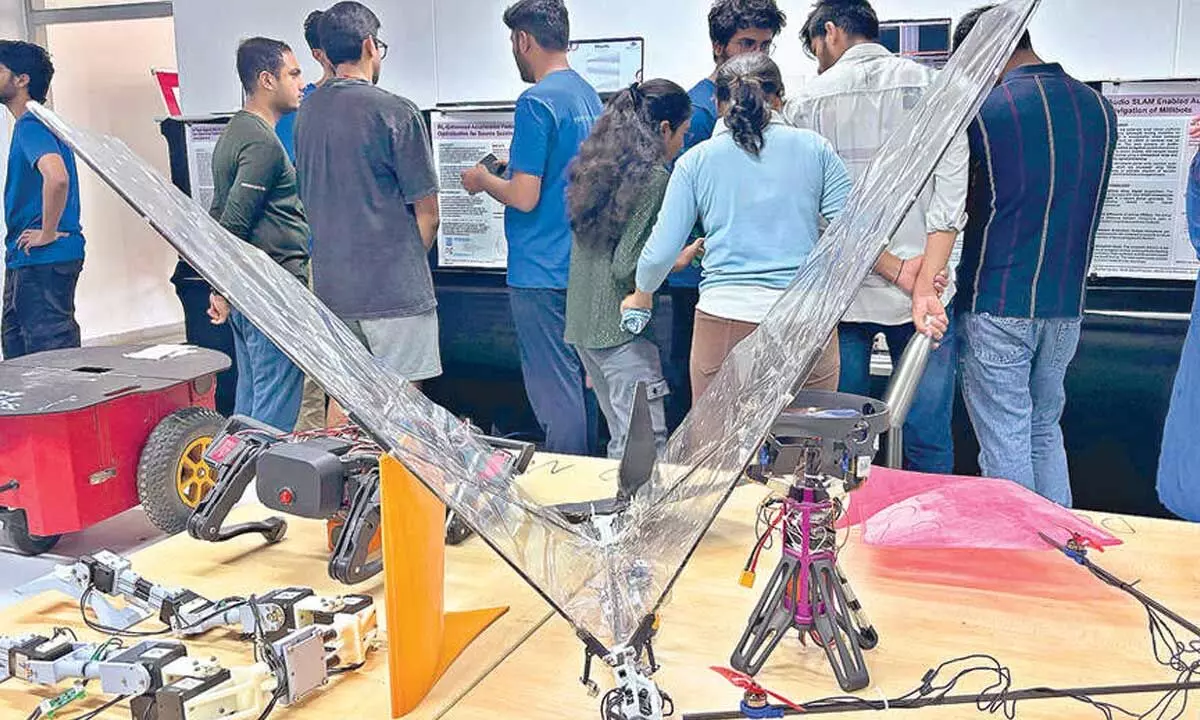
Visitors also witnessed robotics innovations such as flapping-wing robots and spin drones, along with architectural models demonstrating traditional earthquake-resilient housing systems from regions such as Himachal Pradesh, Rajasthan and Assam. These models illustrate how indigenous construction techniques and locally available materials were historically used to build structures capable of withstanding seismic activity.