Stick to facts about Waqf Bill, its utility


I refer to the Bold Talk column by V Ramu Sarma on 'Waqf bill: Reform or rhetoric' (Apr, 5). I fully agree with the views of the author that if the goal is justice and transparency, reforms are inevitable
I refer to the Bold Talk column by V Ramu Sarma on 'Waqf bill: Reform or rhetoric' (Apr, 5). I fully agree with the views of the author that if the goal is justice and transparency, reforms are inevitable. But if the goal is electoral arithmetic, then real progress will always be held hostage by political theatrics. Uncharitable remarks were thrown against Hindus and the BJP by the opposition. Why this persistent rhetoric against Hindus? Waqf board has had sweeping powers. It can claim any property as its own without any document. This is unfair and unjust. Millennium old Hindu temples are claimed now as its property besides many villages. It defies justice. Waqf law is a Nehruvian law. The wrong done by the Congress government in 2013 for vote bank politics is now set right. Waqf is third in the country to hold properties next to Army and Railways. But the revenue generated is less and the properties are mismanaged. The bill assures accountability digitalisation and transparency and is for the betterment of the nation and poor minority people.
–Sravana Ramachandran, Chennai
***
A few aspects are still a challenge to understand. One clause for eligibility for Waqf (donation) to Waqf Board is a practicing Islam for five years. Who will give the certificate such a certificate? The due diligence of property as such lies with revenue department already. Women members are already existing in Board so what's new in it now? Property by possession and usage is a prevailing for the legacy properties wherein revenue documentations system was not robust so reconciliation of authority on property would be a challenge. The disputes of Waqf property probably would not be pressing priority for District Collectors who are posted for a few months to 2-3 years only and as such have to work swiftly on government schemes. Regarding 123 properties of Delhi, they have been with Muslim Board from Colonial era due to various settlements from 1913 to 1945. And government argument that UPA government gave them away to Waqf is half-truth. Arguments and counter arguments from both sides are loaded with half-truths, so for common man it is difficult to discover truth beneath their heap.
–Buddha Jagdish Rao, Visakhapatnam
“The Waqf (Amendment) Bill, 2025 has sparked intense political debate, with the ruling party championing reforms aimed at enhancing transparency and efficiency. Opposition parties have raised concerns about the bill's impact on minority rights, claiming it undermines the autonomy of Waqf properties and disproportionately affects the Muslim community. The Congress has described the bill as an attack on the secular fabric of the Constitution, framing it as a threat to religious freedoms. However, critics argue that the INDIA bloc are relying heavily on emotive rhetoric, rather than addressing the bill's specific provisions. For example, the inclusion of non-Muslim members in Waqf boards has been largely overlooked in their narrative. This approach reflects the opposition parties’ broader political strategy but also highlights the challenges of balancing principled opposition with substantive legislative critique.”
–Ganti Venkata Sudhir,
Secunderabad
***
The concept of ‘Waqf’ is nothing but an offshoot of personal law of a faith running roughshod over the secular credentials of the Indian constitution. The unnecessary and self-serving stirring of the hornet’s nest on account of the Waqf Bill is a direct manifestation of the favorite political game plan of minority appeasement the Congress which leads the opposition INDI Alliance. Ideally movable and immovable properties in India must either belong only to the government or Indians, irrespective of their faith. To label their ownership with the tag of faith is self-defeating and stands against development of the country in her entirety. In other words, manifestations of intrusion of faith into governance, which the Waqf is, must be substituted by a Uniform Civil Code.
–Dr George Jacob, Kochi
***
There was jubilations by a section of the community in different parts of the country as the Bill was being discussed in the Rajya Sabha that took the air out of the sails of AIMIM and AIMPLB which invited the cadres to protest against the proposed Amendments by protests. AIMIM leader Asaduddin Owaisi was so vociferous to the extent of undermining the Constitution, refusing to see the advantages as a result of changes being brought about in the Waqf Act – calling the Waqf properties as nobody's “father’s property” and vowing to teach lessons to the TDP and JDU for supporting the Bill. The Board sits on a treasure trove of wealth at its disposal without it being properly utilised for constructive purposes for improving the lot of the poor. It was interesting that Rahul Gandhi who complains about not being allowed to speak in the House had been conspicuous by his absence during the Waqf debate in the Parliament, so also his sister, the new MP elected from Wayanad. This gave a mammoth disappointment to the Muslim League in Kerala, which was in the forefront extending support to any Congress contesting from Wayanad had been sorely disappointed.
–S Lakshmi, Hyderabad
***
How come the Union Home Minister speaks on behalf of Muslims when there is no Minister in their Cabinet for Muslims' problems or there is no MP from Muslims in BJP? As Vajpayee once said on the floor of Parliament that India was and is and would be secular, at least the present PM must realise that secularism is the undercurrent of cohesiveness of multiliguistic and multireligious pluralistic people of India. Someone might have said that the BJP's future will be toppled by Muslims but let me say that the horizon of anti RSS-BJP spans across secular Hindus, aggrieved minorities irrespective of religion and INDIA bloc and South that is aggrieved by language and education policy that drives a wedge between North and South. We are now not happy unlike in my childhood post-Independence when we had religious harmony barring the aura of partition. Surely, Supreme Court is a Constitutional Body and may deliver goods to the aggrieved minorities.
I am afraid that no Hindu should feel that they are looked down upon by
others but a lot many Hindus are secular to the core and peace loving except a few fundamentalists who must
change a lot to keep in pace with the Constitutional ethos.
–Dr T Ramadas, Visakhapatnam
***
Better late than never. Amending Waqf Board laws is welcome as the laws were made irrationally, and many people lost their properties - some of them committed suicide. Now the people who lost their properties on account of the Waqf Board laws should get back their properties. Appeasing the minorities has become a regular feature.
–K L Rao, Visakhapatnam
***
Introducing representatives of Muslim women, ordering an audit of the accounts of Waqf by the CAG or a designated officer are welcome steps. At the same time what necessitated the central government to introduce non-Muslim people in the Waqf Board? Also removing the provision empowering the Waqf Board to inquire and determine if the property is Waqf and authorising District Collectors to determine whether the disputed property constitutes Waqf or not is a kind of violation of minority rights. Too much intervention by government in minority religious trusts is opposed by Muslims and the opposition. The government must find amicable solutions to solve these issues.
–P Victor Selvaraj,
Tirunelveli
***
The Bill will bring enormous change in the lives of people as accountability, transparency and community’s tangible control over the management will usher in a new dawn for the Muslim friends who have been kept away from by the handful of people who are the helm of things in the Waqf Board to call the shots, so far. The tone and tenor of the Opposition against the Bill was unfortunately one sided, without looking at the merits and advantages the changes would bring to Waqf Boards in the country whose income is grossly understated. The Waqf lands are being sold to private entities with no holds barred. There is rejoicing in the country by sections of people whose lands have been usurped by the Waqf Board in several parts of the country to the tune of several thousands of acres, like in Munambam in Kerala, where 200 families are protesting against Waqf’s highhandedness. They have since withdrawn their agitation.
–K V Raghuram, Wayanad
***
It is surprising that while the Muslim educationists are welcoming the Waqf Amendment Bill, understanding the need for transparency, the political opponents of ruling party in India are blindly opposing it with their inadequate knowledge, selfishness and also treason. The population of misguided, misinformed and illiterate people have to wake up and have a glance at the truth and co-operate with the well-informed population. This is the need of the hour.
–M Chandrasekhar, Kadapa AP
***
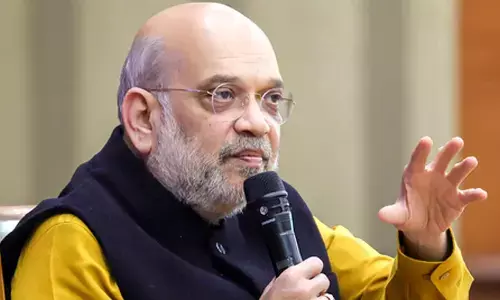
The Union Home Minister explained convincingly, legally and constitutionally that nobody should have any issues due to the approved Waqf Bill. It is a practice for the political leaders to maintain their politics of differing with other party leaders. If a legally valid and approved document/bill is not accepted, then what is the fate of maximum number of illiterates of our country? They don't know how to read or write but know how to be peaceful and productive in their routine services. Another fact is, whenever our cricket team wins the World Cup, entire India welcomes including various political leaders. Irrespective of creed, caste, religion, region, status etc., all show joy and celebrate it. It is a humble request to all parties that all the legally and constitutionally valid bills and documents shall be executed for the benefit of a large in an amicable way.
–G Murali Mohan Rao, Secunderabad