Heavy Inflows Boost Water Levels at PJP Dam and Almatti Reservoir; Authorities Regulate Outflows to Prevent Flooding

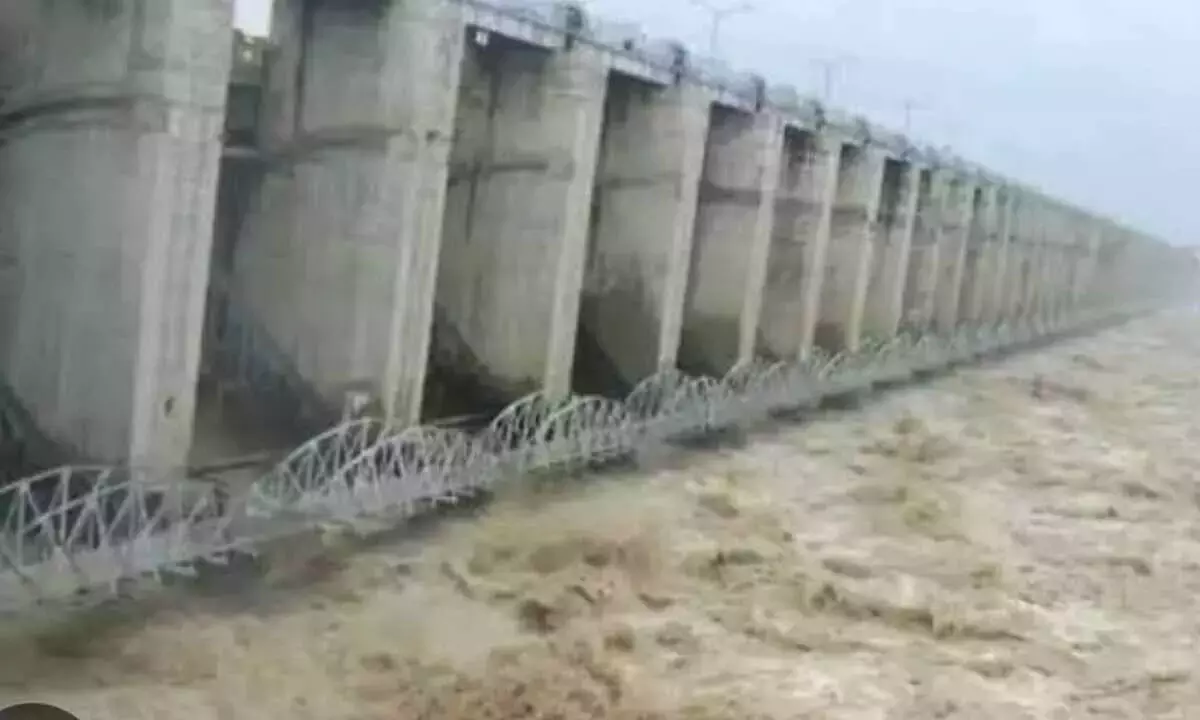
Gadwal: With the onset of continuous upstream rainfall and increased inflows into the Krishna river basin, water levels at the Priyadarshini Jurala Project (PJP) dam and Almatti Reservoir have shown significant rise, prompting dam authorities to regulate outflows carefully.
PJP Dam Status as of 6 PM, July 11, 2025:
According to information received from project officials, the water level at the PJP dam stands at 317.570 meters (1,041.896 feet). Against its Full Reservoir Level (FRL) of 318.516 meters, the gross storage is recorded at 7.778 TMC, while live storage is 4.071 TMC.
The dam is currently experiencing a massive inflow of 1,09,000 cusecs, as reported at 6 PM. To manage this, the authorities have opened 10 spillway gates, releasing 67,310 cusecs downstream.
Additional regulated outflows include:
Powerhouse Discharge: 30,316 cusecs
Evaporation Loss: 44 cusecs
Lift Irrigation Schemes:
Nettampadu Lift: 750 cusecs
Bhima Lift-I: 1,300 cusecs
Koilsagar Lift: 315 cusecs
Main Canal Releases:
Left Main Canal (LMC): 770 cusecs
Right Main Canal (RMC): 460 cusecs
RDS Link Canal: 150 cusecs
Parallel Canal: 800 cusecs
Bhima Lift-II: 750 cusecs
Total outflow from PJP is now calculated at 1,02,065 cusecs, which is slightly lower than the inflow, indicating a marginal net storage gain in the reservoir.
Almatti Reservoir Status:
Further upstream, the Almatti Reservoir, one of the major dams on the Krishna River located in Karnataka, is also witnessing a surge in water levels.
As of 6 PM on July 11, 2025, the reservoir level is at 517.40 meters, close to its Full Reservoir Level (FRL) of 519.60 meters. The gross storage currently stands at 89.534 TMC, which is 72.74% of its total capacity (123.081 TMC at FRL).
Over the past 10 hours, the average inflow into Almatti has been 1,07,389 cusecs, while the average outflow has remained at 1,00,000 cusecs, all of which is being let out to the downstream Krishna River.
Implications and Precautions:
The consistent rise in inflows is attributed to upstream rainfall in Karnataka and Maharashtra. With major projects in the Krishna basin filling up rapidly, officials are maintaining vigilance and issuing alerts to downstream regions to remain cautious, especially in low-lying areas.
Irrigation engineers and district administrations are closely coordinating to monitor inflows, regulate gate operations, and ensure that the downstream water distribution to irrigation canals and lift schemes is done safely.
Farmers across the Jogulamba Gadwal, Narayanpet, and Mahbubnagar districts are expected to benefit from improved irrigation availability. However, emergency teams remain on standby as a precaution against any potential flood-like situations if rains intensify further.