CM Naidu dreams big on Amaravati

Vows to complete capital works by 2028 and Polavaram by 2027
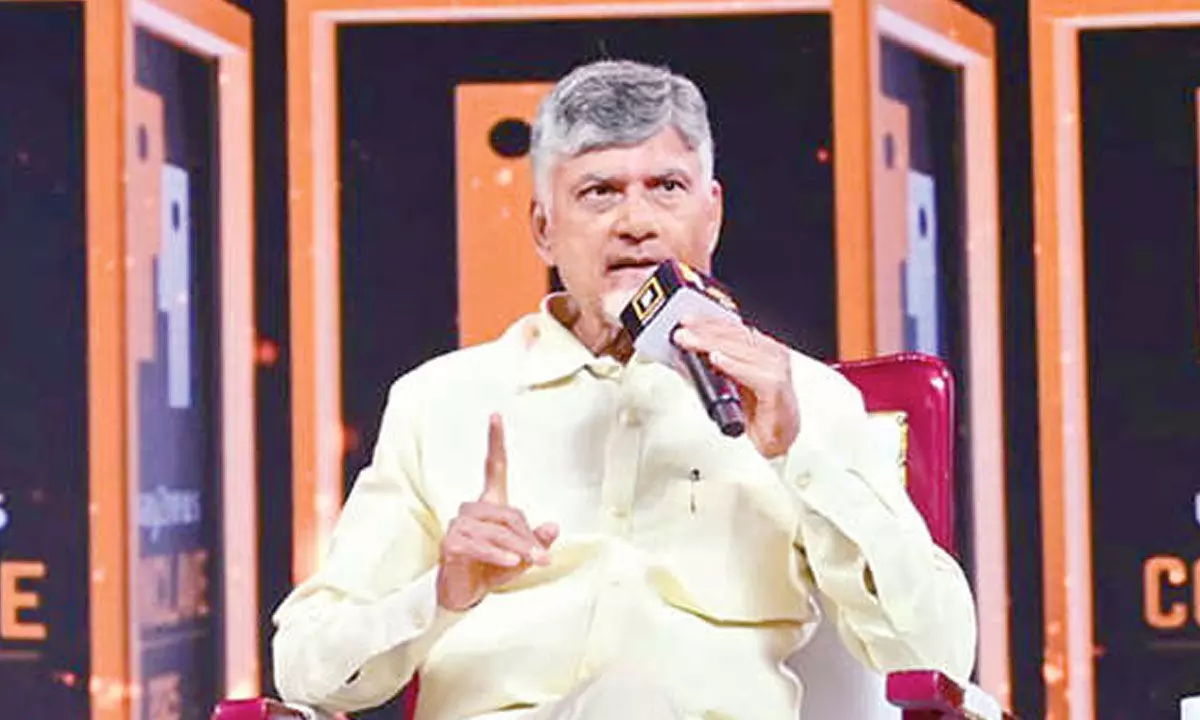
Amaravati: Chief Minister N Chandrababu Naidu on Friday asserted that all works taken up in Amaravati will be completed in the next three years, including infrastructure projects worth Rs 50,000 crore.
Speaking at a conclave here, the Chief Minister reaffirmed that Amaravati farmers who had given up their lands for Amaravati would not suffer loss as Amaravati will be developed as a global city. Citing the example of Hyderabad, the Chief Minister said that before HI-TEC City was developed, the land cost there was Rs one lakh per acre and now it would cost Rs 100 crore per acre. “Similarly, if we fail to develop Amaravati by taking additional land, it will remain as a small municipality,” he said.
The Chief Minister expressed his confidence that the state capital's infrastructure would be ready by 2028 and reiterated that Prime Minister Narendra Modi would inaugurate and dedicate Amaravati to the nation. Chandrababu Naidu exuded confidence that the Polavaram Project will be completed by 2027.
Once these objectives are achieved, he claimed, the “private sector will pick up from there on a massive scale”, paving the way for a knowledge economy with colleges, universities and other centres.
The Chief Minister emphasised the need to not only possess a vision but also work towards making it a reality.
Significantly, taking a broader view of India’s growth story, the Chief Minister said: “India has been witnessing unstoppable economic development with the economic reforms introduced by former Prime Minister PV Narasimha Rao”.
In the context, Naidu highlighted that both the national-level 'Viksit Bharat 2047' and the state-level 'Swarnandhra 2047' visions have been driving the state. The State government has been implementing Swarnandhra vision 2047 for the benefit of future generations.
He said the vision was aimed at placing the state in first position over the coming 22 years.
Naidu detailed the state government's economic plans, which are structured with annual targets. He mentioned that the state achieved double-digit growth last year. Presenting specific economic projections, he stated that the state aims to achieve a GSDP of Rs 29,29,402 crore by 2028-29 and Rs 57,21,610 crore by 2029-34. This includes the targets for reaching a per capita income of Rs 5,42,985 by 2028-29 and Rs 10,55,000 by 2029-34. Naidu affirmed that these goals are not impossible, as the related plans are backed by a clear vision. He stressed the importance of having "mega dreams" and the determination to achieve them.
The Chief Minister underscored the necessity of pursuing both welfare and development simultaneously in a country like India. He explained that in Andhra Pradesh welfare is being delivered through the ‘Super Six’ schemes, while significant funds are also being allocated for development.
Referring to the Polavaram-Banakacharla link canal, the Chief Minister said that the situation has changed in the Rayalaseema region with the operation of Handri-Neeva project and today Anantapur district stands out in GSDP when compared to Godavari districts with the encouragement of horticulture. He said that the government proposed the Banakacharla to utilise the excess water of the Godavari River which was otherwise flowing waste into sea. He said the linking project will benefit farmers in a big way.
Condemning the false campaign of YCP on medical colleges, the Chief Minister said that there was no question of handing over medical colleges to private parties. The state government had decided to develop the colleges on PPP mode for the benefit of medical students and to improve health services, he added.
Naidu stated that while politics is important, one must also think about society. He cited the development of Hyderabad and the implementation of power sector reforms as examples of decisions made by prioritizing the future of the state over political considerations.
Without specifying, he recalled making “difficult decisions” in 1994 and winning in 1999. After coming to power in 1999, he worked with great zeal but felt he couldn't achieve a complete balance. "But now we are achieving a complete balance—creating wealth and delivering it to the poor," he said.