India set for eSIM revolution in telecom technology space

From smartphones to IoT, embedded SIMs are redefining security, convenience, and global telecom strategies
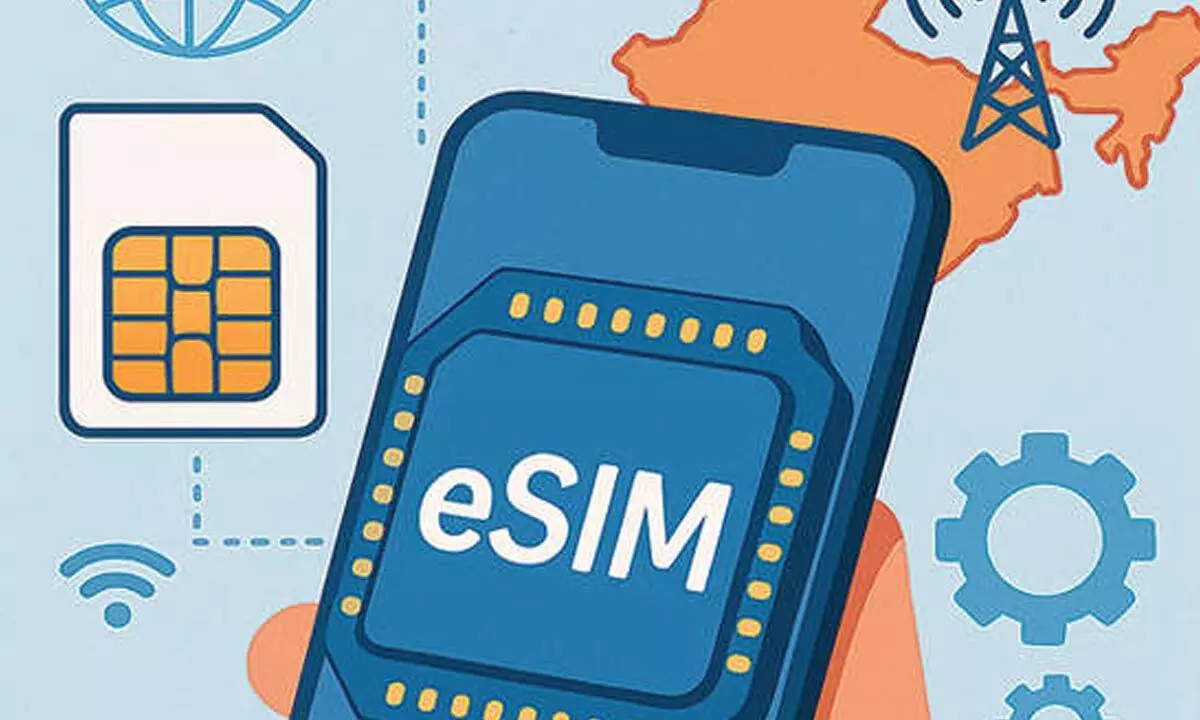
The embedded SIM (eSIM) is a form factor that is physically integrated via surface-mount technology directly to the device mother board, fully encased in the device. The eSIM (Digital SIM) cannot be easily removed in the field. As a result the eSIM requires remote provisioning with the ability to remotely select the SIM profile deployed on the SIM, without physically changing the SIM card.
eSIM technology is a disruptive innovation. GSMA (Global System for Mobile Communications Association) released specifications for eSIM in March 2016. Most flagship devices manufactured since 2018 that are not SIM locked, support this technology. One common physical form factor of eSIM is designated as MFF2 (Miniaturised Form Factor 2), measuring about 6 mm x 5 mm. The eSIM chip is half the size of the smallest physical SIM card, allowing phone designers to use space for other applications. It is ideal for compact devices. By 2025, 98 per cent of mobile network operators are expected to offer eSIMs.
eSIM and embedded Universal Integrated Circuit Card (eUICC) are often used interchangeably, even though there is a difference between the two. The eSIM is the hardware component of the SIM and a physical form that can be soldered into the device. eUICC refers to the software component of eSIM that provides the capacity to store multiple network profiles that can be provisioned and managed Over-the-Air (OTA). ICCID (Integrated Circuit Card Identifier) is the key used to identify profiles and eUICC-ID (EID) is used as the unique key to identify the eSIM. eSIMs support 5G.
eSIM for M2M Communication
SIMs for the purpose of M2M (machine to machine) communication are embedded (integrated/soldered) in the device (sensors, trackers, cellular modules, meters and other industrial non-end-user devices) at the point of manufacturing in order to achieve the standard physical and environmental requirements and are deployed in domestic or international markets. The GSMA eSIM specifications were developed specifically for the M2M market where deployed devices have a long lifetime and/or deployed in locations where physical SIM replacement is not practical. An M2M eSIM is a specialized version of eSIM technology designed for the unique needs of IoT (Internet of Things) and M2M devices. Key differences between M2M eSIM and consumer eSIM (used in smart phones, wearables like smart watches, tablets and computers) are a Push model for profile management via remote Subscription Manager (SM) servers, typically preloaded profiles for quick deployment and robust security which are the features of M2M eSIM. M2M eSIMs and consumer eSIMs follow SGP.02 and SGP.22 specifications respectively.
Advantages of eSIM
eSIM offers instant SIM less activation and improved security. It makes it easier for users to track their stolen smart phones as eSIM can’t be removed whereas physical SIM can be removed from the smart phone by the thief. The risk of damaging a SIM socket’s delicate contacts, while inserting and removing a physical SIM is eliminated. eSIMs have cost-efficiency and improved durability against environmental factors like corrosion, compared to traditional removable SIM cards. Mobile users need not buy a new SIM while changing the Service Provider and so the MNP process will be easier. eSIMs provide cost savings when travelling internationally. One can switch to a local Telecom Service Provider (TSP) when travelling internationally, avoiding expensive roaming charges. eSIMs enable TSPs to expand their business into emerging markets, such as automotives, wearables and consumer electronics. It eliminates SIM card distribution costs. With eSIMs, it becomes easy for the TSPs to provide service from the central location. eSIMs reduce plastic usage and so are eco-friendly.
BSNL eSIM services
Recently BSNL soft-launched its eSIM services in the Tamil Nadu circle. Already Jio, Airtel and Vodafone Idea are commercially offering these services. eSIM service will enable customers to activate mobile connections without a physical SIM on compatible smartphones and wearables. BSNL will roll out the eSIM services nationwide in a phased manner. The eSIM will enable remote provisioning via secure QR code. It can be used alongside a physical SIM in supported devices. The service works in leading devices, including recent models from major OEMs (Original Equipment Manufacturers).
Customers can visit the nearest BSNL customer service centre with an eSIM capable device and valid ID. BSNL staff will complete digital KYC and issue a one-time QR code to the customer to download the eSIM profile. Existing customers also can migrate from physical SIM to eSIM.
TRAI recommendations on eSIM
The Department of Telecommunications sent a reference letter dated September 11, 2011 to TRAI requesting to provide its recommendations for holistic deployment of eSIM in Indian Telecom Network including implementation mechanism under different profile configurations and switch over of profiles by TSPs. TRAI gave its recommendations on the use of eSIMs for M2M communications/ for consumers on March 21. One of the recommendations is that all communication profiles on any M2M eSIM fitted in an imported device on international roaming in India should be mandatorily converted/reconfigured into communication profiles of Indian TSP within a period of six months from the date of activation of international roaming in India on such M2M eSIM or on change of ownership of the device, whichever is earlier. The authority also recommended that the switch-over of the communication profile on M2M eSIMs from one TSP to another TSP should be driven by the concerned OEMs of the devices containing M2M eSIMs.
Regarding consumer eSIMS, at present there is no guideline allowing transfer of profiles from one eSIM capable phone to another eSIM capable phone. In the case of physical SIM, this scenario is possible as a customer can remove the SIM card from his old mobile phone and insert it into a new mobile phone. In the interest of consumer convenience and to prevent frauds, there is a need for a standard process for transfer of profiles from one eSIM capable phone to another eSIM capable phone, assuming that there is no change in the KYC details. The authority recommended that the government, through Telecom Engineering Centre (TEC), examine the possibility of devising a standard process for device-to-device transfer of profiles on consumer eSIMs.
Way Forward
Hope BSNL eSIMs will be available pan India shortly. There is a lot of demand for BSNL eSIMs and already some customer base has been eroded to BSNL because of non availability of ESIMs. BSNL should ensure its availability at all its outlets.