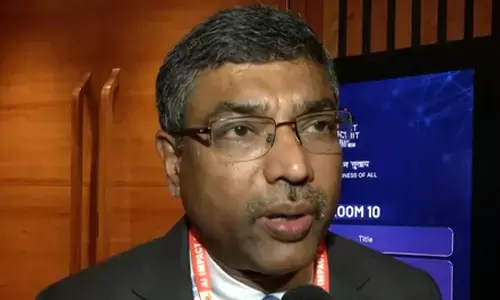
As V-P, Radhakrishnan must restore faith in office of RS Chairman


Elections are no longer a zero-sum game. Last year, the Bharatiya Janata Party-led National Democratic Alliance was happy to have won the general poll third time in a row; and the Congress was happy for almost reaching the three-digit mark. Now, the NDA is celebrating the victory of its candidate C P Radhakrishnan’s win to become the next Vice-President; and the grand old party is jubilant that it has an “arithmetical victory” but “moral and political defeat” for the ruling party.
Congress communications in-charge Jairam Ramesh pointed out in a social media post that Opposition INDIA bloc’s joint candidate, former Supreme Court judge B Sudershan Reddy, got 40 per cent of the vote, as compared to 26 per cent in 2022. Radhakrishnan got 452 valid votes, whereas Reddy received 300. Ramesh had claimed that there was “100 per cent turnout” of 315 Opposition MPs; this suggests Reddy got fewer votes than expected. It may be mentioned here that in the V-P polls, MPs are not restrained by any party whip, so they vote in secret as they want to.
Now that politicians cutting across party lines are cheerful, they should strive to make politics less toxic. As ex-officio Chairman of the Rajya Sabha, Radhakrishnan can play an important role in making that happen. His predecessor, Jagdeep Dhankhar, has not left behind a stellar legacy; he was widely seen as a partisan of the government, which is a devastating denunciation of a person who is expected to be impartial. Worse, he will be remembered as such. This is evident from the fact that even as pundits speculate on the reasons for his sudden resignation from the scene, none of them are lamenting his exit per se.
Dhankhar’s tenure was marked by frequent confrontations with the Opposition and by allegations that he acted more as an extension of the government than as an impartial referee. In Indian parliamentary traditions, such a perception is deeply damaging, for it corrodes the credibility of one of the highest constitutional offices.
The challenge before Radhakrishnan is not just administrative; it is also moral and political. Also, the challenge ahead is unambiguous. He must restore faith in an office that demands impartiality and commands respect across party lines. It is a well-known fact that Radhakrishnan is an RSS man. In the Rajya Sabha, he has to ensure that his belief in Hindutva doesn’t cloud his judgment and conduct as House Chairman.
The House of Elders was envisioned as a chamber of reflection, where calm deliberation and meaningful debate balance the passions of the Lok Sabha. In recent years, however, it has too often been reduced to noisy confrontation, marked by acrimony and political brinkmanship.
Radhakrishnan’s foremost responsibility will be to ensure that this critical institution regains its stature as a forum for reasoned dialogue.
To achieve this, he will need to encourage healthy debate, allow diverse voices to be heard, and prevent the House from becoming a battleground of unproductive partisanship. His conduct, words, and rulings will set the tone.
The political climate in India today is deeply polarised, with mistrust between the government and the Opposition at an all-time high. In such an atmosphere, the role of the Rajya Sabha Chairman assumes extraordinary significance. If Radhakrishnan succeeds in steering the House toward civility and fairness, he could play a transformative role in strengthening parliamentary democracy itself.