Poetry Charged With Evocative Images

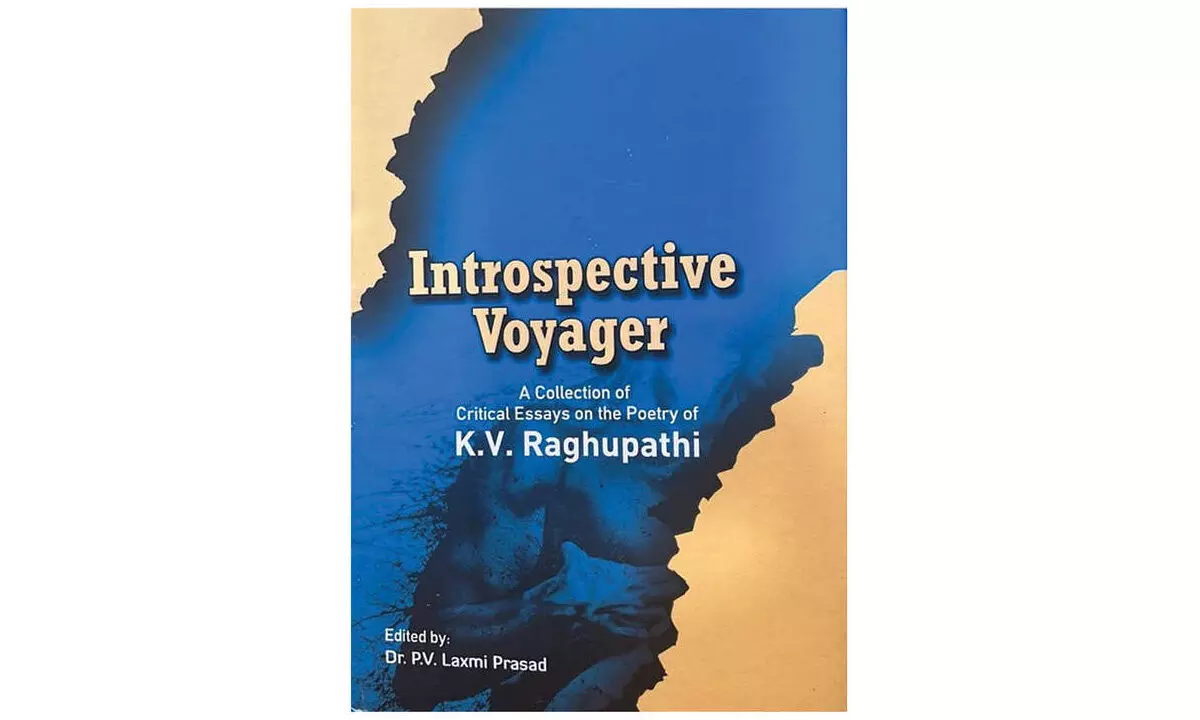
Reviewing any genre of literature is an art that requires a lot of creative effort
Reviewing any genre of literature is an art that requires a lot of creative effort. However, when a literary reviewer takes up the daunting task of analysing books in literary criticism, they must be ultra-cautious and ultra-sensitive. The elegant book ‘Introspective Voyager’, edited by eminent author PV Laxmiprasad, reflects on the different facets of the poetry of KV Raghupathi and emerges as a great classic in the genre.
KV Raghupathi is a notable Indian poet who cherishes Indian sensibility, ecology, transcendental philosophy, and spirituality through his poems. The book discusses almost all the aspects explored by the poet in his volumes. One of Raghupathi’s notable qualities is his insatiable thirst for understanding the various manifestations of the world, and he engages himself in interpreting the mysteries behind the happenings of the universe. His search for knowledge has become a favourite theme of this anthology. He is a committed writer with strong social values. According to T.V. Reddy, Raghupathi’s poetry is charged with images that create a strong impact on the minds of readers, revealing his disenchantment with life — a feeling of aversion noted in many of his poems. In some of his works, the poet reveals his existential worldview and engages in deep philosophical reflections on life, encompassing spiritual, social, and psychological aspects.
His ‘Wisdom of the Peepal Tree’ brings out the spiritual and philosophical dimensions of life. According to critics, the tree answers all the prayers of the devotee-worshipper, who is none other than the poet himself. The tree holds a communion with the poet and offers him the wisdom of human nature and the knowledge of the human condition.
‘Desert Blooms’ is yet another evocative image, intensely rooted in death imagery, reflecting a longing for death and the obscurity of human life. ‘Desert Blooms: A Socratic Discussion’ identifies a conversation among three invisible souls who look at life from different angles. However, they fail to arrive at any conclusion, finding no solution to the problems of human life. What is projected is the voice of the poet — his arguments about human life and his philosophical reflections on existence.
‘Indian Sensibility in KV Raghupathi’s Orphan and Other Poems’ is a true representation of Indian culture and beliefs, as the poet expresses the life of the country with Indian images and similes. Raghupathi’s poetry reflects the search of an ambitious young man, confused by the complexities of the world, striving to establish his own identity. The poet demonstrates how materialistic life lacks meaning and disturbs the harmony of the human soul. Though he struggles to overcome materialism, its stronghold continues to disturb him. Yet, the poet ultimately surrenders himself to nature, finding a path to overcome materialism.
‘Wisdom of the Peepal Tree’ takes the reader along the poet’s journey towards the mysterious aspects of human life, offering knowledge that is sacred and noble, passed down through the ancients. The tree resembles the cosmos, existing since time immemorial. The poet explores the meaning of life and death through nature and reflects on the “enigma of human existence with Indian sensibility.”
The poet highlights the intrinsic value of Nature and the inherent worth of non-human others, ultimately discovering a path towards harmonious living in the world. Thus, the analysis reveals Nature’s manifestation as a divine force and captures Raghupathi’s unwavering faith in its transformative power. PV Laxmiprasad’s editorial skills are truly commendable.
This anthology is diverse in its selection of themes and caters to the intellectual thirst of readers.
(The writer is an eminent literary scholar and book reviewer)