Automated Tutoring: The Future of Personalized Education Assistance

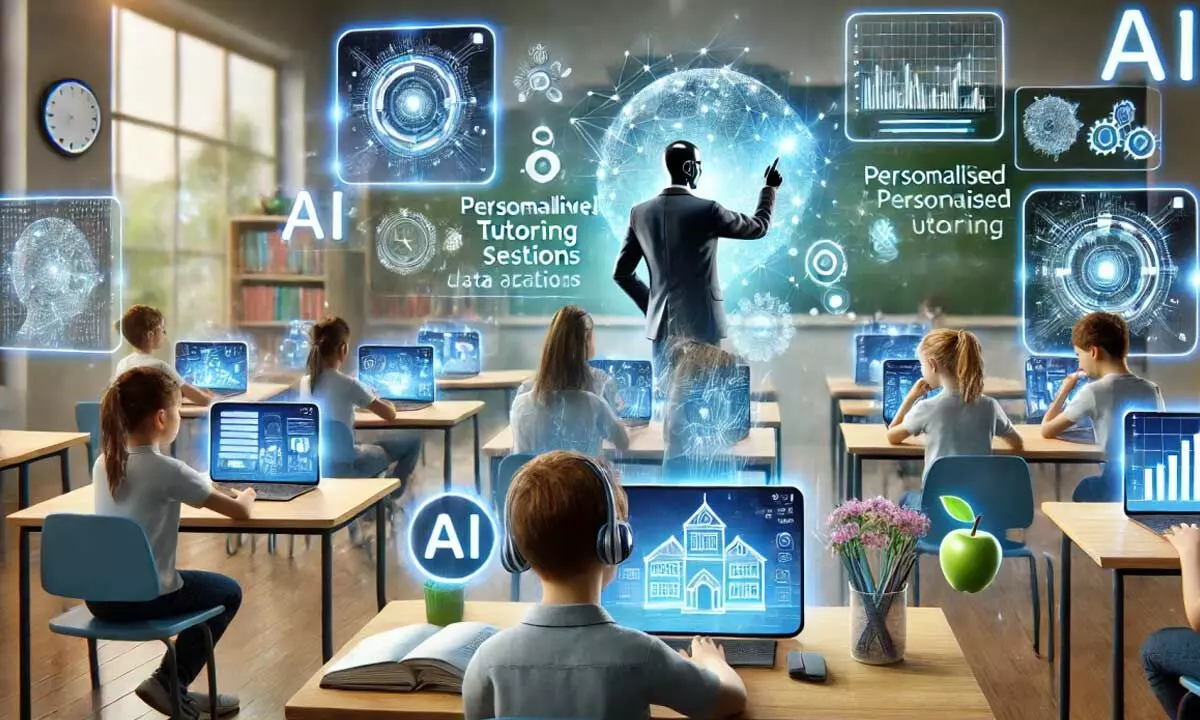
The onset of the pandemic, closely followed by the emergence of the world’s first AI language models, was a significant milestone for humankind.
The onset of the pandemic, closely followed by the emergence of the world’s first AI language models, was a significant milestone for humankind. The global lockdowns played a critical role in democratising education with the advent of digital learning, and the subsequent emergence of Large Language Models (LLMs) supported this shift with unprecedented innovation. Since then, unprecedented advancements in AI technology have also transformed the scope of work for the education domain, and AI-driven automated tutoring and personalised education have become the focus. This paradigm shift represents the global bid to address accessibility, cost-efficiency and location challenges for learners, bringing millions of students under a single umbrella that caters to their educational requirements.
This comprehensive shift towards adopting automated tutoring through AI has led to significant benefits, as a recent study by a globally acclaimed university suggests that AI tutoring helps students to learn more than twice that of their conventionally tutored peers. Furthermore, automated AI tutoring essentially brings a global knowledge bank to students, while also catering to their learning requirements irrespective of challenges. While Intelligent Tutoring Systems have been the focus of a massive development effort over the past several decades, the infusion of AI models, and their text-to-image, voice-to-text features have been driving automated tutoring’s development worldwide. However, while AI tutoring is not expected to completely replace human intervention anytime soon, it may become an integral part of the learning process — transforming the future of personalised learning as we know it.
Overcoming Challenges
The transformation of personalised education through automated AI-driven tutoring is at a nascent stage of development. This developmental effort is being marred with two primary challenges — privacy concerns and bias.
To begin with, AI models require a significant amount of training through data feeding, which is imperative to create adaptive models that can complete permutations and combinations that can be promptly explained to the layman easily. As students interact with these models, AI models may collect and store the private data of learners for analysis purposes. However, this challenge can be addressed easily by integrating a requirement for consent to collect these highly personal data.
Furthermore, privacy concerns could be introduced through third-party stakeholders such as universities, or schools as well, who may deploy AI tutoring services for their students. In this scenario, the AI tutor will be required to collect data for more transparency, however, appropriate ownership of this data and a robust retention policy will be required for this aspect to become successful. Establishing frameworks and responsible usage benchmarks will be the critical enabler for the long-term success and scalability aspects of personalised education through AI-driven tutors and stakeholders will be required to enforce relevant policies that will ensure this.
Additionally, while it is naturally expected of AI tutoring to reduce bias, the reality will largely depend on the training and development phases of the model itself. Creators’ bias could be transferred to AI models through algorithms, which are often a result of the data used for training AI models. However, this could also be done from user-generated data, coupled with the aspect where societal and system bias seep in. However, this challenge is being promptly addressed by industry stakeholders, advancing AI tutoring to the next level.
Frameworks & Regulations
While some AI-based tutoring platforms are already functioning out there, their success will require the establishment of clear frameworks and robust regulations. This will be especially important since no holistic laws are present at the time for regulating AI-driven tutoring. However, the Federal Trade Commission (FTC) in the USA explicitly mandates fair use and transparency in AI. Throughout the world, there are calls for legislation that will regulate AI in the future, an aspect that is gathering more steam.
For instance, the US Department of Education has recently been urged to inculcate data privacy and data security aspects owing to the advancing state of technology. Industry sentiments closely align with this call, as student data may include highly personal aspects like thoughts, behaviour and individual characteristics, elements that may adversely impact learners going forward if used inappropriately. This is why setting clearly defined benchmarks to regulate and responsibly use AI-tutoring is becoming an era-appropriate concern.
Future Outlook
As the world embraces digital learning at the core of education, the integration of AI-based automated tutoring will become more prevalent globally. This paradigm shift closely aligns with the requirement to benchmark personalised education, as well as the related pedagogy and methodologies. The future of this comprehensive shift will redefine education as we perceive it, however, significant inroads will be required in the space before to ensure scalability. Industry stakeholders, including governments and the private sector. However, as the scope of education increases to address diverse issues like accessibility and affordability, AI tutoring will become an indispensable part of the global education space going forward and stakeholders across levels will be required to support this shift. (The author is Founder & CEO of GUVI Geek Networks)