Healthy Cities for Whom? Accessibility Holds the Key

Who truly benefits from healthy cities? Explore how accessibility holds the key to inclusive urban development, ensuring health, mobility, and essential services for everyone.
Authored by Archit Majumdar, Yes to Access Coordinator
The Association of People with Disability (APD)
A city that cannot be entered cannot claim to care.
Urban planning frameworks in India, ranging from master plans to building bylaws, have historically been conceived as top-down blueprints. They are designed for an abstract “average” citizen, a fictional body that walks, sees, hears, and moves without friction. This imagination systematically excludes the diverse realities of human bodies and mobilities, particularly those of persons with disabilities.
India’s adoption of the United Nations Convention on the Rights of Persons with Disabilities was formalised in the Rights of Persons with Disabilities (RPWD) Act, 2016, which positions accessibility as a core value in the design of public spaces. Yet, nearly a decade later, the promise of this legislation remains largely unrealised on the ground. The rationale for accessibility remains poorly understood by shopowners, service providers, and local authorities, a gap compounded by India’s vast scale, the challenge of retrofitting existing structures, and the sheer number of actors involved in shaping the built environment.
Accessibility in Healthcare
Nowhere is this gap more consequential than in healthcare.
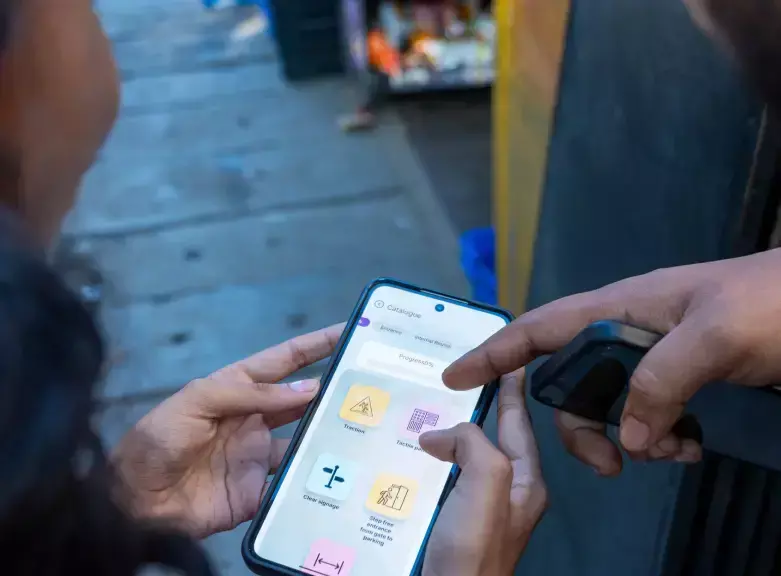
Accessibility in healthcare is ultimately a question of who is allowed to receive care independently and who is structurally excluded from it. Hospitals and clinics are meant to be places of relief, support, and survival. Yet for many persons with disabilities, their families, and caregivers, the barriers begin well before meeting a doctor or entering a waiting room. In Bengaluru, this tension is starkly visible in data captured by the digital public good Yes to Access app. Of the 680 healthcare-related locations audited, only 7 locations—just 1.03%—offer accessible parking. Tactile paths in parking areas are almost entirely absent. Signage paints a similarly grim picture: only 7 locations (1.47%) display accessible parking signage, while 469 locations (98.53%) have none.
Healthcare Access as a Right to the City Issue
The concept of the Right to the City, articulated by Henri Lefebvre and further expanded by Indian scholars such as Ananya Roy, Gautam Bhan, and Solomon Benjamin, argues that urban residents have not only the right to access the city, but also the right to shape it. In this framing, exclusion from urban infrastructure is not merely a technical failure; it is a democratic one.
In India, this right aligns closely with the constitutional guarantees of life and equality and is further codified in the RPWD Act, 2016. The Bangalore healthcare dataset, however, reveals how severely this right is affected in the absence of accessibility features.
The data highlights widespread deficiencies in universal design across healthcare facilities. Non-ambulatory access remains a significant concern, with 62.82% of locations lacking ramps. Onsite wheelchair availability is scarce: 384 locations do not provide wheelchairs, compared to only 85 that do. The environment is particularly hostile for persons with visual impairments, with 93.91% of locations lacking essential tactile paths.
Taken together, these are not design flaws; they are denials of agency.
When hospitals lack ramps, tactile guidance, signage, accessible seating, or clear circulation routes, individuals lose the ability to move independently or decide when and how to seek care. Accessibility becomes the foundation of autonomy, and its absence translates directly into exclusion from healthcare and from urban citizenship itself.
Closing the Gap Between Policy and Practice
Despite the existence of the Harmonised Guidelines and Standards for Universal Accessibility (2021) and the Accessibility Standards for Healthcare (2023) notified by the Ministry of Health and Family Welfare, the on-ground reality in Bengaluru reveals a persistent and troubling gap between intent and implementation.
India does not suffer from a shortage of policy. It suffers from a shortage of accountability at the point where policy meets pavement. Accessibility is still treated as an optional add-on rather than as essential infrastructure, rarely audited, weakly enforced, and easily deprioritised.
Yet the path forward is not out of reach. The growing visibility of accessibility audits, the rise of community-led data collection, and the insistence of persons with disabilities that they be heard are slowly reshaping public discourse. What was once dismissed as a niche concern is increasingly entering institutional conversations, design processes, and governance priorities.
Meaningful participation of persons with disabilities - through consultations, access audits, and co-design is not symbolic; it is essential. Public spaces, especially healthcare facilities, must be shaped by those who navigate them daily with constraint and resilience.
This shift aligns with India’s broader commitment to universal accessibility. At the 2nd World Social Summit, in a session titled “Breaking Barriers, Building Inclusion Through Yes to Access,” Ms. Manmeet Nanda, Additional Secretary, Department of Empowerment for Persons with Disabilities, underscored the need to place universal accessibility at the centre of how public and private institutions plan, build, and operate. Her remarks reflect a growing national recognition: accessibility must move from the margins to the mainstream.
Accessibility is ultimately a question of what kind of city we choose to build. A city designed only for speed, efficiency, and the able-bodied inherently excludes. A city designed for its most vulnerable produces dignity for all.
When healthcare spaces become accessible, they do more than comply with law, they restore agency, independence, and trust. The right to the city is not realised in policy documents alone, but in the simple, powerful moment when a person can enter a hospital, navigate it independently, and seek care without asking for permission.