Trump targets India

By targeting India economically, Trump demonstrated to Beijing that the US could turn its attention to any Asian power if it served American interests. This was regional signalling at its most deliberate. China would take note that even a US partner like India was not immune to pressure, which reinforced Trump’s reputation for unpredictability.
For decades, India and the United States have shared a trajectory that felt increasingly like a strategic partnership. Shared democratic values, growing defence ties, mutual concerns over China, and booming trade painted a picture of an upward relationship. That is why President Donald Trump’s aggressive targeting of India during his tenure, particularly through punitive tariffs and public criticism, raised eyebrows both in New Delhi and Washington.
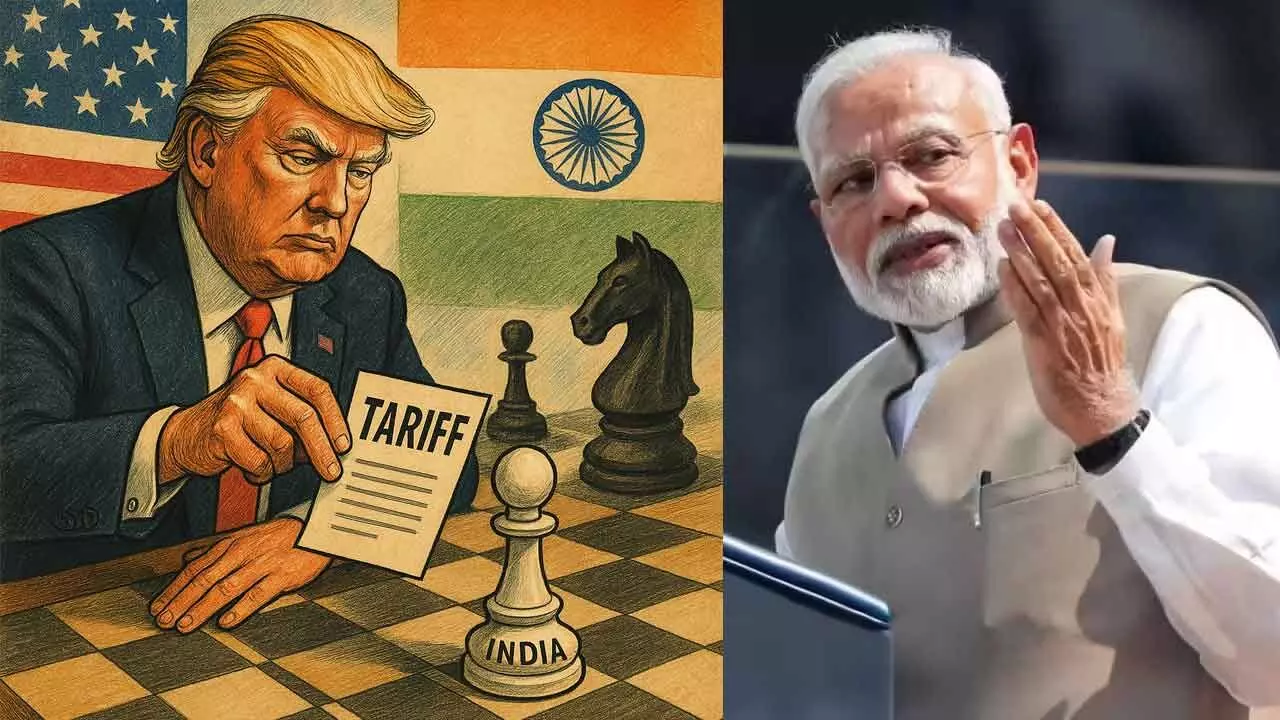
The easy explanation is Trump’s mercurial style. The harder, and more accurate, explanation is that his stance was a calculated geopolitical play. I see at least five clear strategic reasons behind this approach, all deeply connected to his “America First” doctrine, his transactional view of diplomacy, and the larger chessboard of global power.
1. Trade protectionism and the ‘America first’ doctrine:
Trump was elected on a promise to bring jobs back to America. That meant dismantling trade arrangements he saw as unfair, whether with China, the EU, or even long-standing partners like India. His administration’s trade team looked at numbers through a competitive lens. India’s growing export footprint, particularly in pharmaceuticals, IT services, and textiles, was not lost on Trump’s strategists.
The US has long enjoyed a trade surplus with many nations, but India was one of the few developing countries running a significant surplus against America. In Trump’s worldview, that surplus was America’s loss. The withdrawal of India’s preferential trade status under the Generalized System of Preferences (GSP) was not an impulsive act. It was a calculated signal that friendship did not guarantee special treatment.
High tariffs on steel, aluminium, and even niche exports like hand-crafted jewellery or specialty agricultural products were meant to create discomfort in specific industries. The idea was to make political and business leaders in India push their government to open more of the Indian market to US companies. It was economic pressure designed to shift the negotiation table.
Trump understood that in trade politics, perception matters as much as policy. He wanted the American voter to see a leader who would fight for them, even if it meant upsetting allies. That consistency in messaging made his stance on India entirely predictable, to those who understood his doctrine.
2. Containing a future economic challenger:
While China was Trump’s main target in the global economic rivalry, his advisors were not blind to India’s trajectory. The Indian economy, with its youthful demographic and expanding domestic market, had the potential to emerge as another formidable Asian giant within two decades. Pre-emptively shaping that rise was part of a long-term calculation.
History shows that the US often takes early steps to slow down competitors before they become too large to influence. This may take the form of trade barriers, sanctions, technology restrictions, or control over access to critical global markets. In Trump’s calculus, acting now meant shaping the rules of engagement before India’s economic clout matched its demographic weight.
By exerting pressure, he was sending a message not just to India but to other emerging economies that the US would not hesitate to act against those who could someday challenge its economic primacy. In this sense, India was not an immediate threat, but it is a future possibility that needed to be managed.
This approach also reflected Trump’s preference for dealing with partners from a position of strength. By putting India on the defensive early, the US could extract concessions more easily, rather than waiting until India was as powerful a rival as China is today.
3. Strategic signalling to China:
On the surface, pressuring India while confronting China might seem counterintuitive. Both Washington and New Delhi have strong strategic incentives to counter Chinese expansionism in the Indo-Pacific. Yet, Trump’s approach to foreign policy was rarely linear. He often believed in unsettling the board to keep all players guessing.
By targeting India economically, Trump demonstrated to Beijing that the US could turn its attention to any Asian power if it served American interests. This was regional signalling at its most deliberate. China would take note that even a US partner like India was not immune to pressure, which reinforced Trump’s reputation for unpredictability.
In the Indo-Pacific, perception often matters as much as action. By showing that the US could recalibrate relationships in unexpected ways, Trump added an element of uncertainty to China’s strategic planning. If Beijing thought it could predict American behaviour based solely on alliances, this tactic disrupted that assumption.
This kind of signalling also had a secondary purpose, reminding India that alignment with the US did not automatically guarantee immunity from American economic leverage. The subtext was clear: partnerships are conditional, and conditions can change quickly in a transactional framework.
4. The Pakistan factor and South Asian balancing:
No analysis of Trump’s India policy is complete without considering Pakistan. During Trump’s presidency, Washington was deeply involved in negotiations with the Taliban to end the long-running war in Afghanistan. Pakistan’s cooperation was indispensable in facilitating talks and influencing Taliban factions.
Trump’s public warmth toward Pakistan, including his earlier meetings with Prime Minister Imran Khan, more recently with Army Chief Asim Munir at the White House, were not sentimental; but a calculated carrot. The corresponding stick was applied to India, ensuring that the balance in South Asia did not tilt too heavily in New Delhi’s favour.
Historically, US–Pakistan relations have been marked by transactional exchanges - military aid, political backing, or strategic support in exchange for cooperation on specific issues. Trump applied this same logic. By keeping India under trade pressure, he maintained a level of parity in regional optics that made Pakistan feel its role was still valued.
From Trump’s perspective, keeping Islamabad engaged meant keeping the Taliban talks alive, which was a major foreign policy priority for his administration. For India, this dynamic was a reminder that US policy in South Asia is never solely about one bilateral relationship.
5. Bargaining leverage for strategic deals:
Trump’s diplomacy was built on leverage. To him, leverage often meant making the other side feel economic discomfort until they were more inclined to make concessions. India’s large and growing economy made it an attractive target for this approach.
The withdrawal of GSP benefits, the imposition of tariffs, and the public criticism were all part of a toolkit meant to push India toward agreement in other areas - defence purchases, energy imports, and greater market access for US firms. The logic was simple: if the cost of disagreement was high enough, India would be more open to negotiation.
For instance, while raising tariffs, the US was simultaneously pressing India to buy more American oil and liquefied natural gas. Defence deals for fighter jets, drones, and helicopters were on the table. The US was also pushing for greater access to India’s e-commerce and agricultural markets, sectors with enormous potential for American corporations.
Trump treated these as interlinked discussions rather than isolated issues. Pressure in one domain was meant to yield advantage in another. The strategy was not unique to India, but its application to a democratic partner was unusual enough to draw global attention.
Long-term implications:
Trump’s targeting of India created turbulence in the short term. New Delhi responded firmly by resisting tariffs, filing complaints with the WTO, and making it clear that strategic partnerships could not be leveraged purely through economic threats.
Yet, beneath the public disagreements, the fundamentals of the US–India relationship remained steady. Defence cooperation continued, the Quad initiative gained momentum, and backchannel diplomacy ensured communication lines stayed open. In a way, Trump’s pressure tested the resilience of the partnership.
However, the episode carries a cautionary lesson. If the US treats India solely as a competitor to be contained rather than a partner to be cultivated, it risks encouraging New Delhi to diversify its strategic options. This could mean deeper engagement with Europe, a recalibrated relationship with Russia, or even selective cooperation with China on trade matters.
India’s takeaway should be clear, strategic autonomy is not optional. It is the foundation of sustained influence in a world where alliances shift rapidly. Economic diversification, resilient domestic manufacturing, and the capacity to stand firm in negotiations are non-negotiable priorities.
The bigger Picture:
Trump’s punitive stance toward India is not a personal grudge or an emotional whim. It was a calculated extension of his worldview, one that is transactional, competitive, and unapologetically centred on American advantage. Every action, from the tariffs to the GSP withdrawal, fit into a broader pattern.
His objectives are multi-layered, extract more from partners, contain potential challengers early, maintain leverage over rivals, and send strategic messages to adversaries. In Trump’s eyes, the end goal was always the same: advance US interests without compromise.
India, for its part, must read this as a case study in future-proofing its foreign policy. The US will remain a critical partner, but partnership does not mean protection from pressure. National interest, not sentiment, must be India’s guiding principle.
In the great game of global power, emotional narratives are short-lived. Strategy endures. Trump understood that well. India must, too.
(The writer is the Chief Spokesperson of BJP, Chairman for Nation Building Foundation, and a Harvard Business School certified Strategist)