First Solar Eclipse of 2026 to Paint ‘Ring of Fire’ Across Southern Skies

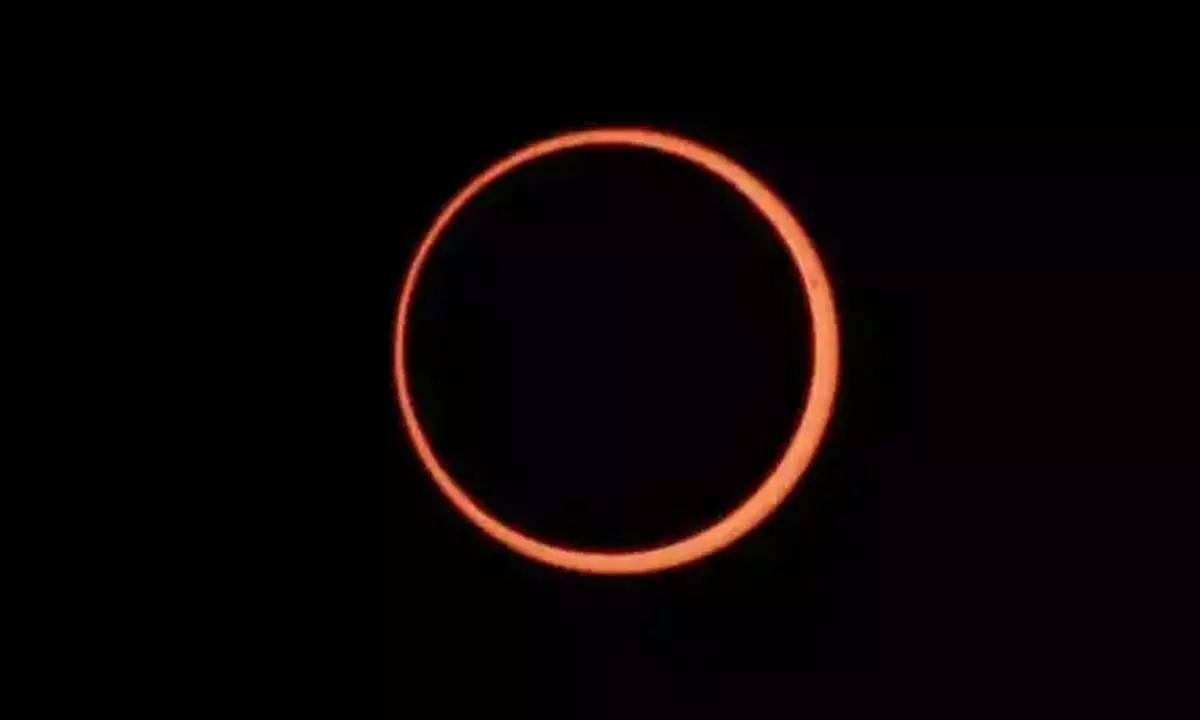
An annular solar eclipse will create a dramatic ring of fire effect, though India will miss today’s celestial spectacle.
The first solar eclipse of 2026 is set to captivate skywatchers today with a stunning “ring of fire” effect. This celestial event, known as an annular solar eclipse, occurs when the Moon moves between the Earth and the Sun but does not entirely block the Sun’s light. Instead of plunging regions into darkness, the Moon leaves a brilliant circle of sunlight glowing around its edges.
Unlike a total solar eclipse, where the Sun is fully obscured, an annular eclipse delivers a striking visual — a dark disc centered within a radiant halo. This happens because the Moon appears slightly smaller than the Sun during this alignment.
Why This Eclipse Creates a ‘Ring of Fire’
The reason behind today’s spectacle lies in the Moon’s elliptical orbit. The Moon does not travel around Earth in a perfect circle. At times, it is closer to Earth (perigee), and at other times it is farther away (apogee). For this eclipse, the Moon is near apogee, making its apparent size roughly 97 percent that of the Sun.
Because of this size difference, the Moon cannot fully cover the Sun. The result is a luminous ring encircling the Moon’s silhouette — a phenomenon that has fascinated astronomers and skywatchers for centuries.
This eclipse is part of the Saros cycle 121, a recurring series of eclipses that repeats approximately every 18 years, 11 days, and 8 hours.
Timings of the January 26, 2026 Eclipse
The annular solar eclipse will unfold over several hours. According to astronomical calculations, the partial phase begins at 3:27 PM IST. The annular phase — when the ring of fire becomes visible — starts at 5:14 PM IST. The maximum eclipse occurs at 5:43 PM IST, with nearly 92.7 percent of the Sun’s surface covered at its peak. The entire event concludes at 7:58 PM IST.
In certain locations along the path of annularity, such as research stations in Antarctica, the ring phase will last just over two minutes.
Where Will the Eclipse Be Visible?
The path of annularity is extremely narrow and primarily crosses Antarctica. However, millions of people across parts of the Southern Hemisphere will witness at least a partial eclipse.
Regions expected to see a partial solar eclipse include southern Chile and Argentina in South America, parts of South Africa, Mozambique, Madagascar, and several islands in the Indian Ocean. It is estimated that around 176 million people worldwide may experience some phase of this eclipse.
Why India Will Not See Today’s Eclipse
Skywatchers in India will not be able to observe this celestial event directly. By the time the eclipse begins, the Sun will have already set across the Indian subcontinent. Astronomy enthusiasts in the country can instead follow live streams provided by space agencies such as NASA and other observatories.
Essential Safety Guidelines for Viewing
Even though annular eclipses are less dramatic than total eclipses, they pose the same risks to eyesight. Looking directly at the Sun without proper protection can cause serious and permanent eye damage.
Experts recommend using ISO 12312-2 certified eclipse glasses for direct viewing. Ordinary sunglasses, tinted glass, or improvised filters like CDs are unsafe. Indirect viewing methods, such as pinhole projectors, are safer alternatives. Photographers attempting to capture the eclipse should use proper solar filters on cameras and telescopes and avoid pointing unfiltered lenses at the Sun.
More Celestial Events Ahead in 2026
Today’s annular eclipse marks just the beginning of an exciting year for astronomy enthusiasts. On March 3, 2026, a total lunar eclipse will turn the Moon a deep reddish hue as Earth’s shadow completely covers it. Later in the year, on August 12, 2026, a total solar eclipse will be visible across parts of Europe, Greenland, and Iceland.
As the cosmos continues its predictable yet awe-inspiring dance, 2026 promises several opportunities for skywatchers to witness rare and breathtaking astronomical events.