Waqf Act: SC’s question exposes union govt

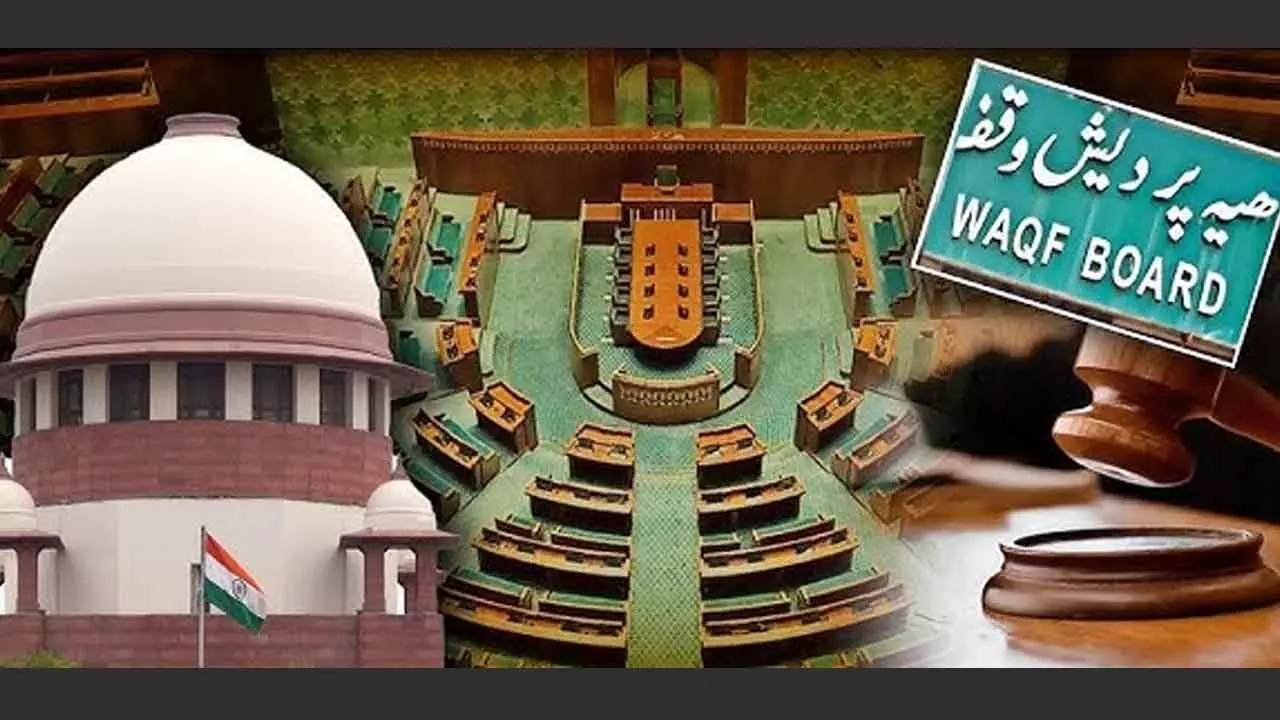
The Apex Court has rightly questioned in many issues to the Central Government, where the Government failed miserably to answer the Courts questions. The Supreme Court has signalled strong reservations about the Waqf law and hinting at interim stay on parts of Waqf Act- gave a huge relief to those who are opposing the Waqf Act. Government has no answer to “will it allow Muslims to be part of the Hindu endowment board?” The judge has rightly said that “When we sit here we lose our religion and just as Hindu religion Boards are managed by Hindus, so to Muslim institution reflect their religious composition. The main highlight of Supreme Court judgement was to pass an interim order that the properties declares by Waqf includes Waqf by user will not be denotified. Ordinarily Courts do not interfere when a law is passed but it will interfere when it feels that the case is an exception.
Now the comments passed by Supreme Court to Central Government and issuing an interim order is a slap on Union govt, which has hurriedly introduced Waqf Act, when crores of Muslims are opposing it and when there was widespread protest from opposition parties and Muslim groups. The Government was busy in boasting that many Muslim women has written letters to introduced Waqf Bill, which is a massive lie told by the government. It is good to note that the Supreme Court has directed that all members of the state Waqf Boards and the Central must be Muslims except the ex-officio members. So from now on it will be better on Central Government not to interfere in one’s religious matters and sentiments.
Zakir Hussain, Kazipet, Telangana
***
The Supreme Court has made some very pertinent observations in the Waqf Amendment Act 2025. Herefore, there had been a media blitzkrieg about how the Waqf Act 1995 needed to be amended, how unfair it was to the majority, how it had led to land-grabbing by the Muslims, etc. Despite the claims made by the ruling government to the contrary, there was never any academic discussion by distinguished scholars/lawyers on both sides of the divide in the media. All that was being said by nearly all TV channels was that Waqf properties ran into hundreds and thousands of acres and more land was in danger of being acquired (usurped) by the Waqf Board. Hence, in the interest of the nation, it was necessary to pass the Waqf Amendment Act, which the ruling dispensation did, by following due process.
However, all that it (the amended Act) did was to rub the minorities (Muslims) the wrong way, leading to a rash of petitions in the Apex Court. The learned judges of the Supreme Court, will, of course, separate the grain from the chaff very soon. Even though the final word of the SC is not yet out, one is tempted to refer to this quote by Mark Twain --”Whenever you find yourself on the side of the majority, then it’s time to pause and reflect”. I can’t help feeling that a lot of valuable time of the parliament has been wasted in debating this sensitive matter. It could have been resolved out of court by holding discussions with all stakeholders. And last but not the least, it is sad that it has exacerbated the schism between the two communities, with large-scale violence and mayhem over the issue.
Avinash Godboley, Madhya Pradesh
***
The Supreme Court of India hearing on 150 petitions challenging the validity of changes in WAQF Act. The Court observes keenly on the provisions requiring the nomination of non-muslims as members of the central Waqf Council and Auqaf Boards in states.
And asks openly about the will government enact a law allowing non-Hindus and Muslims to be members of Hindu religious endowment boards or Hindu religious institutions. And also quoted by Apex court that You can’t rewrite history or the past. Properties which are waqf by user and hundreds of years old can’t be reopened now and it will have huge consequences.
Dr. Ch. Anand Kumar, Movva, AP
***
The Supreme Court’s discussion on the Waqf Amendment Act 2025 is an opportunity to reinforce constitutional values—equality, secularism, and justice. This debate is a positive step toward preserving the Constitution’s spirit and ensuring fairness for all citizens. The Court has begun reviewing provisions, such as the Waqf Board’s authority to ‘de-notify’ or declare property as Waqf without judicial process, which requires balance with property rights and fair hearing principles.
The Court asked the Centre: Does this Act respect judicial process and equality? Its positive stance signals efforts to align contentious provisions with the Constitution, improving the law and fostering public trust. This reflects the judiciary’s strength and commitment to the Constitution.
Prof. RK Jain Arijeet, Barwani (MP)