TG’s Life Science Policy aims at $25bn investments

Designed to create five lakh jobs over five years
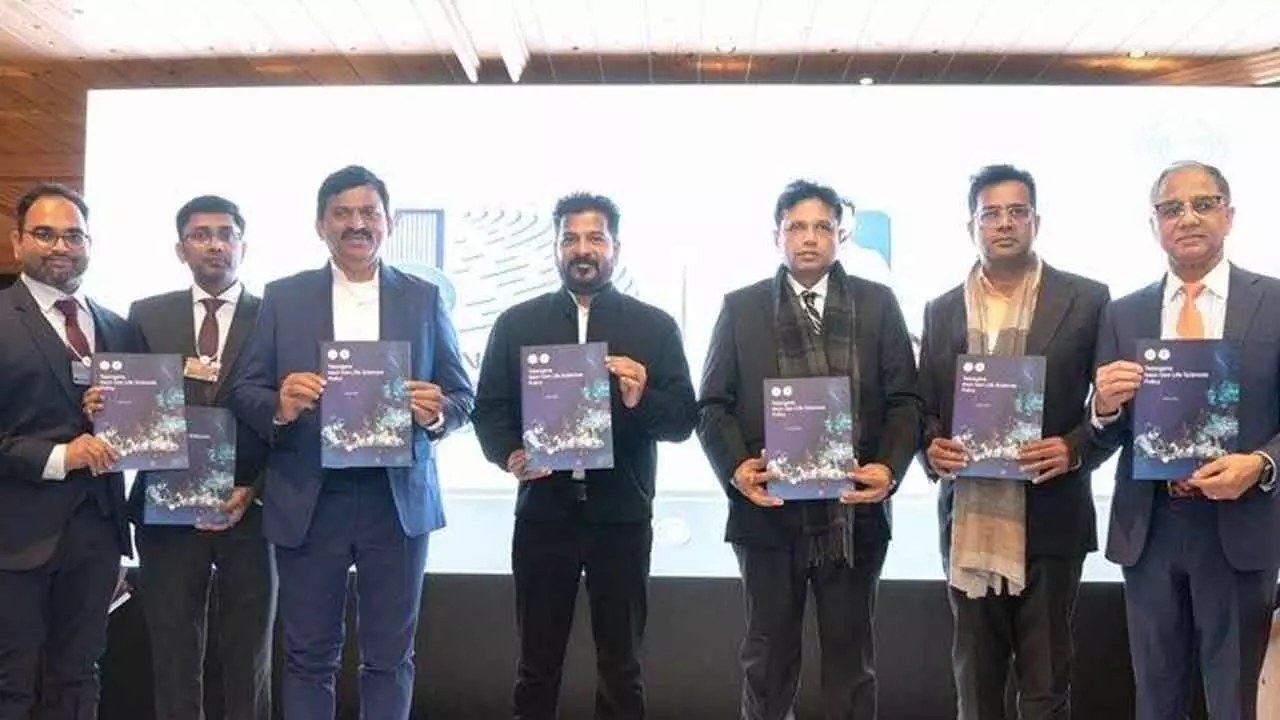
Hyderabad: The Telangana government has unveiled its ‘Next-Gen Life Sciences Policy 2026–30’ at the World Economic Forum annual meeting in Davos, aiming to attract investments totaling $25 billion and create five lakh jobs over five years. The policy highlights the establishment of 10 ‘pharma villages’ along the Outer Ring Road (ORR) and Green Pharma City as well as the expansion of the Genome Valley and the Medical Devices Park in the state.
Chief Minister A Revanth Reddy said: “We are building one of the world’s most trusted and transformational bioscience ecosystems—driving global health impact from Telangana. The policy’s global unveiling at Davos reflects Telangana’s conviction that the next phase of growth in life sciences will be driven by cross-border collaboration, global capital, and shared innovation agendas.”
“With a clear ambition to rank among the top five life sciences clusters worldwide by 2030, the policy targets $25 billion in investments, creation of 5,00,000 high-quality jobs, and deeper integration into global life sciences value chains”, the Chief Minister declared.
Under the policy, it is proposed to create world-class infrastructure in the state to support the full spectrum of life sciences value chain. The Green Pharma City would be a sustainable and integrated industrial cluster incorporating zero liquid discharge (ZLD), centralised waste management, energy-efficient systems, and net-zero practices. The 10 pharma villages, each spanning approximately 1,000 to 3,000 acres along the ORR, will promote decentralised, balanced, and inclusive industrial growth across the State.
The policy also envisages the expansion of the Medical Devices Park, with enhanced common infrastructure and plug-and-play facilities to support R&D and manufacturing in medical devices and diagnostics.
Further, the Chief Minister said, the government would establish a dedicated Life Sciences Innovation Fund with an initial corpus of Rs 100 crore, scalable to Rs 1,000 crore, structured through a public-private partnership model with co-investment alongside venture capital and private equity funds to support startups, scale-ups, and translational research initiatives. Ancillary Ecosystem Development is also mentioned in the policy, which talks of a strong and integrated ancillary ecosystem comprising suppliers, service providers, logistics partners, testing facilities, and specialised vendors to support the core life sciences industry and enhance overall sector competitiveness.