Buzz around Dhankhar resignation not good for NDA govt

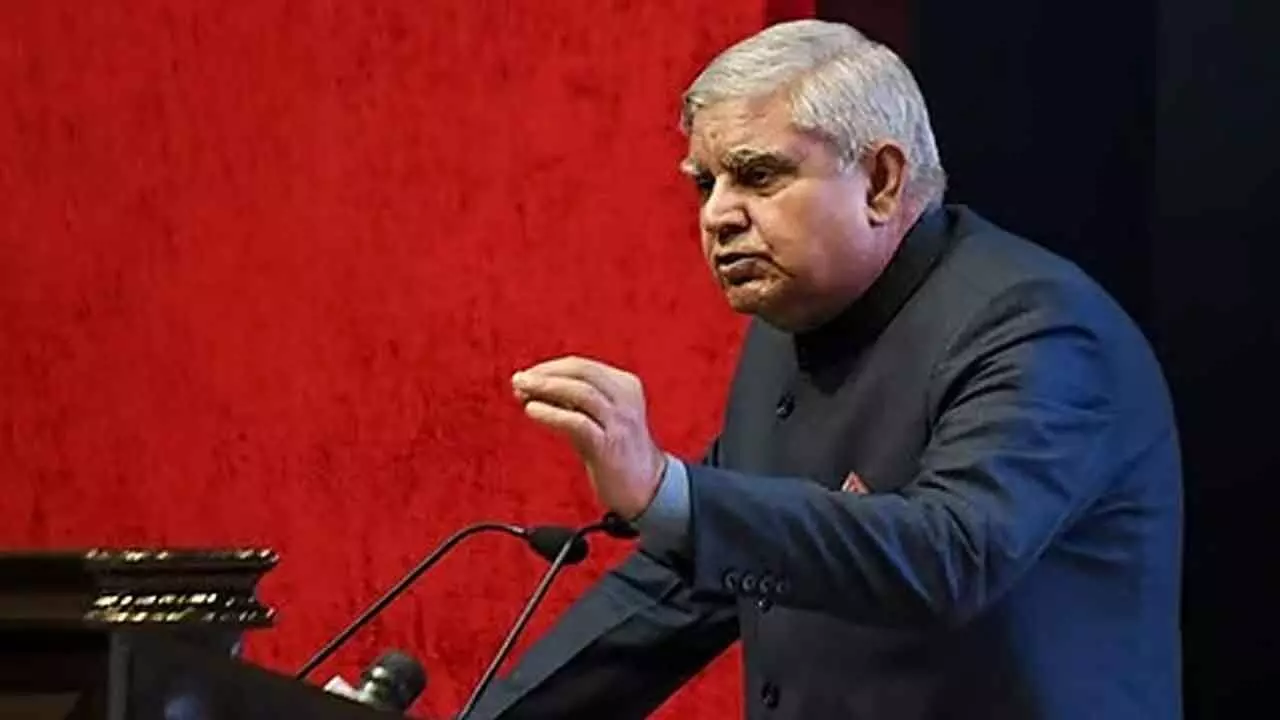
Jagdeep Dhankhar’s sudden resignation as Vice-President of India has thrown the political establishment into a whirlwind of speculation. Officially attributed to health reasons, the resignation has, nonetheless, triggered a host of alternative theories. The government’s response has been remarkably muted—limited to a terse acknowledgment from Prime Minister Narendra Modi on X. But behind the scenes, there appears to be far more than meets the eye. One dominant theory making the rounds is that Dhankhar’s acceptance of an Opposition-sponsored motion against Justice Yashwant Varma played a central role in his exit. This move reportedly angered the Bharatiya Janata Party-led National Democratic Alliance (NDA) with whispers of a possible no-confidence motion being used as leverage to force Dhankhar’s resignation. The chain of events unfolded rapidly, with his stepping down in what appears to be a politically calculated exit. To understand the implications of his resignation, four key points must be highlighted. First, the real reasons behind his exit remain shrouded in ambiguity. While the health excuse offers a convenient public explanation, the various accounts emerging from political insiders suggest a far more complex and possibly turbulent backstory.
Many of these narratives may be shaped by the agendas of those leaking them—be they disgruntled insiders, Opposition operatives or even strategic BJP functionaries. As such, caution is needed before accepting any one version as the definitive truth. Second, what’s evident is the triumph of realpolitik over principle. Dhankhar’s acceptance of the motion against Justice Varma—seen by many as a rare assertion of parliamentary independence—was met not with support but with swift retribution. This episode underscores the extent to which loyalty and conformity are prized within the ruling alliance, often at the cost of institutional autonomy. Dhankhar may have acted in accordance with parliamentary norms, or may have some other objective in mind, but his action was not in sync with the political sensitivities of his backers. Any slackness in loyalty angers those who matter—and there are consequences. Third, it is difficult to cast Dhankhar as a defender of democratic values, even if we accept that his final stand was principled. His record as Governor of West Bengal was marked by frequent clashes with the elected state government, with critics accusing him of undermining federal principles. Even in the Rajya Sabha, he was often seen as overtly siding with the ruling party, which has cast many aspersions.
Thus, while his resignation may be interpreted by some as an act of principle, his conduct, on the whole, doesn’t suggest any deep commitment to the norms that ensure the proper functioning of a democratic republic. Lastly, the fallout from his resignation is likely to intensify political activity in the NDA, especially within the Sangh Parivar. The search for his successor will not merely be a procedural formality but a deeply political exercise. With tensions brewing between the BJP and the RSS over the upcoming election of the BJP president, Dhankhar’s replacement could become another flashpoint in the ongoing power struggle. It is quite certain that any Vice-Presidential nominee will now be evaluated not just on competence or stature but on their loyalty, political alignment, and potential role in future parliamentary confrontations. Therefore, Dhankhar’s resignation should not be seen as a personal decision or an isolated political development; it is a revealing episode in the larger drama of India’s contemporary power politics.