A gripping tale of struggles and aspirations in modern India

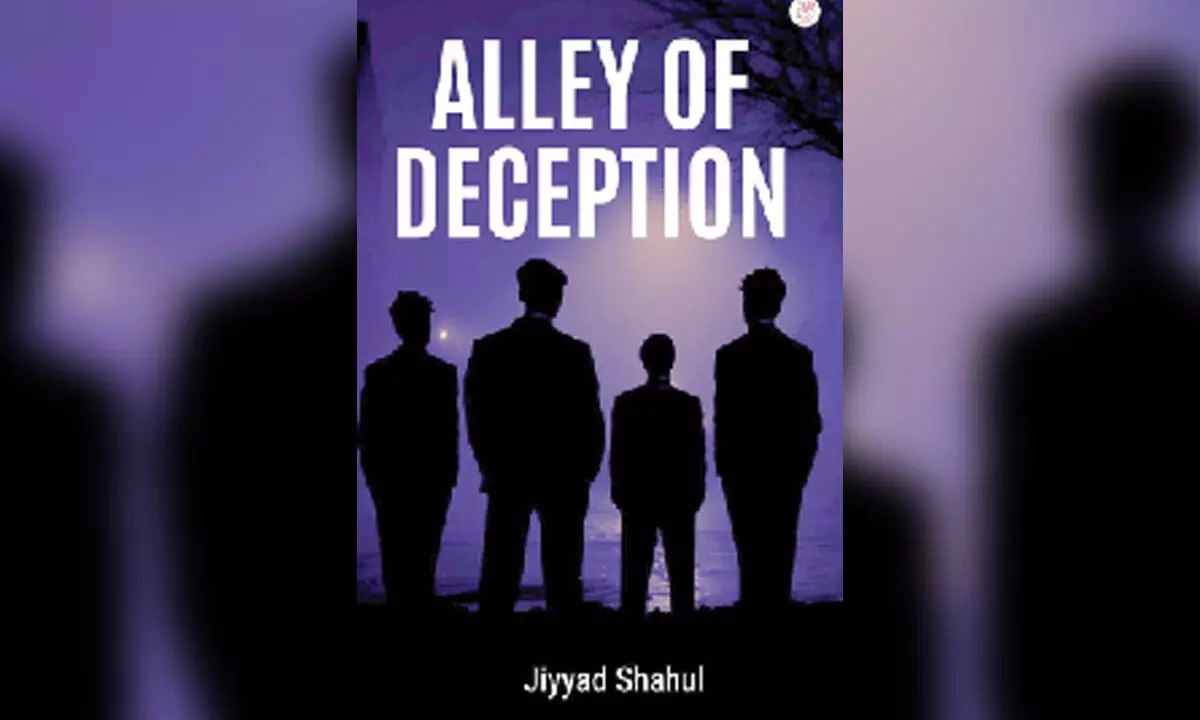
The newly released book ‘Alley of Deception’ by eminent Indian author Jiyyad Shahul has created ripples in the realm of Indian English literature with its profoundly engaging narrative
The newly released book ‘Alley of Deception’ by eminent Indian author Jiyyad Shahul has created ripples in the realm of Indian English literature with its profoundly engaging narrative. As we begin to leaf through its pages, we are instantly drawn into a riveting prologue that unfolds bone-chillingly terrifying details about Vishnu Gowda, the head of a mafia group, lynching a former gang member accused of betrayal. Then, a sudden twist in the tale steers us towards a calmer path, shedding light on the story of four young friends who have graduated in Mechanical Engineering and are now searching for jobs.
The novelist Jiyyad Shahul seems genuinely inclined towards the “Art for Life’s Sake” school of literature advocated by French philosopher Victor Cousin. Adhering to its chief tenets, he depicts the back-breaking trials and tribulations of middle-class youngsters through four individuals who aptly represent the modern-day middle-class youth and reflect their pitiable predicament. These young friends, like most youngsters today, are burdened with cumbersome financial crises, weighed down by family pressures, and subjected to unwanted societal comparisons.
It is rightly remarked that literature is the mirror of society. As we explore the different dynamics of this magnum opus, we gradually realize that these four youngsters, who form the warp and woof of the narrative, are among us. Their resonance with the readers’ subconscious and conscious minds is both absolute and remarkable. We are subtly drawn to them and spontaneously step into their proverbial shoes.
Just as Chaucer’s art of characterization is considered superb—where he objectively and affectionately delineates each of his characters—similarly, the novelist has created a cast of compelling and convincing characters who, in truth, seem to be trudging alongside us shoulder to shoulder.
It is rightly said that if the plot is the skeleton upon which the meat of your story hangs, then surely characters are its heart and soul. The author has truly infused new life into each of his characters. All are vividly and lucidly depicted, each grappling with their own inherent issues. The novelist’s storytelling prowess shines through as he most aesthetically and elegantly sketches a slew of characters who even meticulously meet the ‘probability and necessity’ criteria proposed by the great Greek intellectual Aristotle in his work Poetics. His ability to take readers on a nostalgic journey through these characters makes him stand out among his contemporaries. The friendship among these four friends has also been portrayed with great literary finesse. A slew of rib-tickling episodes scattered throughout lends a unique charm to the story.
Matthew Arnold, a staunch conventionalist, agrees with Aristotle’s theory of an ‘episodic plot of absoluteness’, wherein the narrative unfolds linearly with minimal deviation. However, the author of this book seems to be partially in consonance with the ‘stream of consciousness’ technique of modernist novelist Virginia Woolf. Partially—in the sense that while the plot does drift in a few wayward directions, it remains firmly rooted and connected to its core.
Literature is not a blind mimicry of life. It is the sensitive recreation of reality, shaped by the fertile imagination of a creative genius like Shahul. Bitter realities of modern life are revealed as the author dwells on the hardships and ordeals faced by his characters. The book also reminds us of Charles Dickens’ novel Hard Times, laying bare the flawed and fractured social structure of which we are an integral part.
George Bernard Shaw, a great dramatist of the modern era, echoes the sentiment that it is every author’s duty to highlight the sordid and seamy sides of life and raise their voice against the flaws and foibles prevalent in society. To our elation, the author does not flinch even slightly in raising his voice against the social evils that corrode the fabric of our society. The novelist vehemently and vociferously casts aspersions on the corrupt political system and its sheer gimmickry. However, this has been done with caution—avoiding any direct naming or shaming of individuals or organizations.
To conclude, written in simple yet captivatingly convincing language, ‘Alley of Deception’ is one of the greatest books in its genre. Go and grab your copy!