Politics of absurdity is costing Parliament its dignity
Institutions weaken when politics substitutes theatre for thought
It is deeply disturbing to watch how India’s political ecosystem has slipped into a culture of absurdity. What unfolded during the first half of the Budget Session crossed the line from legitimate dissent into outright irresponsibility—driven less by policy disagreement and more by personal animus toward Prime Minister Narendra Modi.
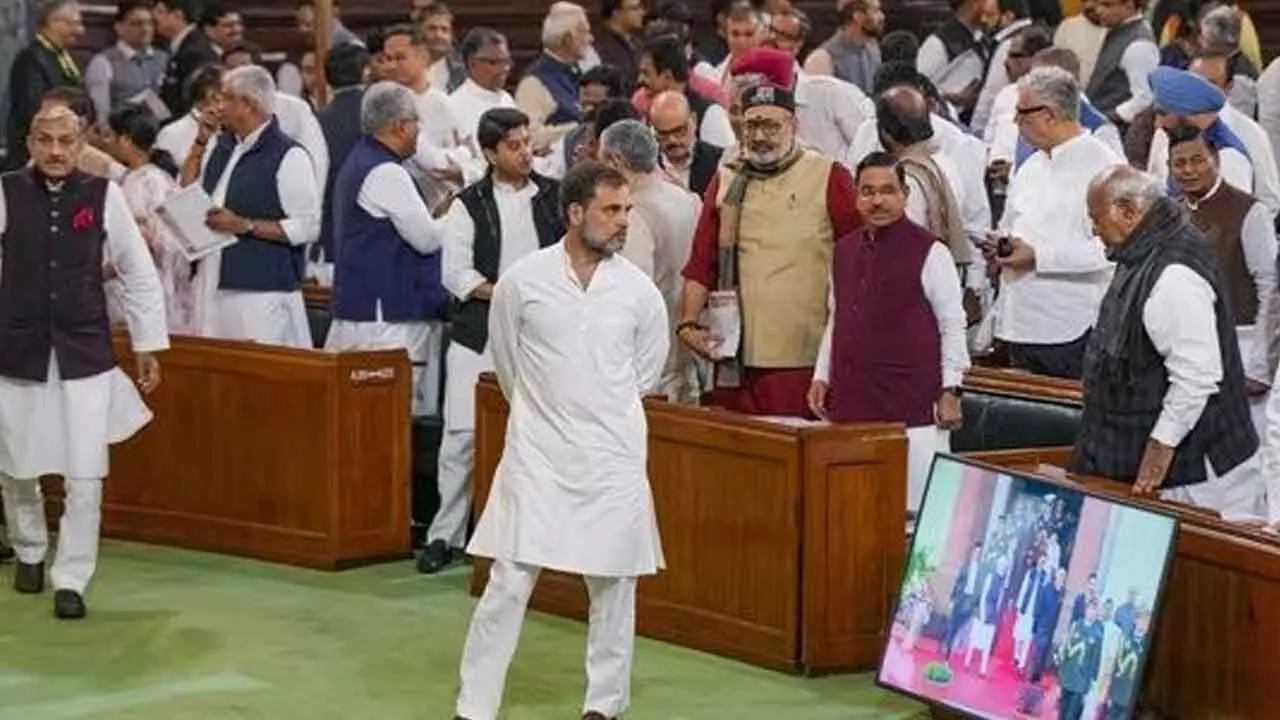
The conduct of Rahul Gandhi, in particular, was not a parliamentary strategy but performative politics. Parliament exists to scrutinise the Budget, challenge assumptions, propose alternatives, and hold the government accountable through facts and data. Instead, the House was reduced to a theatre of disruption—sloganeering, repeated adjournments, and refusal to debate.
Most astonishingly, the Leader of the Opposition appeared not to have read the Budget’s fine print at all, choosing instead to speak about martial arts, grip techniques, and abstract metaphors entirely disconnected from fiscal policy.
Aggression is not only the Opposition’s right—it is its duty. But aggression without substance degenerates into noise. This is evident in the constant rhetoric about the Prime Minister’s alleged “seva” for industrialists like Adani and Ambani. If this charge was sincere, one would expect consistency. Yet there is conspicuous silence on why Congress Chief Ministers in Telangana and Karnataka actively court these very industrialists, roll out red carpets, and celebrate investment summits. Double standards of this kind only weaken credibility.
Ironically, the Budget offered ample scope for sharp, data-backed criticism—on unemployment, fiscal pressures, welfare delivery, and social spending. Those openings were squandered. Storming the Well, blocking proceedings, mocking the Prime Minister and even the Chair does not weaken the government; it weakens Parliament itself. When senior leaders repeatedly choose disruption over discussion, it signals either lack of preparation or a belief that optics matter more than outcomes. Democracy requires a strong Opposition—but one that argues, not merely agitates. Otherwise, public trust in institutions erodes.
This pattern extended beyond the Budget. On the India–US trade engagement, Rahul Gandhi declared—without reading the details—that farmers’ interests had been “sold out” and that the country itself had been compromised. He even convened a meeting with select farmer representatives inside Parliament House yet failed to establish how or where farmers’ interests were concretely harmed. Slogans replaced substance, once again.
The Opposition’s mental block is such that it now objects even to the construction of a new Prime Minister’s Office, ridiculing it with juvenile taunts like “naya car, naya office.” The insinuation that governance infrastructure equals personal indulgence is not criticism; it is contempt for public intelligence.
Equally shocking is the limitless hypocrisy on display over symbols of national unity. Even an ode to the motherland now provokes outrage. When the government issued flexible guidelines allowing restoration and respectful playing of Vande Mataram—whose later stanzas were set aside in 1937 following a Congress Working Committee (CWC) decision—the Opposition ecosystem cried “dictatorship.” AIMIM called it authoritarianism. The All India Muslim Personal Law Board objected to even standing in respect when the song is played. Never mind that the guidelines made singing voluntary and merely required standing in respect, as is customary for national symbols. This reaches the limits of hypocrisy. Opposition parties have gone so far as to allege that history is being “rewritten,” as though the poem’s full text never existed. Nothing has been erased or imposed. Respect is not coercion. Standing is not submission. To brand such courtesy as unconstitutional is intellectual dishonesty.
Some Opposition spokespersons further exposed their bankruptcy by claiming that Bankim Chandra Chatterjee was “on British payrolls.” This is a deliberate distortion. Bankim Chandra was a salaried officer of the British Indian government, serving as a deputy magistrate and deputy collector—like thousands of Indians of his era. Being paid for administrative service is not the same as ideological subservience. He was not a propagandist for colonial rule. Through his novels and essays, he reclaimed civilisational confidence, critiqued Indian self-denigration under colonial modernity, and laid cultural foundations for Indian nationalism.
Vande Mataram later became a rallying cry against the very empire that employed him. To judge him through today’s crude binaries—colonial stooge versus freedom fighter—is illiteracy.
If the Congress wishes to raise the issue of “payrolls,” it should first introspect. Can it claim, with a straight face, that it never maintained pliant media houses or vulnerable journalists during its decades in power? History suggests otherwise.
This obsessive fascination with minority appeasement has pushed patriotism to the background. The Opposition remains trapped in an anglicised 1937 mindset, arguing that lines invoking Durga—“Tvam hi Durgā daśa-prāharana-dhārinī…”—are incompatible with a multi-religious nation. This argument misses the essence of the song. Vande Mataram transcends language and faith.
Patriotism is not inherited; it is felt. Its power lies in emotion, not compulsion. The opening imagery—moonlit nights, flowering trees, fertile fields—portrays India as a living mother, evoking gratitude and belonging, not religious coercion.
A simple question arises: would any Islamic country abandon its national anthem or symbols if expatriate Indians claimed that they were hurt? Is this secularism, or weak-minded leadership surrendering cultural confidence?
The Opposition’s contradictions deepen when it claims Vande Mataram has no constitutional standing. Yet the same voices defend religion-based reservations. When challenged, they insist Congress never implemented Muslim reservations. Facts say otherwise. In 2004, Y S Rajasekhara Reddy introduced five per cent reservation for Muslims in the undivided Andhra Pradesh. Though repeatedly struck down by the High Court, his government pursued it through ordinances and legislation. Today, Telangana Chief Minister A Revanth Reddy seeks to revive it after promising so during elections. Even major TV channels failed to counter false claims during debates. The larger question remains: should radical voices dictate what the majority may or may not honour? Is that the definition of secularism?
The pattern of unpreparedness persists. Rahul Gandhi confused Doklam with Ladakh while speaking on China. When restrained by the Speaker for violating rules, the Opposition responded with a no-confidence motion against the Chair.
Mockery has replaced decorum. He ridiculed panel Speaker Jagdambika Pal, labelled Union Minister Ravneet Singh Bittu a “traitor,” and sneered at journalists with insinuations of bias. Congress was never a paragon of media objectivity. It had its own methods of pressure. Reckless commentary now only exposes insecurity.
Repeated references to Epstein files by opposition also backfired. Parliamentary immunity is not a licence for irresponsibility.
Finally, the hypocrisy on welfare promises is glaring. The Opposition erupted when the Prime Minister announced ₹10,000 for women ahead of Bihar polls. Now Tamil Nadu Chief Minister Stalin announces a ₹5,000 cash dole. What they do is virtue; what others do is vice. This mindset must change.
“Harāo, satta mein āo” cannot be reduced to theatrics. Threatening to undo everything the NDA has done is not governance. Andhra Pradesh’s disastrous 2019–24 experiment stands as a warning.
It is time the Opposition introspects. Democracy deserves better. Parliament deserves seriousness. And the nation deserves an Opposition that debates, not derails. Jago Bharat Jago.
(The author is former Chief Editor of The Hans India)