Constituent Assembly debates

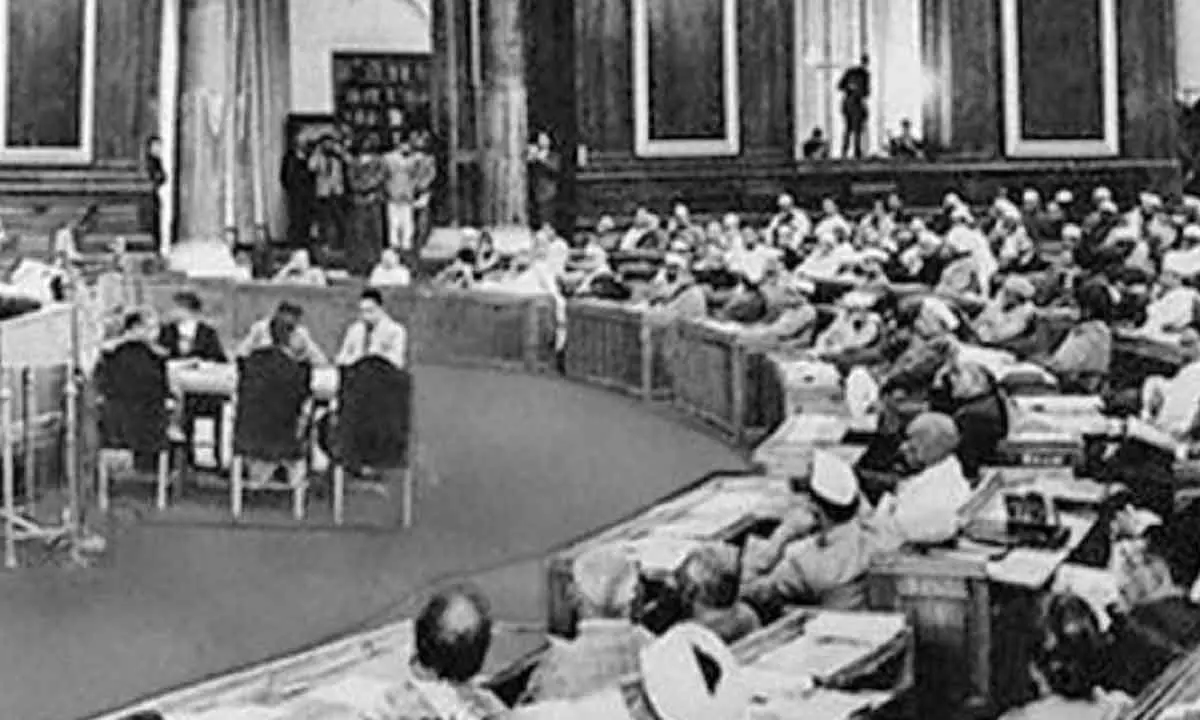
I desire to make it clear that this Resolution does not go into details. It only seeks to show how we shall lead India to gain the objectives laid down in it.
I desire to make it clear that this Resolution does not go into details. It only seeks to show how we shall lead India to gain the objectives laid down in it. You will take into consideration its words and I hope you will accept them; but the main thing is the spirit behind it. Laws are made of words but this Resolution is something higher than the law. If you examine its words like lawyers you will produce only a lifeless thing. We are at present standing midway between two ears; the old order is fast changing, yielding place to the new. At such a juncture we have to give a live message to India and to the world at large. Later on we can frame our Constitution in whatever words we please. At present, we have to send out a message to show what we have resolved to attempt to do. As to what form or shape this Resolution, this declaration will ultimately take, we shall see later. But one thing is, however, certain: it is not a law; but is something that breathes life in human minds.
I hope the House will pass the Resolution which is of a special nature. It is an undertaking with ourselves and with the millions of our brothers and sisters who live in this great country. If it is passed, it will be a sort of pledge that we shall have to carry out. With this expectation and in this form, I place it before you. You have copies of it in Hindustani with you. I will therefore not take more of your time to read it one way, or, I will, however, read it in English and speak further on it in that language.
I beg to move:
“(1) This Constituent Assembly declares its firm and solemn resolve to proclaim India as an Independent Sovereign Republic and to draw up for her future governance a Constitution;
(2) WHEREIN the territories that now comprise British India, the territories that now form the Indian States, and such other parts of India as are outside British India and the States as well as such other territories as are willing to be constituted into the Independent Sovereign India, shall be a Union of them all; and
(3) WHEREIN the said territories, whether with their present boundaries or with such others as may be determined by the Constituent Assembly and thereafter according to the Law of the Constitution, shall possess and retain the status of autonomous Units, together with residuary powers, and exercise all powers and functions of government and administration, save and except such powers and functions as are vested in or assigned to the Union, or as are inherent or implied in the Union or resulting therefrom; and
(4) WHEREIN all power and authority of the Sovereign Independent India, its constituent parts and organs of government, are derived from the people; and
(5) WHEREIN shall be guaranteed and secured to all the people of India justice, social, economic and political; equality of status, of opportunity, and before the law; freedom of thought, expression, belief, faith worship, vocation, association and action, subject to law and public morality; and
(6) WHEREIN adequate safeguards shall be provided for minorities, backward and tribal areas, and depressed and other backward classes; and
(7) WHEREBY shall be maintained the integrity of the territory of the Republic and its sovereign rights on land, sea, and air according to Justice and the law of civilised nations, and
(8) this ancient land attains its rightful and honoured place in the world and make its full and willing contribution to the promotion of world peace and the welfare of mankind.”
Sir, this is the fifth day of this first session of the Constituent Assembly. Thus far we have laboured on certain provisional and procedural matters which are essential. We have a clear field to work upon; we have to prepare the ground and we have been doing that these few days. We have still much to do. We have to pass our Rules of Procedure and to appoint Committees and the like, before we can proceed to the real step, to the real work of this Constituent Assembly, that is, the high adventure of giving shape, in the printed and written word, to a Nation’s dream and aspiration. But even now, at this stage, it is surely desirable that we should give some indication to ourselves, to those who look to this Assembly, to those millions in this country who are looking up to us and to the world at large, as to what we may do, what we seek to achieve, whither we are going. It is with this purpose that I have placed this Resolution before this House. It is a Resolution and yet, it is something much more than a resolution. It is a Declaration. It is a firm resolve. It is a pledge and an undertaking and it is for all of us I hope a dedication. And I wish this House, if I may say so respectfully, should consider this Resolution not in a spirit of narrow legal wording, but rather to look at the spirit behind that Resolution. Words are magic things often enough, but even the magic of words sometimes cannot convey the magic of the human spirit and of a Nation’s passion. And so, I cannot say that this Resolution at all conveys the passion that lies in the hearts and the minds of the Indian people today. It seeks very feebly to tell the world of what we have thought or dreamt of so long, and what we now hope to achieve in the near future. It is in that spirit that I venture to place this Resolution before the House and it is in that spirit that I trust the House will receive it and ultimately pass it. And may I, Sir, also, with all respect, suggest to you and to the House that when the time comes for the passing of this Resolution let it be not done in the formal way by the raising of hands, but much more solemnly, by all of us standing up and thus taking this pledge anew.
The House knows that there are many absentees here and many members who have a right to come here, have not come. We regret that fact because we should have liked to associate with ourselves as many people, as many representatives from the different parts of India and different groups as possible. We have undertaken a tremendous task and we seek the co-operation of all people in that task; because the future of India that we have envisaged is not confined to any group or section or province or other, but it comprises all the four hundred million people of India, and it is with deep regret that we find some benches empty and some colleagues, who might have been here, absent. I do feel, I do hope that they will come and that this House, in its future stages, will have the benefit of the co-operation of all. Meanwhile, there is a duty cast upon us and that is to bear the absentees in mind, to remember always that we are here not to function for one party or one group, but always to think of India as a whole and always to think of the welfare of the four hundred millions that comprise India. We are all now, in our respective spheres, partymen, belonging to this or that group and presumably we shall continue to act in our respective parties. Nevertheless, the time comes when we have to rise above party and think of the Nation, think sometimes of even the world at large of which our Nation is a great part. And when I think of the work of this Constituent Assembly, it seems to me, the time has come when we should, so far as we are capable of it, rise above our ordinary selves and party disputes and think of the great problem before us in the widest and most tolerant and most effective manner so that, whatever we may produce, should be worthy of India as a whole and should be such that the world should recognise that we have functioned, as we should have functioned, in this high adventure.
There is another person who is absent here and who must be in the minds of many of us today- the great leader of our people, the father of our Nation (applause)–who has been the architect of this Assembly and all that has gone before it and possibly of much that will follow. He is not here because, in pursuit of his ideals, he is ceaselessly working in a far corner of India. But I have no doubt that his spirit hovers over this place and blesses our undertaking.
As I stand here, Sir, I feel the weight of all manner of things crowding around me. We are at the end of an era and possibly very soon we shall embark upon a new age; and my mind goes back to the great past of India to the 5,000 years of India’s history, from the very dawn of that history which might be considered almost the dawn of human history, till today. All that past crowds around me and exhilarates me and, at the same time, somewhat oppresses me. Am I worthy of that past? When I think also of the future, the greater future I hope, standing on this sword’s edge of the present between this mighty past and the mightier future, I tremble a little and feel overwhelmed by this mighty task. We have come here at a strange moment in India’s history. I do not know but I do feel that there is some magic in this moment of transition from the old to the new, something of that magic which one sees when the night turns into day and even though the day may be a cloudy one, it is day after an, for when the clouds move away. we can see the sun later on. Because of all this I find a little difficulty in addressing this House and putting all my ideas before it and I feel also that in this long succession of thousands of years, I see the mighty figures that have come and gone and I see also the long succession of our comrades who have laboured for the freedom of India. And now we stand on the verge of this passing age, trying, labouring, to usher in the new. I am sure the House will feel the solemnity of this moment and will endeavour to treat this Resolution which it is my proud privilege to place before it in that solemn manner. I believe there are a large number of amendments coming before the House. I have not seen most of them. It is open to the House, to any member of this House, to move any amendment and it is for the House to accept it or reject it, but I would, with all respect, suggest that this is not moment for us to be technical and legal about small matters when we have big things to face big things to say and big things to do, and therefore I would hope that the House would consider this Resolution in this big manner and not lose itself in wordy quarrels and squabbles.
I think also of the various Constituent Assemblies that have gone before and of what took place at the making of the great American nation when the fathers of that nation met and fashioned out a constitution which has stood the test of so many years, more than a century and a half, and of the great nation which has resulted, which has been built up on the basis of that Constitution. My mind goes back to that mighty revolution which took place also over 150 years ago and to that Constituent Assembly that met in that gracious and lovely city of Paris which has fought so many battles for freedom, to the difficulties that Constituent Assembly had and to how the King and other authorities came in its way, and still it continued. The House will remember that when these difficulties came and even the room for a meeting was denied to the then Constituent Assembly, they be took themselves to an open tennis court and met there and took the oath, which is called the Oath of the Tennis Court, that they continued meeting in spite of Kings, in spite of the others, and did not disperse till they had finished the task they had undertaken. Well, I trust that it is in that solemn spirit that we too are meeting here and that we, too, whether we meet in this chamber or other Chambers, or in the fields or in the market-place, will go on meeting and continue our work till we have finished it.
Then my mind goes back to a more recent revolution which gave rise to a new type of State, the revolution that took place in Russia and out of which has arisen the Union of the Soviet Socialist Republics, another mighty country which is playing a tremendous part in the world, not only a mighty country but for us in India, a neighbouring country.
So our mind goes back to these great examples and we seek to, learn from their success and to avoid their failures. Perhaps we may not be able to avoid failures because some measure of failure is inherent in human effort. Nevertheless, we shall advance, I am certain in spite of obstructions and difficulties, and achieve and realize the dream that we have dreamt so long. In this Resolution which the House knows, has been drafted with exceeding care, we have tried to avoid saying too much or too little. It is difficult to frame a resolution of this kind. If you say too little, it becomes just a pious resolution and nothing more. If you say too much, it encroaches on the functions of those who are going to draw up a constitution, that is, on the functions of this House. This Resolution is not a part of the constitution we are going to draw up and it must not be looked at as such. This House has perfect freedom to draw up that Constitution and when others come into this House, they will have perfect freedom too to fashion that constitution. This Resolution therefore steers between these two extremes and lays down only certain fundamentals which I do believe, no group or party and hardly any individual in India can dispute. We say that it is our firm and solemn resolve to have an Independent sovereign republic. India is bound to be sovereign, it is bound to be independent and it is bound to be a republic. I will not go into the arguments about monarchy and the rest, but obviously we cannot produce monarchy in India out of nothing. It is not there. If it is to be an independent and sovereign State, we are not going to have an external monarchy and we cannot have a research for some local monarchies. It must inevitably be a republic. Now, some friends have raised the question: “Why have you not put in the word ‘democratic’ here. Well, I told them that it is conceivable, of course, that a republic may not be democratic but the whole of our past is witness to this fact that we stand for democratic institutions. Obviously we are aiming at democracy and nothing less than a democracy. What form of democracy, what shape it might take is another matter? The democracies of the present day, many of them in Europe and elsewhere, have played a great part in the world’s progress. Yet it may be doubtful if those democracies may not have to change their shape somewhat before long if they have to remain completely democratic. We are not going just to copy, I hope, a certain democratic procedure or an institution of a so-called democratic country. We may improve upon it. In any event whatever system of Government we may establish here must fit in with the temper of our people and be acceptable to them. We stand for democracy, It will be for this House to determine what shape to give to that democracy, the fullest democracy, I hope. The House will notice that in this Resolution, although we have not used the word ‘democratic’ because we thought it is obvious that the word ‘republic’ contains that word and we did not want to use unnecessary words and redundant words, but we have done something must more than using the word. We have given the content of democracy in this Resolution and not only the content of democracy but the content, if I may say so, of economic democracy in this Resolution. Others might take objection to this Resolution on the ground that we have not said that it should be a Socialist State. Well, I stand for Socialism and, I hope, India will stand for Socialism and that India will go towards the constitution of a Socialist State and I do believe that the whole world will have to go that way. What form of Socialism again is another matter for your considerations. But the main thing is that in such a Resolution, if, in accordance with my own desire, I had put in, that we want a Socialist State, we would have put in something which may be agreeable to many and may not be agreeable to some and we wanted this Resolution not to be controversial in regard to such matters. Therefore we have laid down, not theoretical words and formulae, but rather the content of the thing we desire. This is important and I take it there can be no dispute about it. Some people have pointed out to me that our mentioning a republic may somewhat displease the Rulers of Indian States. It is possible that this may displease them. But I want to make it clear personally and the House knows. that I do not believe in the monarchical system anywhere, and that in the world today monarchy is a fast disappearing institution. Nevertheless it is not a question of my personal belief in this matter. Our view in regard to these Indian States has been, for many years, first of all that the people of those States must share completely in the freedom to come. It is quite inconceivable to me that there should be different standard and degrees of freedom as between the people in the States and the people outside the States. In what manner the States will be Parts of that Union that is a matter for this House to consider with ,the representatives of the States. And I hope in all matters relating to the States, this House will deal with the real representatives of the States. We are perfectly willing, I take it, to deal in such matters as appertain to them, with the Rulers or their representatives also, but finally when we make a constitution for India, it must be through the representatives of the people of the States as with the rest of India. Who are present here. (Applause). In any event, we may lay down or agree that the measure of freedom must’ be the same in the States elsewhere. It is a possibility and personally I should like a measure of uniformity too in regard to the apparatus and machinery of Government. Nevertheless, this is a point to be considered in co-operation and in consultation with the States. I do not wish, and I imagine this Constituent Assembly will not like, to impose anything on the States against their will. If the people of a particular State desire to have a certain form of administration, even though it might be monarchical, it is open to them to have it.
The House will remember that even in the British Commonwealth of Nations today, Eire is a Republic and yet in many ways it is a member of the British Commonwealth. So, it is a conceivable thing. What will happen, I do not know because that is partly for this House and partly for others to decide. There is no incongruity or impossibility about a certain definite form of administration in the States, provided there is complete freedom and responsible Government there and the people really are in charge. If monarchical figure-heads are approved by the people of the State, of a particular State, whether I like it or not, I certainly will not like to interfere. So I wish to make it clear that so far as this Resolution or Declaration is concerned, it does not interfere in any way with any future work that this Constituent Assembly may do, with any future negotiations that it may undertake.