The man who turned barren hills into Rajarajeshwari Nagar

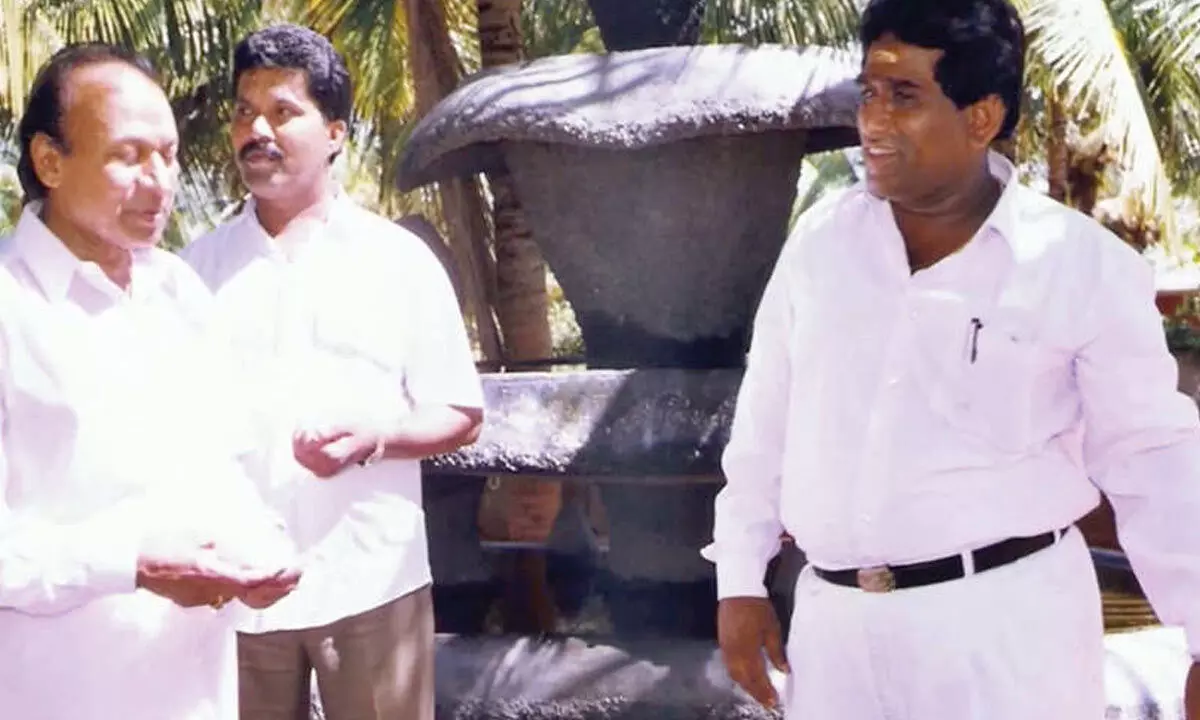
Bengaluru: Longbefore Rajarajeshwari Nagar became one of Bengaluru’s most sought-after residential hubs, it was nothing more than a barren, rocky hillock—lifeless, wind-swept, and written off as unusable land. The man who saw a future in that wasteland was Dr R. Arunachalam, whose extraordinary journey from a daily wage worker to a visionary builder continues to inspire generations.
Arunachalam began his career in 1971, after completing his ITI in Mechanical Engineering, working at Ideal Jawa for a daily wage of Rs 4. His dedication and quick learning earned him a promotion within a year as a Tester with a salary of Rs 400, a significant leap that changed his life.
In January 1972, he joined BEML as an apprentice under the Ministry of Defence. Two years later, after competing against four contenders for two posts, he was appointed as a Crane Operator. His leadership qualities soon became evident, and by the early 1980s, he was actively involved in trade union activities, eventually winning association elections.
But it was a deeper vision—sparked by Dr Rajkumar’s iconic film Bangarada Manushya—that shaped his life’s defining work. The film’s message of transforming barren land into prosperity stayed with him, planting a belief that real-life change was possible through will and effort.
That belief took form in 1988, when Arunachalam played a pivotal role in developing Rajarajeshwari Nagar, turning a no-man’s land into a meticulously planned township. Roads, drainage, electricity, and layouts were designed with precision, ensuring no water stagnation—a rarity even in modern developments.
Beyond housing, he focused on building a complete community—schools, banks, medical shops, commercial complexes, an open-air theatre, and an employees’ club. The hilltop was later transformed into “Arunachalam Creation”, featuring forts, caves, and waterfalls that attracted filmmakers from across the country.
Legendary actor Dr Rajkumar, on visiting the site, famously called Arunachalam a “Nijavada Kavi”—a real poet who created in reality what others only imagined in words. Today, sites that once sold for Rs 12 per square foot are worth crores. More importantly, thousands of middle-class families found not just homes, but dignity and security.
Arunachalam’s story stands as a testament to how vision, integrity, and persistence can change landscapes—and lives. Speaking about this achievement, Arunachalam said that in the beginning, many people claimed the land was filled with hillocks and therefore unsuitable for residential development.
However, the government acquired the land on behalf of the BEML Society for the third stage. The process was later stalled due to a High Court stay obtained by the landowners. After he took charge of the society, he personally visited the houses of all the landowners, held discussions, and reached compromises with them. This resolved the issue, leading to the vacation of the stay. He then proceeded to pass the award, and possession of the land was taken as per the Land Acquisition Act, with full support from the Government of Karnataka. Subsequently, he initiated plan approval from the Bangalore Development Authority by paying a 9 per cent supervision fee for self-execution of civil works.
He said that all civil infrastructure works were executed in the layout, including water supply lines, sewerage lines, water tanks, borewells, a complete water system, and electricity. For the first time in Karnataka, permission was granted for self-execution of a full township electricity system, which included erecting electric poles, laying underground and overhead cables, and installing transformers, while power supply was obtained from the electricity board by paying a 20 per cent supervision charge.
The layout also featured asphalted roads, stormwater drains, a shopping complex with 30 units, a school, a power receiving station, a bus depot, a man-made lake, and a well-equipped club for members and children. All these facilities were developed at a cost of Rs.13 per square foot in 1988, Arunachalam stated.
He further said that more than 1,800 sites were distributed in 1987. In the same year, 85 acres of land were acquired for the formation of the fourth stage to allot sites to remaining members from scratch. After completing all government procedures and obtaining plan approvals, the infrastructure was developed and more than 1,300 sites were allotted to members at a rate of Rs.18 per square foot during 1989–90.
In 1990, another 175 acres of land were acquired through acquisition proceedings with the assistance of the Government of Karnataka. The plan was approved by the Bangalore Development Authority, and more than 2,300 sites were allotted at a rate of Rs.25 per square foot in 1992. Additionally, in 1991, five acres of land were acquired for the 5th A Stage, comprising around 80 sites.
Altogether, the third stage, fourth stage, fifth stage, and 5th A Stage resulted in the formation of 5,555 sites, collectively developing into the township known as Rajarajeshwari Nagar. He added: ‘With God’s grace, the township emerged as a well-planned area without major errors, and he acknowledged the support of many individuals who contributed to the process.’
That belief took form in 1988, when Arunachalam played a pivotal role in developing a no-man’s land into a meticulously planned township. Roads, drainage, electricity, and layouts were designed with precision, ensuring no water stagnation—a rarity even in modern developments