Nepal crisis & four angles of analysis

Nepal’s democratic experiment has been turbulent from the start. The abolition of monarchy was supposed to usher in an era of stability and responsive governance. Instead, the country has lurched from one coalition to another, with frequent collapses of governments and endless bargaining among party leaders
For older generations, the instability has been frustrating but familiar. They remember Nepal’s long journey from monarchy to multi-party democracy and are inclined to view the turbulence as a necessary cost of transition. Gen Z does not share this patience. They live in a digital world where responsiveness is immediate and competence is demanded. When they see leaders using parliamentary chambers as arenas for personal ambition instead of platforms for public service, they draw their own conclusions about the worth of the system
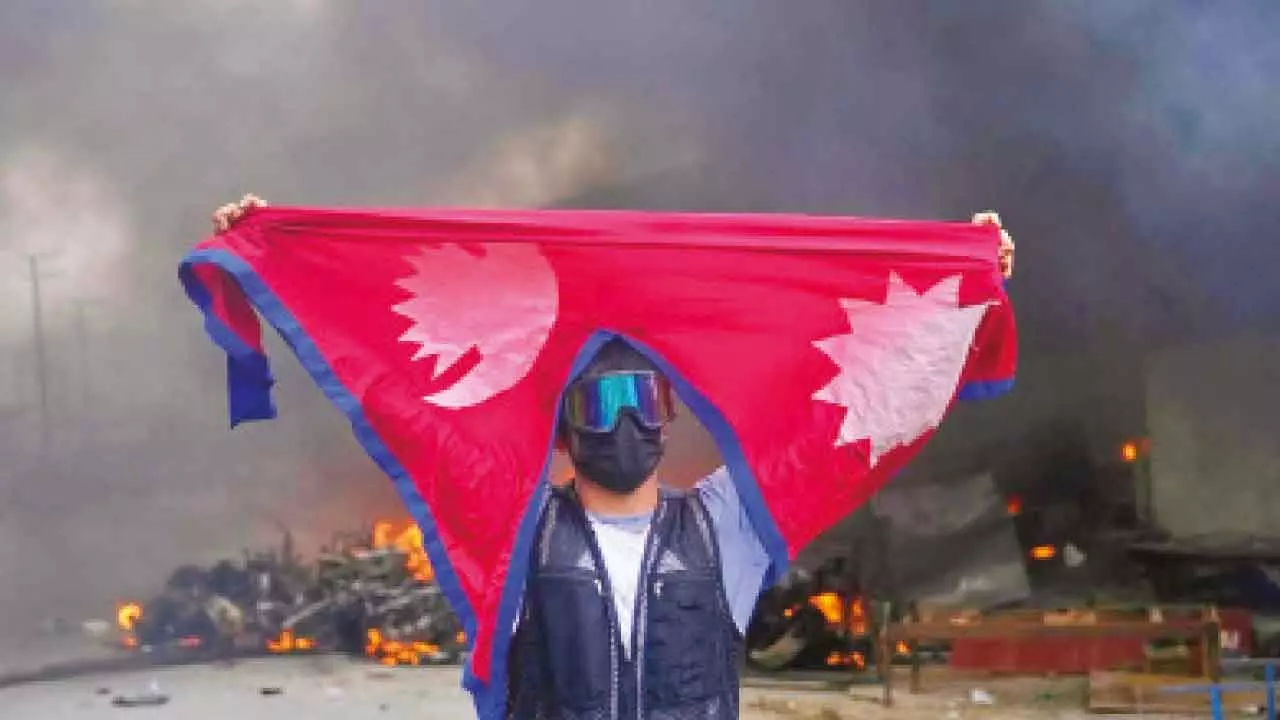
Nepal’s recent uprising has shaken a region that often looks at this small Himalayan nation as a quiet neighbour. The images of Kathmandu’s streets filled with young protesters, barricades set ablaze, and armed police struggling to hold their lines are not scenes that disappear easily from memory. What unfolded was not a random riot or an isolated burst of rage. It was a concentrated release of frustration from a generation that has grown weary of leaders who promise reform but deliver inertia, corruption, and chaos.
The trigger
For years, Nepal has occupied a fragile space between aspiration and dysfunction. Its people, particularly its youth, have lived in an uncomfortable limbo where opportunity is scarce and governance is unreliable. The recent turmoil was a culmination of long-simmering grievances that were waiting for a trigger to push them from simmer to boil. That moment arrived when the government, in an astonishing display of tone-deafness, ordered an outright ban on 26 popular social media applications.
The decision struck directly at the heart of Gen Z’s daily life. For young Nepalis, these platforms are not idle pastimes, they are essential forums for communication, collaboration, and personal expression. They connect students to study groups, freelancers to global clients, and activists to communities of shared purpose. The state’s heavy-handed attempt to control these channels was interpreted as an assault on identity and freedom. Instead of suppressing dissent, the ban became a rallying cry. Protests spread with the same speed that once belonged to the apps themselves. What began as outrage over censorship quickly expanded into a movement that questioned the entire legitimacy of Nepal’s ruling establishment.
Corruption, the oldest wound
If the ban on social media was the spark, systemic corruption was the combustible material that made the uprising inevitable. Nepal’s political class has, for decades, been accused of squandering public resources and treating state institutions as private fiefdoms. Transparency is rare, accountability rarer still. Contracts are awarded through patronage, funds meant for development often evaporate, and even routine services are entangled in webs of bribes and favours.
For a globally connected generation, these practices are more than irritants, they are insults. Young people who study hard and seek honest employment find themselves boxed out by networks of privilege. Inflation eats into modest salaries, while stories of officials buying luxury properties or funnelling money abroad circulate unchecked. Corruption has seeped so deeply into the marrow of Nepal’s governance that it is no longer viewed as an aberration, it has become an expectation.
The resentment this breeds is profound. It is not only about financial injustice, but also about the erosion of dignity. When an entire cohort realizes that effort will not guarantee fairness, frustration turns into moral outrage. In Nepal, that outrage has been simmering beneath the surface, amplified by every scandal and whispered tale of political enrichment. The social media ban did not invent this anger; it simply illuminated it and gave it direction.
A fragile democracy exposed
Nepal’s democratic experiment has been turbulent from the start. The abolition of monarchy was supposed to usher in an era of stability and responsive governance. Instead, the country has lurched from one coalition to another, with frequent collapses of governments and endless bargaining among party leaders. Policies are often abandoned halfway through their design, ministries become revolving doors, and citizens have come to expect more drama than delivery from their elected representatives.
For older generations, the instability has been frustrating but familiar. They remember Nepal’s long journey from monarchy to multi-party democracy and are inclined to view the turbulence as a necessary cost of transition. Gen Z does not share this patience. They live in a digital world where responsiveness is immediate and competence is demanded. When they see leaders using parliamentary chambers as arenas for personal ambition instead of platforms for public service, they draw their own conclusions about the worth of the system.
This impatience is not shallow. It reflects a deeper cultural shift in which younger citizens value results over rhetoric. Democracy, in their eyes, is not an end in itself but a contract to ensure prosperity, fairness, and order. When that contract is repeatedly broken, legitimacy evaporates. Nepal’s uprising was as much a rejection of democratic dysfunction as it was of specific policies or individuals.
Social media, catalyst and risk
No discussion of the uprising is complete without examining the role of social media. The government’s clumsy ban exposed just how powerful these platforms have become in shaping public sentiment. Social media is a double-edged weapon. On one side, it democratises information, allows marginalized voices to be heard, and builds solidarity across geography and class. On the other, it can amplify anger to the point of anarchy, spreading misinformation and turning legitimate grievances into unrestrained fury.
In Nepal, once the ban was announced, outrage surged through encrypted groups, proxy networks, and offline gatherings organized through word of mouth.
Images of protests, tear gas, and defiance were circulated through alternative channels, ensuring that the narrative could not be contained.
The youth, already reactive from years of frustration, found in social media a mechanism to coordinate action with speed and precision.
Yet, the same channels that gave voice to principled protest also created opportunities for chaos. Rumours about police brutality or fabricated plans of state violence circulated unchecked, inflaming passions and widening the gap between protesters and security forces.
This is the new challenge for democracies: how to preserve freedom of expression while preventing the manipulation of public anger into disorder. Nepal’s experience shows that a careless ban can ignite precisely the unrest it seeks to prevent. Governments must engage, not muzzle, the online public square, while citizens must learn to temper their reflexes with discernment.
Deep states, geopolitics, and regional lessons
Beyond internal grievances, Nepal’s turmoil has been shaped by less visible forces. Every democracy harbours entrenched networks, sometimes described as the deep state, where bureaucrats, security officials, and political veterans pursue their own agendas regardless of electoral mandates. In Nepal, these actors have historically intervened during times of flux, often tipping the scales to preserve influence or reset power balances. Their fingerprints are not always obvious, but their presence is undeniable.
Geopolitics adds another layer. Nepal’s location between India and China has always made it a strategic chessboard. While India traditionally maintains caution, China has shown a willingness to cultivate influence within Nepal’s political ecosystem. Financial support for preferred factions, subtle disinformation campaigns, and strategic pressure are tools that Beijing has used elsewhere and appears willing to deploy in Nepal when it serves its interests. The intersection of domestic fragility and external opportunism creates a combustible environment. When deep state actors sense leverage and external powers see advantage, democratic stability becomes precarious.
Nepal’s story carries urgent lessons for its neighbours. Democracies in South Asia must recognize how quickly disillusioned youth, systemic corruption, institutional fragility, and covert manipulations can converge to destabilize governments. Sri Lanka’s economic collapse and the protests that forced its leadership to retreat, along with the political unrest that has flared in Bangladesh, demonstrate that this is not a uniquely Nepali dilemma. These are signals of a generational impatience that will not tolerate incompetence, venality, or hidden conspiracies.
For governments across the region, the warning is clear. Suppressing dissent through bans or intimidation may offer temporary calm but will not address the structural deficits that feed unrest. Reform must become a genuine priority. Integrity in public life, stability in governance, and accountability in institutions are no longer abstract ideals, they are prerequisites for survival in an era where young citizens organize at the speed of a tweet and can overturn a regime before its leaders even grasp the scale of the backlash.
Nepal’s uprising was not a random episode of rage; it was the predictable eruption of a generation betrayed by its rulers and provoked by a shortsighted attempt to silence them. It unfolded at the crossroads of technology, governance, and geopolitics, showing how fragile democracies can be when they underestimate the power of connected youth and the volatility of covert power games.
(Author is a BJP Leader, the Chairman of Nation Building Foundation & a Harvard Business School certified strategist.)