Srikalahasti stays open with special rituals

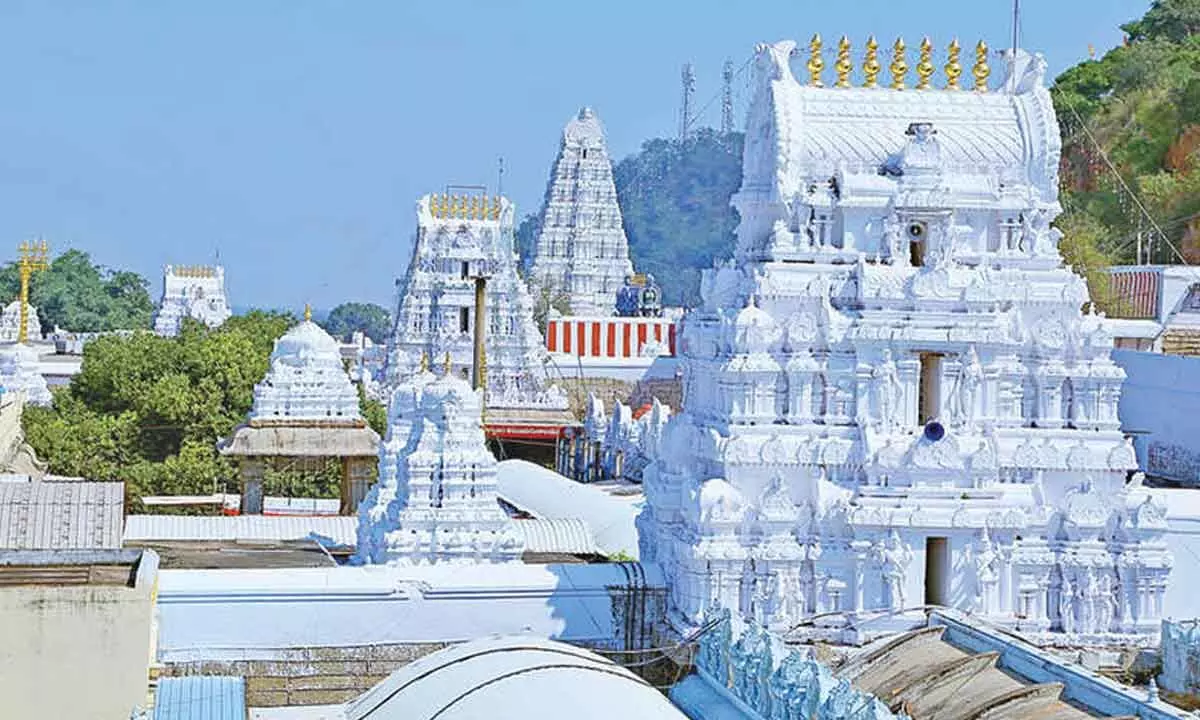
Tirupati: Although temples across the state were closed in view of lunar eclipse on Sunday night, the Srikalahasteeswara (Srikalahasti) temple near Tirupati stood apart by remaining open but conducting special rituals during the celestial event. All temples, including the world-renowned Lord Venkateswara shrine in Tirumala, shut their doors from the afternoon as per tradition, resolving to resume darshan for the public only after purification ceremonies in the early hours of Monday. Srikalahasti, however, continued its unique practice of performing ‘Grahana Kaala Abhishekam’ during the eclipse.
Staunch believers in Vedic astrology hold that eclipses occur when ‘Rahu’ and ‘Kethu’, known as shadow planets (being imaginary points and not physical bodies as per Vedic astrology), ‘swallow’ the Sun or Moon, resulting in the celestial event. Thus, a lunar eclipse happens when 'Kethu' devours the Moon and a solar eclipse happens when 'Rahu' swallows the Sun.
Priests at Srikalahasti had fixed the timings of the present eclipse as between 9.50 pm and 1.31 am, with the Abhishekam to Lord Srikalahasteeswara and Goddess Gnana Prasunambika scheduled around 11.41 pm. Unlike in other temples, where no rituals take place during eclipses, this shrine– revered as ‘Rahu-Kethu Kshetram’, welcomes the occasion with specific pujas.
As per custom, devotees suffering from planetary ‘doshas’ in their horoscopes throng the temple during eclipses to perform ‘Rahu-Kethu Puja’ and seek blessings of Lord Siva and Goddess Gnana Prasunambika.
However, since the Abhishekam was scheduled at midnight this year, temple officials announced that the ritual would be performed in ‘ekantam’ (privately) by the priests without public participation. Regular darshan will resume at 6:00 am on Monday.
In fact, the temple draws large numbers of pilgrims from the state as well as from neighbouring states such as Tamil Nadu and Karnataka during eclipses.
People used to take part in ‘Rahu Kethu Puja’ especially during the time of eclipse.
This year, however, with the eclipse duration falling late into the night, devotees had no such option.
Temple priests explained that the distinction of Srikalahasti is deeply rooted in mythology.
The idol of Lord Siva here is believed to embody all 27 ‘Nakshatras’ and nine ‘Rashis’ within His ‘kavacham’, signifying control over the entire solar system. Further, as per mythology, a five-headed serpent, ‘Kethu’, adorns the head of Lord Siva, while ‘Rahu’, as a single-headed serpent, forms the waist belt of ‘Ammavaru’.
With both ‘Rahu’ and ‘Kethu’ being part of worship in this shrine, it is believed to be immune to the negative effects of eclipses.