Met Gala: A global runway, a cultural mirror, and Bharat’s tryst with the blue carpet

Every year, on the first Monday of May, the grand marble steps of the Metropolitan Museum of Art in New York City transform into a theatrical runway of fashion, fantasy, and fame
Every year, on the first Monday of May, the grand marble steps of the Metropolitan Museum of Art in New York City transform into a theatrical runway of fashion, fantasy, and fame. The Met Gala, the world’s most-watched fashion fundraising event, is known for its extravagant costumes. It provides an opportunity for representatives from different countries to showcase their rich art, fashion, and cultural narratives. For Bharat—a civilization steeped in unique design sensibilities—the Met Gala offers both a stage and a question: Can we use this global platform to showcase our Bharatiya culture?
Origins of the Met Gala
The Met Gala, officially called the Costume Institute Benefit, was inaugurated in 1948 by fashion publicist Eleanor Lambert. Initially a modest affair, it was conceptualized as a fundraiser for the newly founded Costume Institute of the Metropolitan Museum of Art. Under the leadership of Vogue’s formidable editor-in-chief, Anna Wintour, from 1995 onwards, the Gala transformed into a global spectacle of celebrity glamour and fashion artistry. Wintour’s vision turned the event into an annual theme-based pageant that fuses haute couture with cultural commentary.
Understanding the Themes
Each year, the Met Gala is anchored around a theme that coincides with the Costume Institute’s annual exhibition. Themes such as Heavenly Bodies: Fashion and the Catholic Imagination (2018), Camp: Notes on Fashion (2019), and In America: A Lexicon of Fashion (2021) have allowed designers to explore diverse narratives—from religion to satire, national identity to futuristic imagination.
While the themes pose aesthetic challenges, they are also invitations to reinterpret, provoke, or pay homage to cultural ideas through the medium of fabric and design.
Celebrities from Bharat at the Met: A Cultural Bridge?
Celebrities from Bharat began making a serious mark on the Met Gala carpet in the last decade, signaling the country’s growing soft power. From Priyanka Chopra Jonas to Deepika Padukone, and more recently Alia Bhatt, Natasha Poonawalla, and Isha Ambani, icons from Bharat are now regulars on this prestigious carpet.
But why to participate?
Firstly, the Met Gala offers unmatched global visibility. Celebrities attending the event make headlines not only in fashion media but also in cultural and political commentary. For stars from Bharat, it’s a way to break through the Western pop culture barrier, claim visibility, and shape their global brand.
Secondly, it is an opportunity to represent the fashion and craftsmanship heritage of Bharat. Whether through embroidery, draping, or jewelry, Bharat’s design sensibilities are among the richest in the world. The Met Gala can be an ideal stage for showcasing this.
Is the Bharatiya Craftsmanship represented?
The Met Gala, originally a fundraiser for New York’s Metropolitan Museum of Art’s Costume Institute, has evolved into a global cultural event. The 2025 theme, Superfine: Tailoring Black Style, celebrated Black fashion heritage and identity, featuring over 250 iconic pieces.
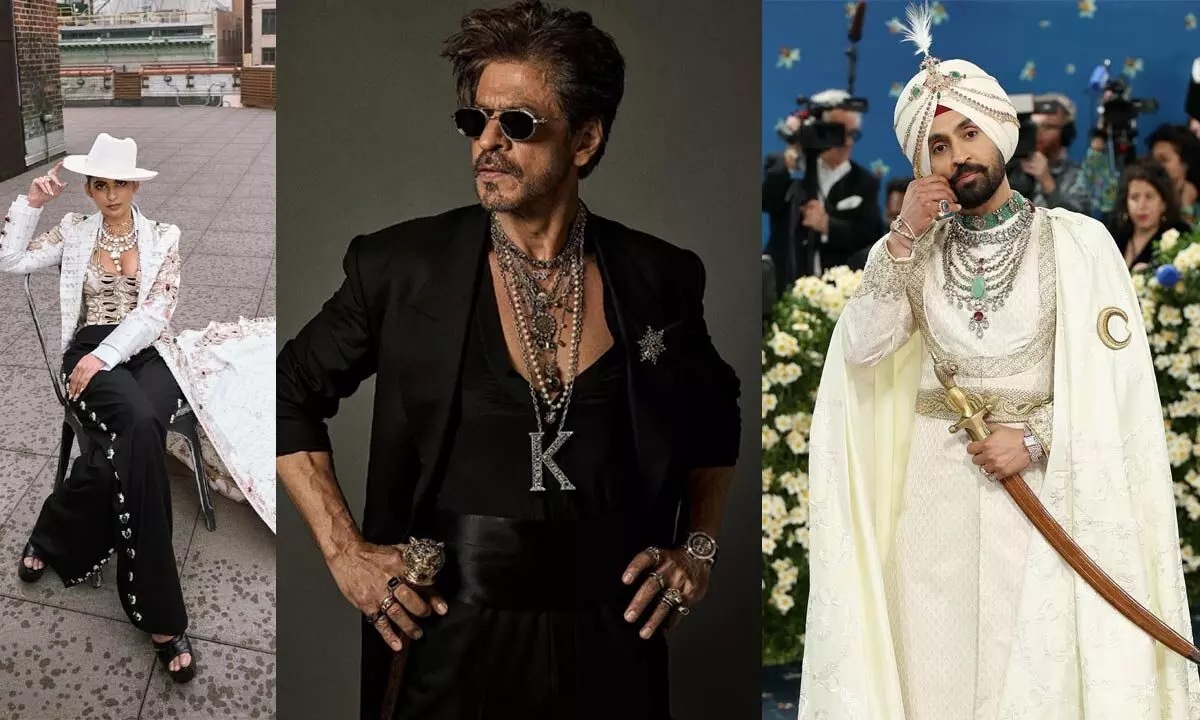
While there was a significant rise in participation from Bharat—with Shah Rukh Khan, Kiara Advani, Diljit Dosanjh, and Isha Ambani showcasing style—it was still a poor representation of the country’s craftsmanship and heritage on such a global platform.
The Gala does not provide tangible benefits for Bharat, but it remains an opportunity to promote our intangible heritage. Most of the time, the only designers from Bharat seen on global platforms are Sabyasachi and Manish Malhotra. There is almost no spotlight on indigenous textiles, embroidery, fashion, and heritage.
A notable exception at the recent Met Gala was the costume worn by Punjabi hitmaker Diljit Dosanjh, which paid homage to the Maharaja of Patiala—an embodiment of royal Bharatiya splendor.
Another unnoted contribution from Bharat was the white base carpet beneath the blue carpet. It was woven by Extraweave, the parent company of Neytt, a luxury home furnishings brand based in Cherthala, Alappuzha, Kerala. The carpet was shipped in 57 rolls (each four metres by 30 metres), covering a total area of 6,840 square metres. It took 480 people over 90 days to complete the work to Met Gala standards.
For the employees of this Cherthala-based brand, it was a moment of pride. “A lot of care and effort have gone into the carpet. The entire team, across departments, worked together to create this beautiful piece of art,” said Sivan Santhosh, Director of Extraweave and CEO of Neytt.
Although it was hand-painted by artists in New York, the white base carpet was woven from natural sisal fibre imported from Madagascar.
Why It Matters ?
l Global Attention: Handlooms and craftsmanship from Bharat get worldwide recognition.
l Cultural Diplomacy: Celebrities become ambassadors of Bharatiya textile heritage.
l Sustainability: Traditional weaving aligns with the global shift to ethical fashion.
l Economic Upliftment: Promotes rural artisans and endangered crafts.
Challenges
l The Gala doesn’t directly promote causes of Bharat unless efforts are intentional.
l Western institutions rarely reciprocate by showcasing culture of Bharat.
l Participation is often driven by personal branding, not cultural advocacy.
Recommendations
l Celebrities from Bharat should deliberately feature heritage weaves and craft narratives.
l Government and cultural bodies can push for Bharat-themed exhibitions at global museums.
l Collaborations with artisan clusters and textile councils can ensure authentic representation.
(The writer is an Expert, Creative Economy)