Opposition’s costly chaos-Raga & Co swap debate for drama
Rs133 crore wasted – who’s the real paisa chor?
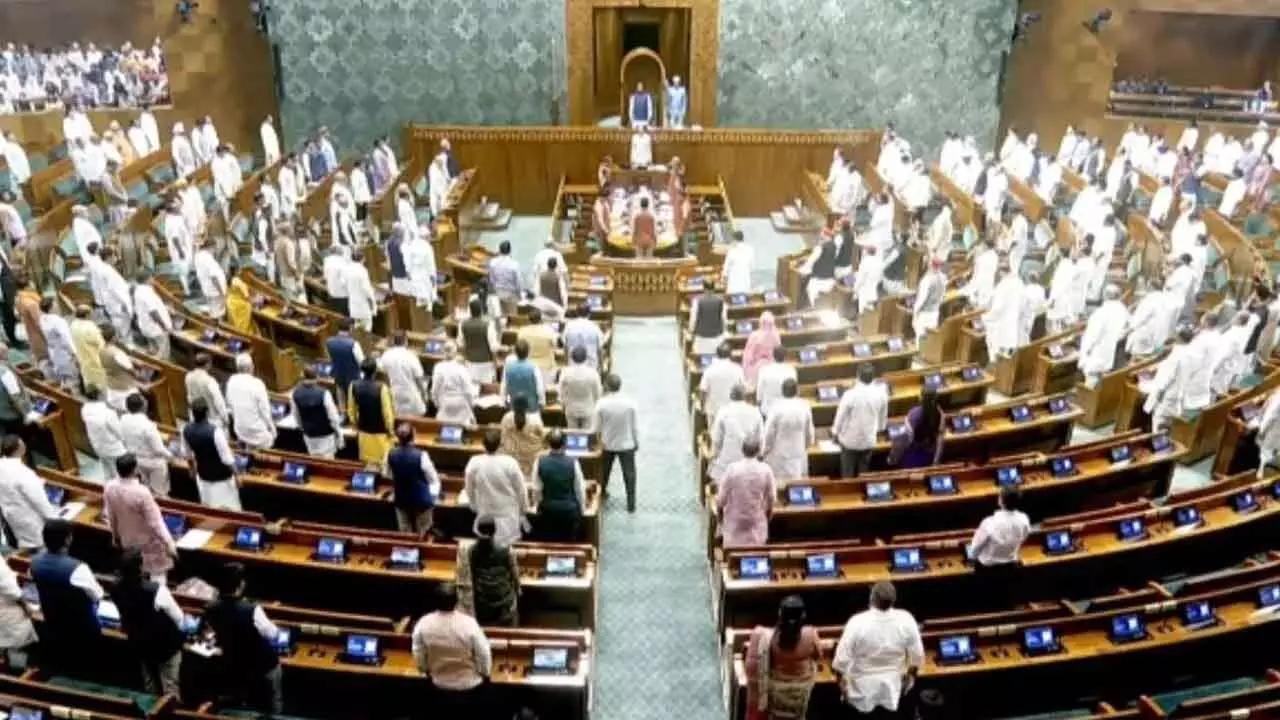
The Congress and its allies have once again abandoned Parliament and taken to the streets, reducing democracy to a theatre of chaos. Parliament is the ultimate forum for debate and accountability, yet the Opposition disrupted the monsoon session so badly that out of 126 working hours, only 37 were productive, wasting over Rs133 crore of taxpayers’ money. Leaders who call the Prime Minister a “vote chor” should themselves answer for being “paisa chor.” By treating sloganeering and street protests as substitutes for debate, they insult the very Constitution they claim to protect. Their hypocrisy is glaring — silent on the national flag being disrespected, apathetic to India’s first astronaut’s achievement, yet loud in peddling false narratives. This is not democracy, but opportunism bordering on anarchy. India is not Bangladesh; our institutions have withstood darker storms. The people must see through these theatrics and defend Parliament as the true home of democracy.
The Congress and its allies have once again repeated their most irresponsible act — one that runs against the very Constitution they wave around without ever reading or understanding it. Political lineage does not give anyone the right to behave recklessly in the name of democracy, nor does being born into a political family automatically confer greatness.
In a parliamentary democracy, the House is the ultimate forum for debate, dissent, and accountability. It is here that governments are questioned, policies debated, and laws scrutinised. But what happens when the Opposition — whose primary duty is to hold the government accountable — abandons Parliament and takes its politics to the streets?
Street protests are not inherently wrong. They have historically powered great movements, from the freedom struggle to social justice campaigns. But when the principal Opposition bloc treats street agitation as a substitute for parliamentary responsibility, the message is clear: they prefer fighting political battles outside the constitutional framework.
This strategy has two objectives. First, it allows them to paint the government as “authoritarian” by claiming they are silenced — even when disruptions originate from their own benches. Second, it fosters unrest and instability, which they hope will erode public confidence in governance.
The results of this cynical game are plain. During the just-concluded monsoon session, the House functioned for barely 37 hours out of 126. Out of a total expenditure of ₹189 crore, an estimated ₹133.5 crore of taxpayers’ money was wasted. Who gave the Opposition this right? They claim to represent 50 per cent of the people — but did these voters authorise Rahul Gandhi, Akhilesh Yadav, Stalin, Mamata Banerjee and others to squander crores by shouting slogans instead of debating issues? Leaders, who lecture about accountability, should answer whether these rules apply to them. If they call the Prime Minister a “vote chor,” should taxpayers not brand them “paisa chor” for wasting public money?
Their intention is not democracy; it is opportunism. Rahul Gandhi has no word of condemnation for the Left hoisting the Congress flag in place of the national flag. Both Congress and CPM dismissed it as a “local issue.” Is this their idea of patriotism? No responsible party in any democracy would tolerate such an act. Yet these are the same leaders who speak of Mohabbat ki Dukan and claim the “Constitution is under threat.”
Equally telling is their apathy towards national pride. They had no time to discuss at length the historic achievement of astronaut Subhanshu Shukla. That discussion was wrapped up in just 25 minutes — after which the Opposition rushed out to resume their protests on the streets.
The hypocrisy runs deeper. Congress has raised a stink about social justice, even demanding quotas in beauty contests. Yet, when the NDA nominated OBC leader C P Radhakrishnan for the Vice-President post, the Opposition ignored its own rhetoric and instead fielded a candidate from a privileged community. This duplicity exposes the gap between what they preach and what they practice.
When citizens elect representatives, they expect their voices to be heard inside Parliament, not drowned out by street rallies. By undermining the sanctity of Parliament, the Opposition is not just insulting the institution but weakening democracy itself. Worse still, there may be a more sinister design. The Opposition’s shift from Sansad to Sadak is not merely a sign of electoral panic — though their fear of losing Bihar is evident. It may well be part of a larger playbook of disruption, possibly with foreign encouragement.
The world has seen how Washington engineered instability in Bangladesh, paving the way for regime change. Should we not be wary when Congress and its allies openly warn that India will face “fire and storm” and when Mani Shankar Aiyer says that it could lead to another Bangladesh like situation?
But India is not Bangladesh. Ours is a democracy that has weathered storms far greater — from the dark days of the Emergency to the horrors of 1984 anti-Sikh riots where in hundreds of Sikhs were killed and some burnt alive. Indira Gandhi once declared that the office of Prime Minister was beyond judicial scrutiny. Ironically, the same Congress now opposes the political reforms bill that makes all leaders, including the PM, accountable under law. Their selective outrage is nothing but a mask for political survival.
We have witnessed how former Delhi CM Arvind Kejriwal brazenly declared that even if he were jailed, he would neither resign nor relinquish control, insisting he could run the administration from prison. Such a stance is nothing short of an insult to both the Constitution and the voters, who elect leaders to govern responsibly. When a government official is arrested, suspension is automatic. Should a minister or chief minister, then, be allowed to cling to office merely because he is “only an accused” and not yet convicted? Ironically, the same Opposition that demands accountability cries “dictatorship” when the government introduces the 139th Constitutional Amendment Bill—providing that any minister, chief minister, or even the prime minister must vacate office if jailed continuously for 30 days. This amendment is not only reasonable but also essential.
Governance entails fundamental duties—reviewing departmental work, conducting cabinet meetings, taking key policy decisions, and most importantly, staying directly connected with the people. How can any leader, who is locked behind bars, credibly discharge these responsibilities?
The Opposition today is not fighting for democracy; it is fighting for its own relevance. By turning Parliament into a circus, wasting taxpayers’ money, undermining patriotism, and playing into foreign narratives, they are endangering the very democracy they claim to defend. The people of India must recognise the Opposition’s theatrics for what they are: not dissent, but disruption; not accountability, but anarchy. Democracy thrives in Parliament — not on the streets.
The time has come to reject those who trade in chaos and reaffirm faith in the institutions that make India strong.
(The author is former Chief Editor of The Hans India)