AI technology revolutionises agriculture in Koppal dist

n recent times, artificial intelligence (AI) technology has made its mark in various sectors, including media and cinema. Now, AI is also making a significant impact in the agricultural sector.
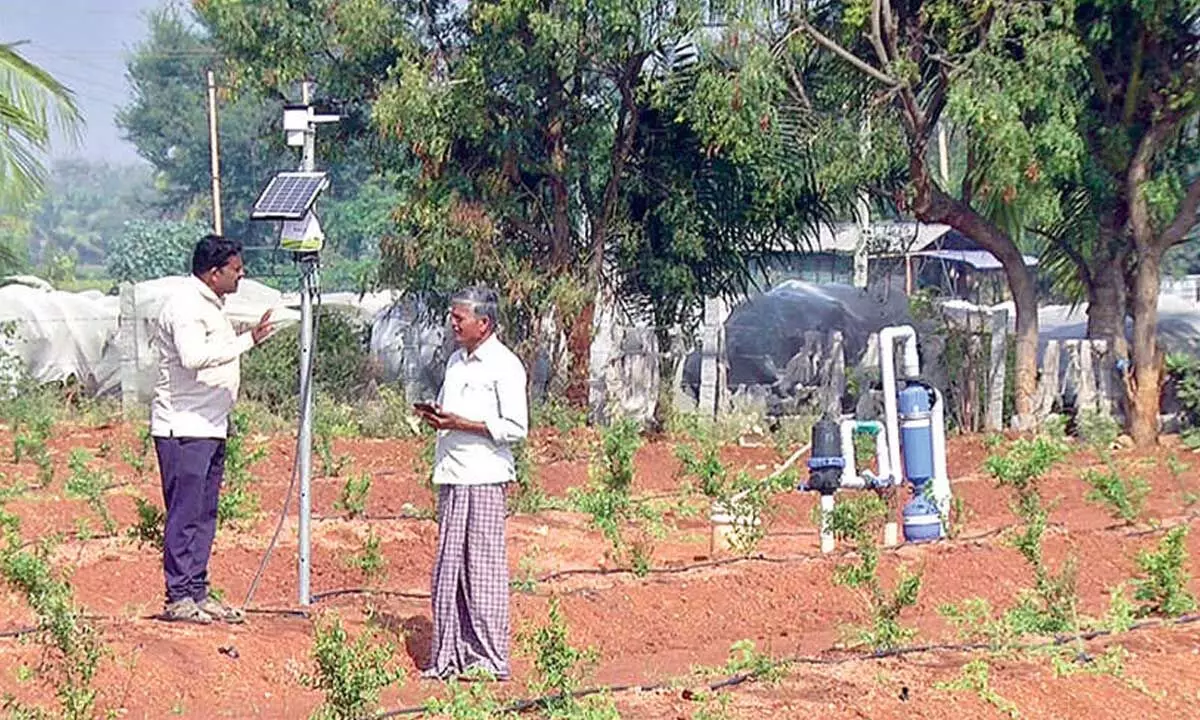
Koppal: In recent times, artificial intelligence (AI) technology has made its mark in various sectors, including media and cinema. Now, AI is also making a significant impact in the agricultural sector. Farmers in Koppal district have embraced automated weather forecasting units on their farms, ushering in a new era of precision farming.
The automated weather forecasting unit provides farmers with precise data on humidity, temperature, wind direction and speed, barometric pressure, rainfall measurements, soil moisture, and temperature, as well as leaf moisture and light intensity. This information is directly sent to farmers’ mobile phones through an app, ensuring they stay updated with accurate weather conditions on a daily basis.
Suresh Sajjjan, a farmer, and Krishna Ukkund, the Deputy Director of the Horticulture Department, spoke about the impact and benefits of the weather forecasting unit. Farmers growing horticultural crops have already integrated AI technology into their fields, installing weather forecasting units to enhance productivity and reduce risks. The unit provides weather information for about 20 acres of land surrounding the installation. Several companies are involved in manufacturing these units, which are powered by solar energy.
The Horticulture Department offers financial assistance for farmers adopting these weather forecasting units. The total cost of one unit is approximately ₹40,000, of which the department provides a subsidy of ₹20,000. This initiative is part of the National Agriculture Development Program, and over 10 farmers in the district growing horticultural crops have benefited from this scheme.
Weather fluctuations often cause significant damage to crops like pomegranates, grapes, mangoes, and bananas. Even a slight change in weather conditions can cause problems for farmers. However, the introduction of automated weather forecasting units is expected to address these challenges by providing advanced weather predictions. Farmers believe that this technology will be crucial in managing their crops and preventing damage caused by unpredictable weather patterns.
Suresh Sajjjan, who grows pomegranates on 10 acres of land, shared his experience with the weather unit. He stated, “The Horticulture Department introduced me to this weather unit, and it’s a great tool. I’ve been struggling to manage the fertilization schedules and wind patterns on my farm. With this unit, I can get real-time data on rainfall, fertilization management, and weather conditions. This will also help us monitor and manage pest attacks, diseases, and water usage more efficiently.”
Krishna Ukkund, the Deputy Director of the Horticulture Department, explained the benefits of the technology, saying, “Farmers can now install AI sensor-based weather forecasting units in their fields. These units will provide accurate weather predictions for the next 15 days. If any crops are at risk of diseases, the unit will alert farmers and advise on preventive measures, including which pesticides to use. It also provides data on soil moisture, humidity levels, and the amount of water required for crops, making water management more efficient.”
With the integration of AI and automated weather forecasting units, Koppal district’s farmers are now better equipped to handle the challenges posed by climate change, enhance their crop yields, and ensure a more sustainable future for agriculture. This innovation marks a significant step toward precision agriculture, leading to increased productivity and profitability for farmers.