Amazon’s Robot Revolution: Automation Could Cut 1,60,000 Warehouse Jobs by 2027

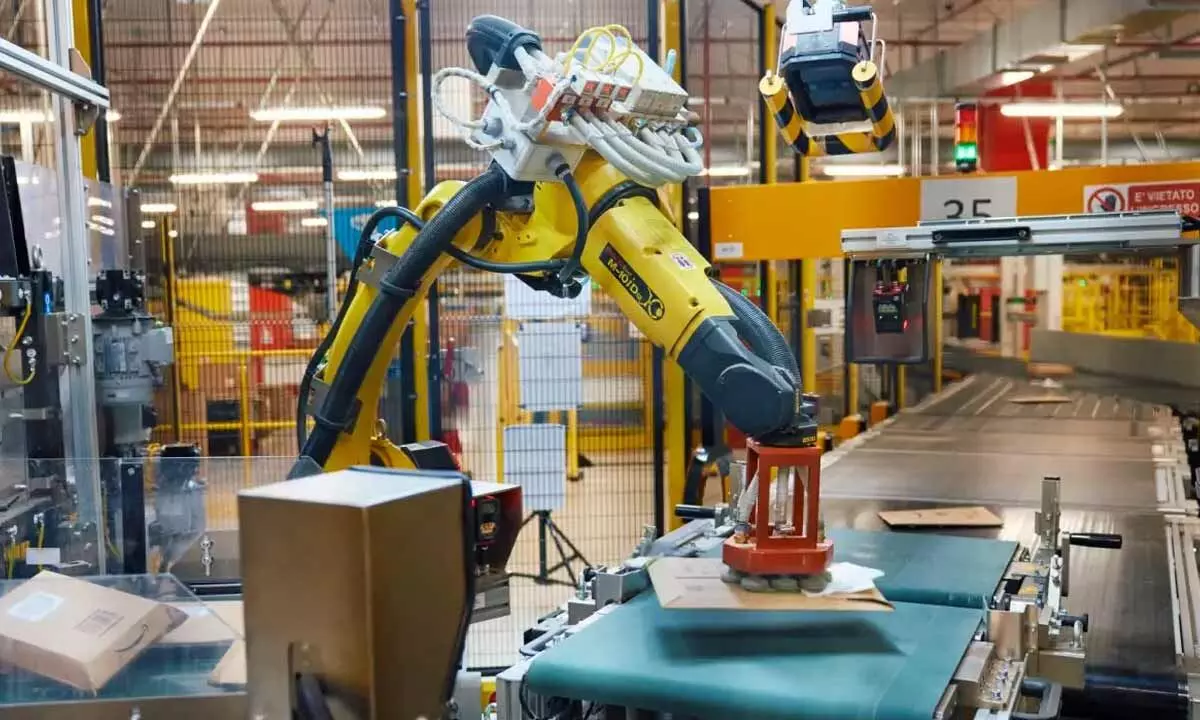
Amazon’s accelerated automation drive could eliminate 1,60,000 warehouse roles by 2027, reshaping logistics and sparking major employment concerns.
Amazon’s growing push toward automation inside its fulfilment centers could dramatically reshape the future of warehouse employment in the United States. A recent report from a major American publication reveals that the tech giant is quietly advancing its robotics and AI automation efforts, with plans that could replace a large portion of its U.S. workforce by 2033.
According to internal company documents and interviews cited by the report, Amazon aims to automate nearly 75 percent of its warehouse operations within the next decade. By 2027 alone, the company could avoid hiring nearly 1,60,000 workers—potentially saving about 30 cents per item processed and cutting operational costs by an estimated $12.6 billion between 2025 and 2027.
Amazon’s robotics division is currently testing a new generation of “cobots” (collaborative robots) that work alongside human employees to sort, pack, and move goods with precision and efficiency. These advancements are part of a broader effort to make fulfilment centers faster, leaner, and far less reliant on manual labor, even as Amazon anticipates doubling its sales volume in the same timeframe.
But as these robots take on more responsibilities, an unsettling question arises—what happens to the human workers they replace?
The report indicates that Amazon is already preparing for the potential public backlash from large-scale job reductions. Internally, the company has reportedly explored ways to present automation in a more positive light by using neutral phrases like “advanced technology” instead of “AI” or “automation,” and by referring to robots as “cobots” to emphasize collaboration over replacement.
Still, many experts warn of the broader economic consequences. “Nobody else has the same incentive as Amazon to find the way to automate,” said Nobel Prize-winning economist Daron Acemoglu in his remarks to a leading U.S. newspaper. “Once they work out how to do this profitably, it will spread to others, too.” Acemoglu further noted that if Amazon’s plan succeeds, “one of the biggest employers in the United States will become a net job destroyer, not a net job creator.”
Amazon, however, disputes this characterisation. In a statement to a popular tech news outlet, company spokesperson Kelly Nantel said the leaked materials “reflect the perspective of just one team” and do not represent the company’s official policy. She added that Amazon is “actively hiring at operations facilities across the country” and recently announced plans to fill 2,50,000 positions for the upcoming holiday season.
Nantel also clarified that Amazon’s leadership is not being directed to avoid specific terminology like “AI” or “automation,” and that its community engagement programs are unrelated to automation initiatives.
If Amazon’s automation goals are realised, the impact could extend far beyond its own warehouses—transforming the entire logistics industry. What were once bustling employment hubs may soon become highly automated ecosystems, managed by algorithms and supervised by a smaller human workforce.
Ironically, the company that once revolutionized online shopping through massive job creation may now redefine it again—this time, through large-scale automation.